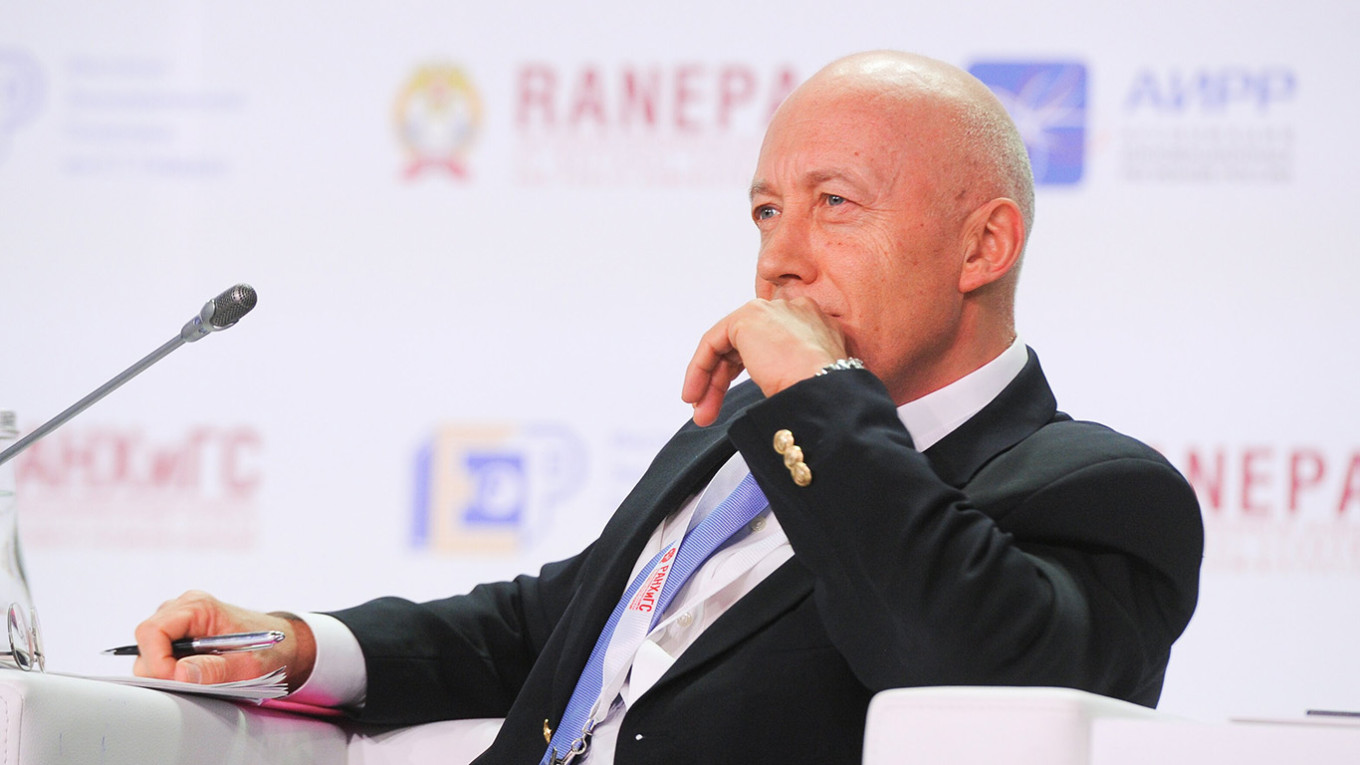
A Moscow judge has placed prominent establishment economist Sergei Sinelnikov-Murylev under house arrest on bribery charges, the RBC news outlet reported Thursday, citing law enforcement sources.
Sinelnikov-Murylev, 66, is a senior researcher at the Gaidar Institute for Economic Policy and the former president of the Economic Development Ministry’s Russian Academy of Foreign Trade.
He received state awards and a presidential commendation in 2018 for contributing to Russia’s 2018-24 national development strategy. He also joined the government’s expert council in December 2022.
The Zamoskvoretsky District Court reportedly granted the investigation’s request to place Sinelnikov-Murylev under house arrest for two months.
The 66-year-old economist faces up to 15 years in prison if found guilty of receiving a large-scale bribe.
Specific details on the alleged bribe amount or the involved parties have not been disclosed. The Interfax news agency reported that the case material is available on the court’s website.
This is Sinelniov-Murylev’s second criminal prosecution in recent years. He was arrested in April 2023, and in March 2025 convicted of large-scale embezzlement and abuse of power, receiving a suspended prison sentence of five and a half years.
Sinelnikov-Murylev served as president, or rector, of the Russian Academy of Foreign Trade from 2007 to 2024, continuing there as chief researcher while also holding senior research roles at the Gaidar Institute.
According to RBC, Sinelnikov-Murylev in 2017 ranked third among Russia’s wealthiest university rectors with an annual income of 53.4 million rubles ($638,700 at the current exchange rate). He attributed the earnings primarily to research and teaching activities at the time.
A Message from The Moscow Times:
Dear readers,
We are facing unprecedented challenges. Russia's Prosecutor General's Office has designated The Moscow Times as an "undesirable" organization, criminalizing our work and putting our staff at risk of prosecution. This follows our earlier unjust labeling as a "foreign agent."
These actions are direct attempts to silence independent journalism in Russia. The authorities claim our work "discredits the decisions of the Russian leadership." We see things differently: we strive to provide accurate, unbiased reporting on Russia.
We, the journalists of The Moscow Times, refuse to be silenced. But to continue our work, we need your help.
Your support, no matter how small, makes a world of difference. If you can, please support us monthly starting from just $2. It's quick to set up, and every contribution makes a significant impact.
By supporting The Moscow Times, you're defending open, independent journalism in the face of repression. Thank you for standing with us.

Remind me later.