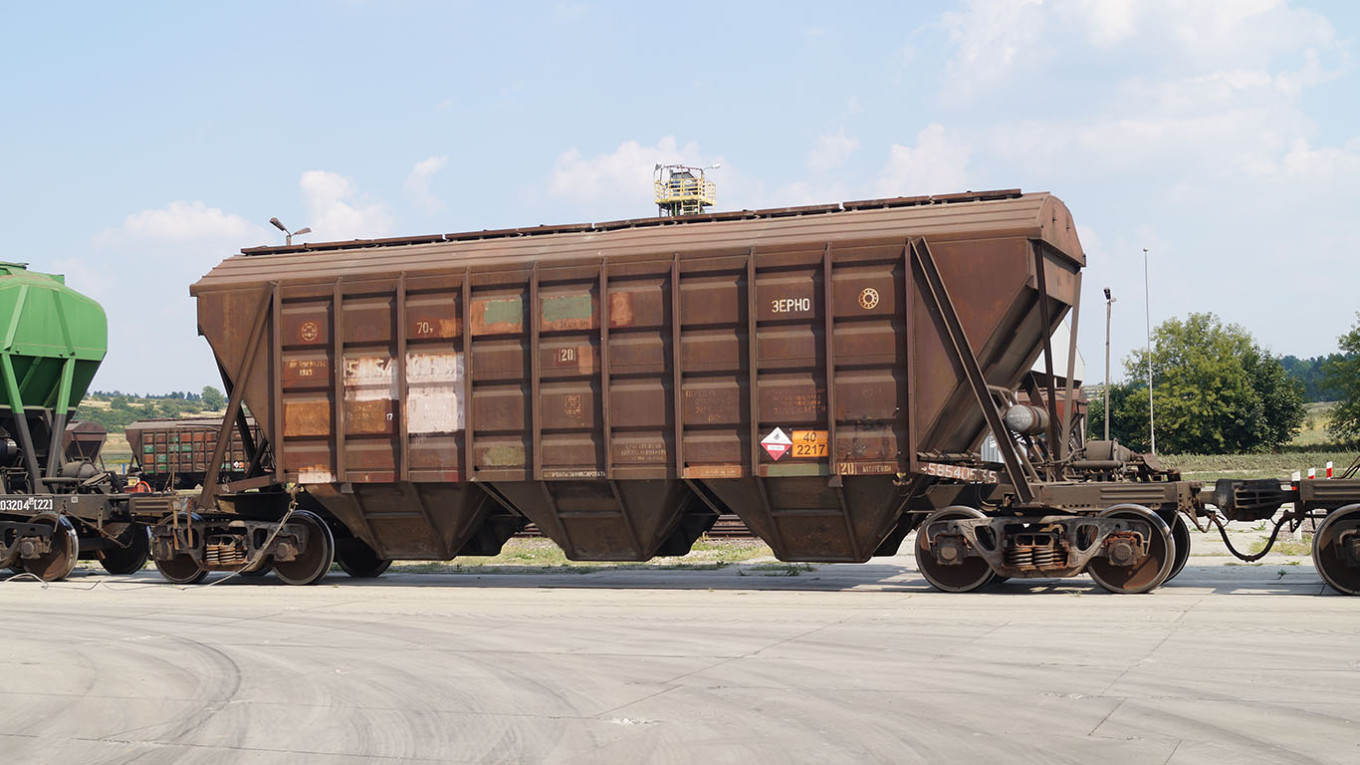
President Vladimir Putin has ordered Russian Railways to give priority to export grain shipments across the national rail network as Ukrainian drone attacks cut off southern shipping hubs, the Kommersant newspaper reported Tuesday.
Standard Russian Railways rules generally prioritize domestic freight and transit shipments over export goods. Now, grain trains can leapfrog other export commodities like coal on congested rail routes leading to Baltic and Arctic ports.
“Regarding commercial shipping in the Black Sea, the president indeed instructed the Agriculture Ministry together with other agencies to work out alternative delivery routes for domestic grain to world markets,” Kremlin spokesman Dmitry Peskov told the publication.
Grain has been moved into the third-highest priority category on Russia’s railway system, which is reserved for cargo transported under direct presidential orders.
The shift in priorities follows a 465% year-on-year surge in daily rail deliveries of agricultural goods to northwestern Russia in September, according to sources cited by Kommersant.
Companies are actively repurposing their fertilizer, coal and other cargo terminals at Baltic and Arctic ports to handle grain exports.
Russia’s overall agricultural exports slumped, with total grain exports for September falling nearly fourfold year-on-year to 1.7 million metric tons. Outbound shipments from Russia’s primary Black Sea grain hub of Novorossiysk plunged tenfold.
Despite the workarounds, market analysts warn that Baltic and Arctic ports lack the storage capacity and specialized infrastructure of southern terminals to handle larger long-term volumes.
Agricultural consultancy SovEcon recently slashed its forecast for Russia’s 2026/27 grain exports from 49.4 million metric tons to 44.7 million metric tons amid expectations that normal commercial operations in the Black Sea will remain disrupted until at least 2027.
A Message from The Moscow Times:
Dear readers,
We are facing unprecedented challenges. Russia's Prosecutor General's Office has designated The Moscow Times as an "undesirable" organization, criminalizing our work and putting our staff at risk of prosecution. This follows our earlier unjust labeling as a "foreign agent."
These actions are direct attempts to silence independent journalism in Russia. The authorities claim our work "discredits the decisions of the Russian leadership." We see things differently: we strive to provide accurate, unbiased reporting on Russia.
We, the journalists of The Moscow Times, refuse to be silenced. But to continue our work, we need your help.
Your support, no matter how small, makes a world of difference. If you can, please support us monthly starting from just $2. It's quick to set up, and every contribution makes a significant impact.
By supporting The Moscow Times, you're defending open, independent journalism in the face of repression. Thank you for standing with us.

Remind me later.