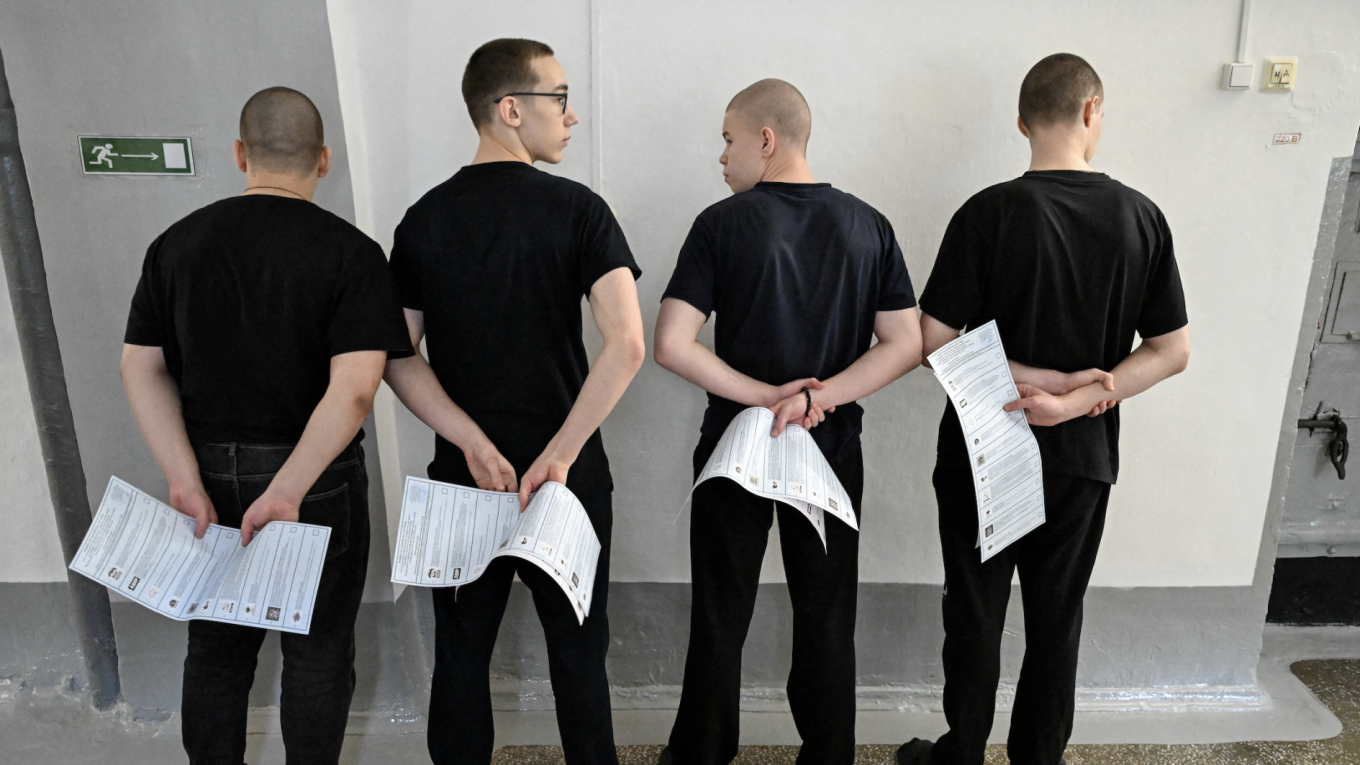
The ruling United Russia party predictably won the parliamentary elections held on Sept. 18-20, receiving 58% of the votes and 349 of the 450 seats in the lower-house state Duma.
Russian officials declared that this result demonstrated popular support for Putin’s regime and its war, or, as Putin himself put it, rallying “in the face of historic challenges” in a year when the war has come to many Russians’ doorsteps. However, for any independent observer, the declared results of these elections inevitably raise doubts.
Even before the final result was announced, many journalists and political analysts got to work on exposing the falsehood of the state’s claims. For example, Novaya Gazeta Europe used statistical analysis (the Shpilkin method) to estimate the scale of electoral fraud and concluded that United Russia’s “real result” was around 34%.
Such calculations are not undisputed, however; experts continue to debate their methodologies. In particular, Leonid Volkov, one of the leaders of the Anti-Corruption Foundation (FBK), argues that the number of added votes can be estimated when there is a “clearly defined core of verifiably honest polling stations.” Yet the scale of fraud in this election was so great that such a core has been effectively eliminated.
I believe it is important to draw attention to two aspects that have been overshadowed in these discussions.
First, knowing exactly what was inside the ballot boxes does not give us the real result. The elections were not competitive: not only were opposition forces in exile unable to participate, but even Yabloko, a long-standing sparring partner for United Russia that had received between 2 and 4% of the vote for the past 20 years, was removed from the ballot.
Furthermore, there is extensive evidence of the use of “administrative resources,” a euphemism for putting pressure on groups of voters, such as military personnel or state employees, to vote for United Russia.
Finally, the entire state apparatus worked in support of the ruling party, affecting the electoral process at every stage through the media, electoral commissions, the police, and the courts.
The second aspect to consider is the actual techniques of electoral malpractice. There have been reasonable doubts about the fairness of Russian elections expressed repeatedly throughout the quarter-century of Putin’s rule. What matters, however, is exactly how elections are falsified.
Over the past decade, statistical analysis has revealed the so-called Churov Saw: statistically unlikely spikes in graphs of voting results at round numbers: 60, 65, 70% and so on. These statistical anomalies not only prove the fact of the fraud but also indicate who committed it. Apparently perfect numbers mean that members of certain election commissions simply wrote the made-up figures into the final results tables, and that there were no independent observers to prevent them from doing so.
This, however, was not always the case. In the 2000s and the early 2010s, more primitive techniques were widely used: stuffing stacks of completed ballots into ballot boxes; voting under the names of people who had died or moved away; “carousel voting,” in which groups of voters traveled from one polling station to another to cast their votes multiple times; and manipulation, including pressure on voters, often elderly or ill, during home voting, where a portable ballot box is brought to the homes of voters who cannot come to a polling station. It was this home voting that secured a first-round victory for the Kremlin-backed Sergei Sobyanin in the 2013 Moscow mayoral election, preventing Alexei Navalny from going head-to-head with him in the second round.
These methods of electoral fraud were more expensive and complicated to organize, as well as more scandalous when exposed. Obviously, numerous videos of ballot stuffing or carousel voting leave ordinary citizens with far less room for doubt than statistical calculations that are not only difficult to understand, but also open to being challenged by experts. The fact that the authorities were forced to use these unsophisticated techniques meant that they had not yet gained complete control over the voting process.
This control was secured through the destruction of the election-monitoring movement, which had existed in Russia since the early 2000s but grew considerably after the decline of the 2011-2012 street protests, when numerous protesters became election observers. Golos, the largest election-monitoring organization, was among the first targeted under the “foreign agent” legislation in 2013, when the Justice Ministry treated the 7,700-euro Sakharov Prize — which the organization had refused to accept — as foreign funding.
The organization came under increasing pressure and eventually ceased its work because of the repression: in 2025, one of its co-chairmen, Grigory Melkonyants, was sentenced to five years in prison. At the same time, opportunities for election monitoring were increasingly restricted: the introduction of three-day voting made continuous observation of ballot boxes physically impossible, further restrictions limited who could be an observer — the list goes on.
The relatively small number of independent observers who nevertheless worked during the 2026 election faced unprecedented obstacles. In St. Petersburg, for example, more than 250 of the 430 observers appointed by Yabloko were unable to even begin observing the election.
Finally, even political analysts have become subject to repression. Just a few days after the election, prominent political scientist Alexander Kynev, a former head of Golos' analytical department, was brutally arrested on charges of allegedly distributing drugs.
Securing control over election commissions not only makes electoral fraud easier. It also corrupts tens, if not hundreds, of thousands of their members who either participate in electoral fraud or, at the very least, turn a blind eye to it. Russia has almost 50,000 election commissions, each of which consists of between three and 16 members. Since many polling stations in Russia are established in schools, a lot of those commissions are made up of teachers who are responsible for the education of future Russian citizens and voters. As the regime makes them legal and moral accomplices in its crimes, corruption inevitably seeps into the younger generations.
Thus, there is little point in trying to calculate the ruling party’s real result. When opposition candidates and observers are barred from participation, such a result simply does not exist.
It seems quite likely to me that, if Russia ever has fair democratic elections again, all this fabricated popular support for United Russia will disappear overnight.
What will not disappear, however, is the damage its supposed victories have inflicted. Unfortunately, statistics can hardly address the moral question of how so many people are made complicit in rigging, manipulation, coercion or worse — and even more people are completely desensitized to it. This is the deeper problem we need to address.
A Message from The Moscow Times:
Dear readers,
We are facing unprecedented challenges. Russia's Prosecutor General's Office has designated The Moscow Times as an "undesirable" organization, criminalizing our work and putting our staff at risk of prosecution. This follows our earlier unjust labeling as a "foreign agent."
These actions are direct attempts to silence independent journalism in Russia. The authorities claim our work "discredits the decisions of the Russian leadership." We see things differently: we strive to provide accurate, unbiased reporting on Russia.
We, the journalists of The Moscow Times, refuse to be silenced. But to continue our work, we need your help.
Your support, no matter how small, makes a world of difference. If you can, please support us monthly starting from just $2. It's quick to set up, and every contribution makes a significant impact.
By supporting The Moscow Times, you're defending open, independent journalism in the face of repression. Thank you for standing with us.

Remind me later.