When I was approached to write this article, I was asked to demonstrate the evidence that Russia’s elections were falsified in favor of the ruling United Russia party.
In fact, I’d frame that question differently. The elections were falsified not so much in favor of United Russia as in favor of the Kremlin’s vision of stability.
And it is precisely the falsifications in favor of the small nationalist A Just Russia party that show that the system did not have one simple goal of securing a constitutional majority for the incumbent. The goal was broader: to prevent changes to the political landscape. It appears that the Kremlin is afraid of any political dynamics that it did not initiate itself.
We have already seen from the published data, through analysis of the distributions, that there was a sea of falsification in favor of United Russia. The data are incomplete and everyone uses different methodologies, so estimates range from 9 million to 18 million votes. I am not going to be using the method developed by my teacher, Sergei Shpilkin, because it was designed to detect ballot stuffing and is not particularly well suited to this case.
In Moscow, one in every twenty sets of results showed signs of one of two main types of manipulation. Interestingly, among the 73 changes in the published data, there was not a single case of ballot stuffing. In these cases, the figures for a party simply increased because the number of supposed voters increased. In all of these cases, the votes for one party were simply switched to another.

The first type of manipulation inflates the vote of A Just Russia. For example, at polling station No. 241, the party ended up in first place. How did that happen? The falsifiers took 189 votes from the New People party — favored by opposition movements making a protest vote — and added those 294 votes to A Just Russia.
Or take polling station No. 2181 — 600 votes were transferred from United Russia to A Just Russia.
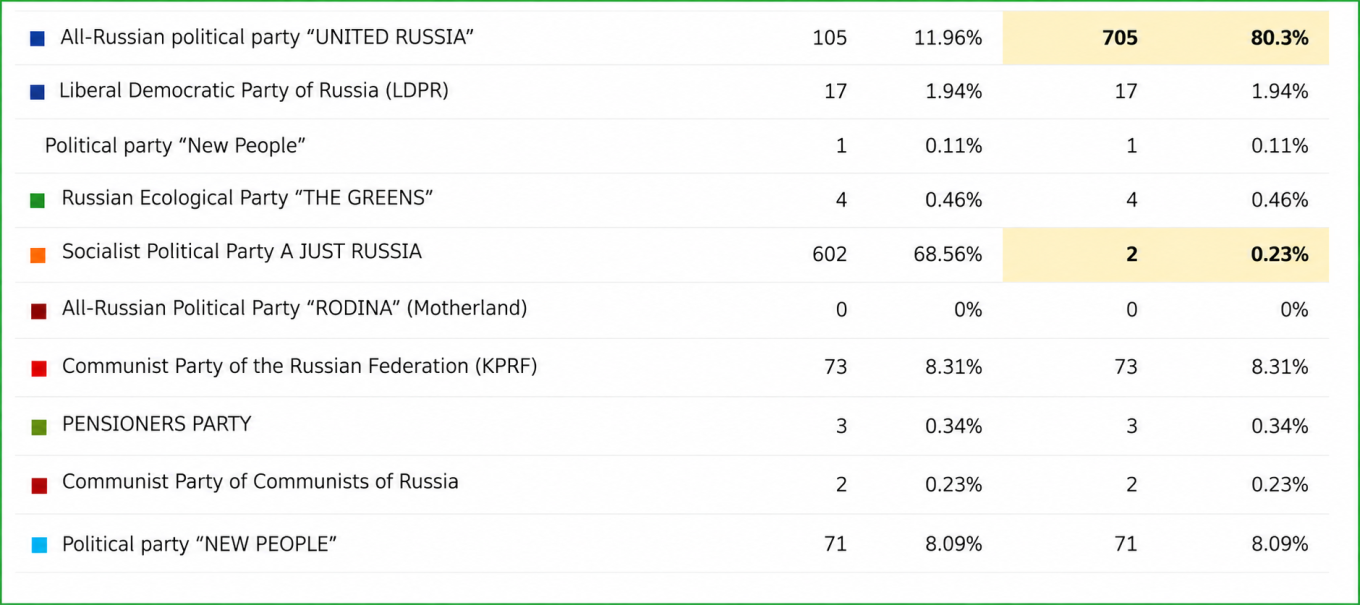
The second type looks like someone’s attempt to make the Communist Party’s showing (e.g. 0.66%) look more plausible. Some of the results still look unnatural even after being corrected.
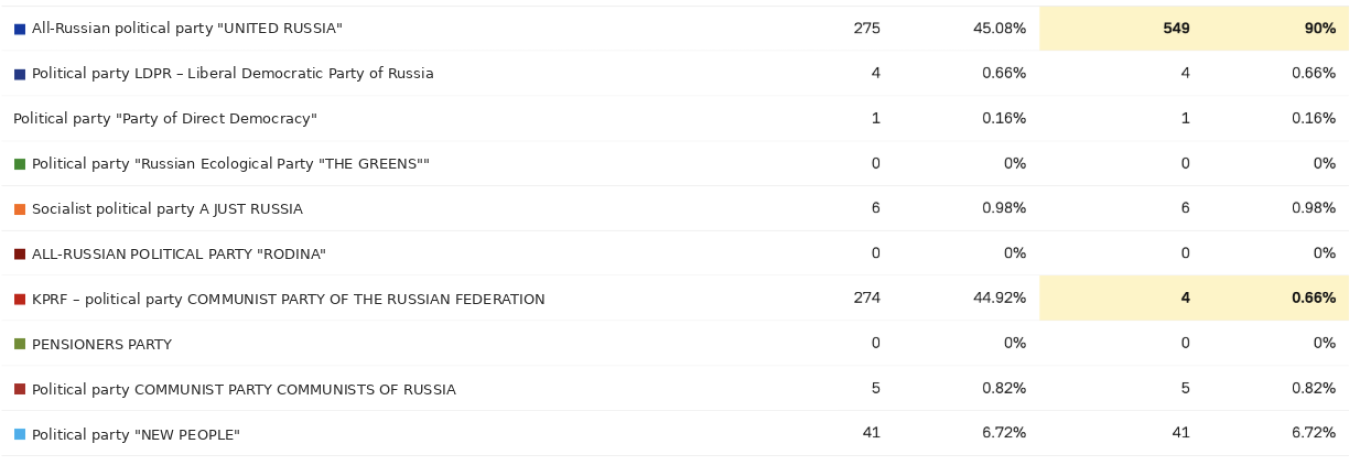
What unites all of them is that the results become closer to natural ones; at polling station No. 3084, United Russia even remained in the lead. But unusually, there was not a single case in which United Russia’s result increased. The falsification strictly altered the numbers toward A Just Russia.
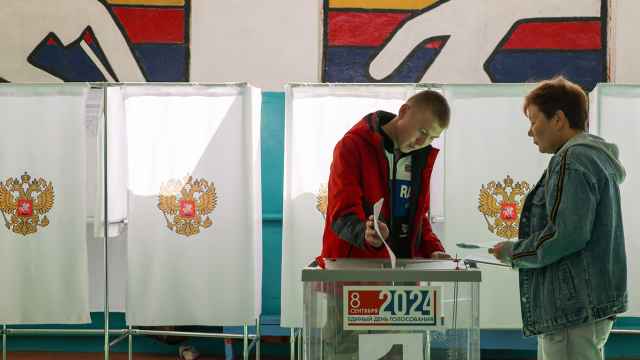
Was there ballot stuffing for United Russia across the country? Of course there was, and this can be seen from the “comet’s tail” pattern on graphs showing the distribution of the party’s result against turnout. It is still difficult to say how extensive the ballot stuffing was. When the scale of falsification becomes noticeably greater than the number of honest votes, the Shpilkin method stops coping with it. In St. Petersburg, for example, it shows no anomalies at all.
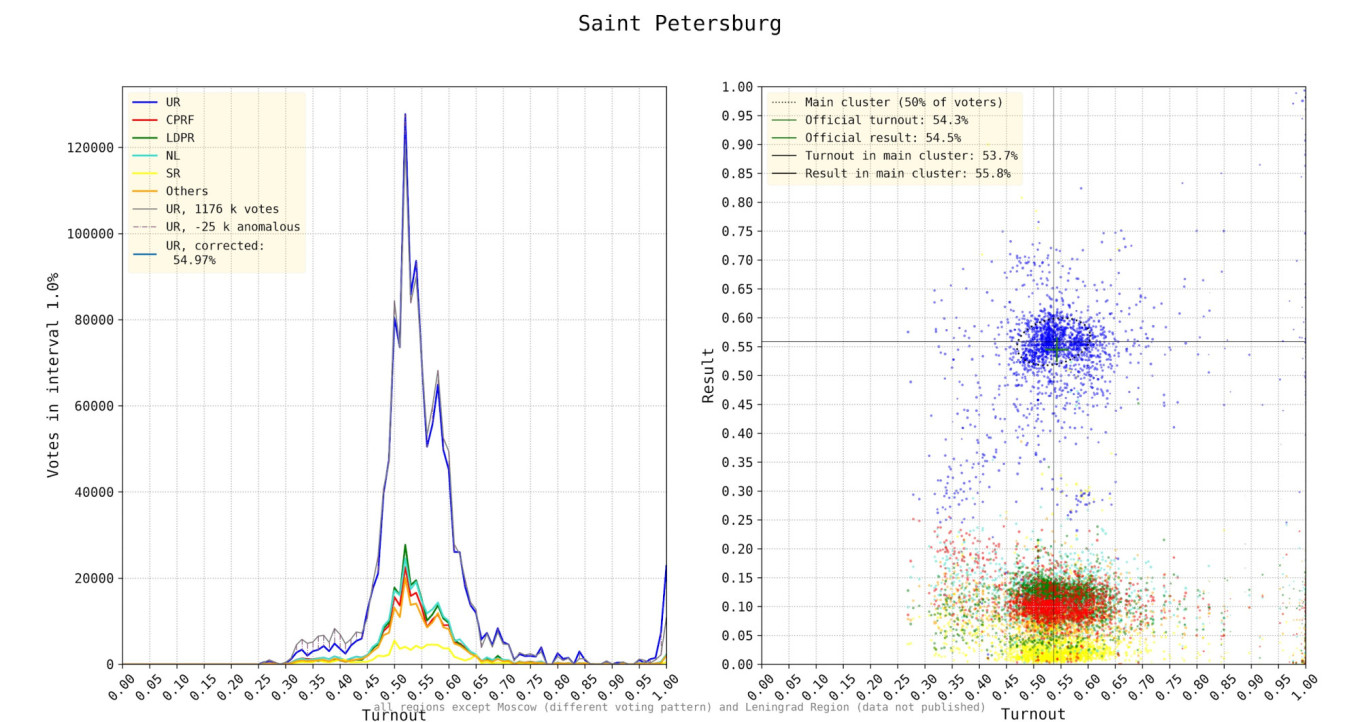
Yet both reports from observers and independent commission members show that turnout was inflated twofold compared to the last comparable election in 2021. A completely fabricated result cannot be compared with anything, and so the method fails.
One reason could be that the analysts who called out the vote fixing last timeinadvertently taught electoral manipulators about Gaussian distributions, which they in turn learned to reproduce. A case during the 2024 presidential election in Perm showed that those organizing the falsification prepare spreadsheets of predetermined results in advance. They then cut those spreadsheets into strips, glued each polling station’s target onto a separate piece of paper and handed those pages to the commission chairs of selected polling stations before sending them off to produce those results
Despite these efforts, some clues snuck through. A small cluster of results showing 30% of voters backing United Russia against a turnout of 35% is still visible — these are the polling stations where there is still no crude fabrication of the results and where observation is strong. St. Petersburg, however, has been completely lost.
In general, it seemed that these two vectors — falsification in favor of United Russia and falsification in favor of A Just Russia — operated somewhat independently of one another. Thus, despite total fabrication in favor of United Russia in St. Petersburg, it was only after 12:00 on Monday that results showing a sharply increased percentage for A Just Russia began appearing in the GAS Vybory election system.
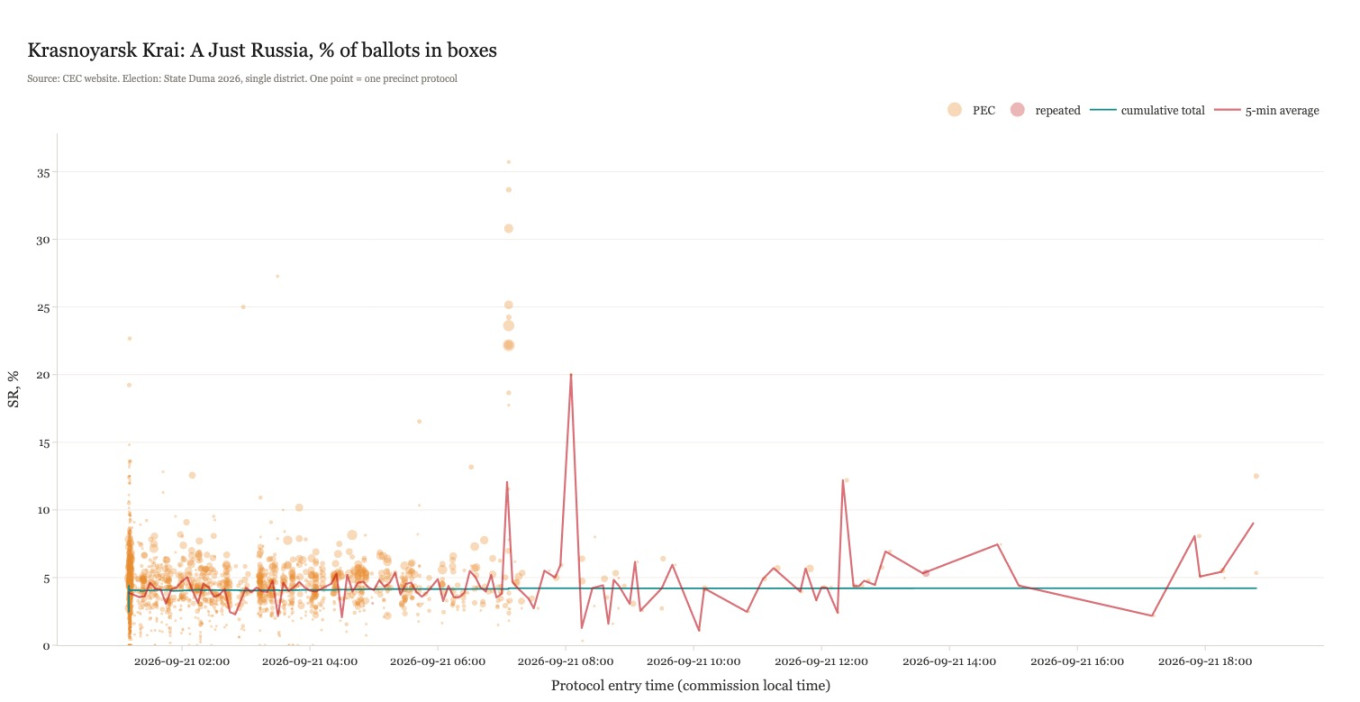
Krasnoyarsk, having reported its results several hours before midday on Monday, had only one short burst of protocols with an anomalously high result for A Just Russia, published its results and calmly remained below the 5% threshold. Nobody touched it again. It was as though the alarm was raised precisely at midday on Monday and something began to be done about the possibility of the party being knocked out of the State Duma. This is exactly what elections without intervention look like — everything happens quickly, everything is published by morning, and it raises no doubts.
Falsification is not always recorded directly. Over many years, the system has adapted its strategy. It is much easier to violate the rights of an observer or commission member than to be afraid, hide and deal with the consequences.
If you do not give an observer or commission member access to the voter list, they will never be able to find out that there are only 300 voter signatures on the list when there are 600 ballots in the ballot box.
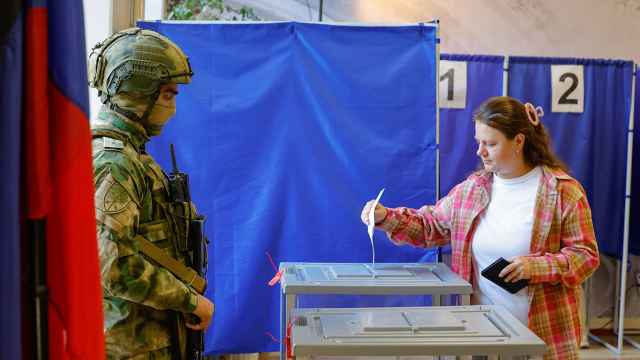
Despite the fact that interfering with election observers and officials is an administrative offence, the police often come to the aid of mad actors or even help them. At polling station No. 1010 in Kuban, for example, the commission chair and a police officer barred a commission member from taking part in the count because she wanted to check the voter list. Naturally, ballot stuffing took place there, like at tens of thousands of other polling stations across the country. The commission prevented anyone from investigating this.
The picture was the same in St. Petersburg, where commission members were widely prohibited from checking voter lists. Commission members with voting rights submitted large numbers of dissenting opinions against this results sheet because they noticed discrepancies and did not want simply to let them pass.
The mass violation of observers’ rights and their removal by court order all undermine confidence in the elections. And it is precisely the response of the Central Election Commission and the commissions organizing the elections that shows they have no goal of conducting the campaign lawfully. Unfortunately, their objectives are corrupted by the desire to please the Kremlin. And so, even though there are thousands of cameras at polling stations, the Central Election Commission does not protect observers.
People often have doubts that you can have cast iron proof of falsifications. Without video of ballot stuffing, they say it is impossible to know whether any violations occurred at all. It would seem to be a logical question. But the lack of transparency from the election commissions is precisely what deprives us of proof. The Central Election Commission did not remove live election-day broadcasts from the internet for nothing.
But thankfully, we have the official data. When elections in a country are honest, voters vote completely independently of one another. If you plot turnout at polling stations on a graph, you get a certain smooth, bell-shaped curve.
There simply cannot be a situation in which people somehow manage to coordinate across the entire country so that there are more polling stations with turnout of exactly 70% than any other level — and noticeably more than polling stations with turnout of 70.5% or 69.5%. The only way turnout can peak at whole-number values is if it's being fabricated centrally.
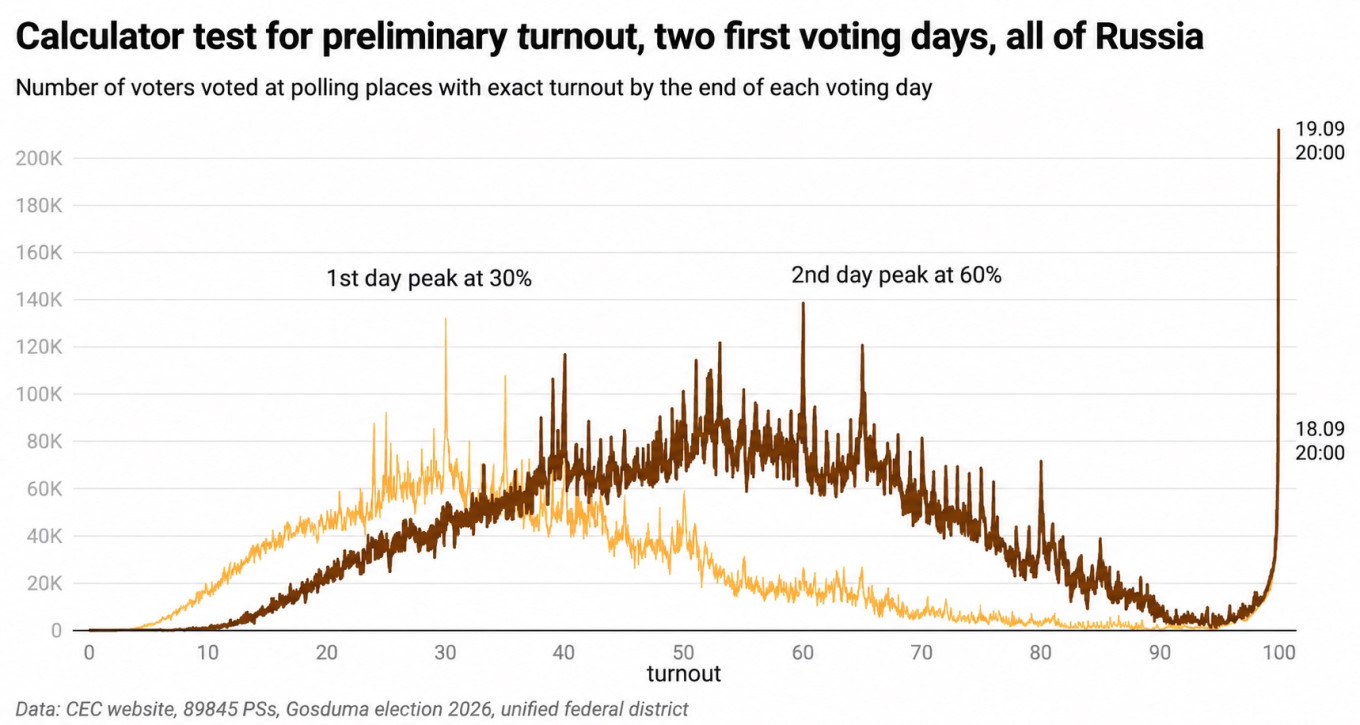
Observers call these curves with peaks at whole numbers the “Churov saw,” after the chairman of the Central Election Commission under whom this pattern first began to be detected on a mass scale. It is evidence of the most brazen forms of falsification — final results fabricated entirely out of thin air.
Numerous peaks of fabricated turnout during the first two days of voting.
Nor is it possible for voters across entire districts to vote in such a way that every polling station has exactly the same result. People in neighboring parts of a city always differ at least slightly. In some places, people favor the Communists more; elsewhere, United Russia. This always produces a spread in results between different polling stations.
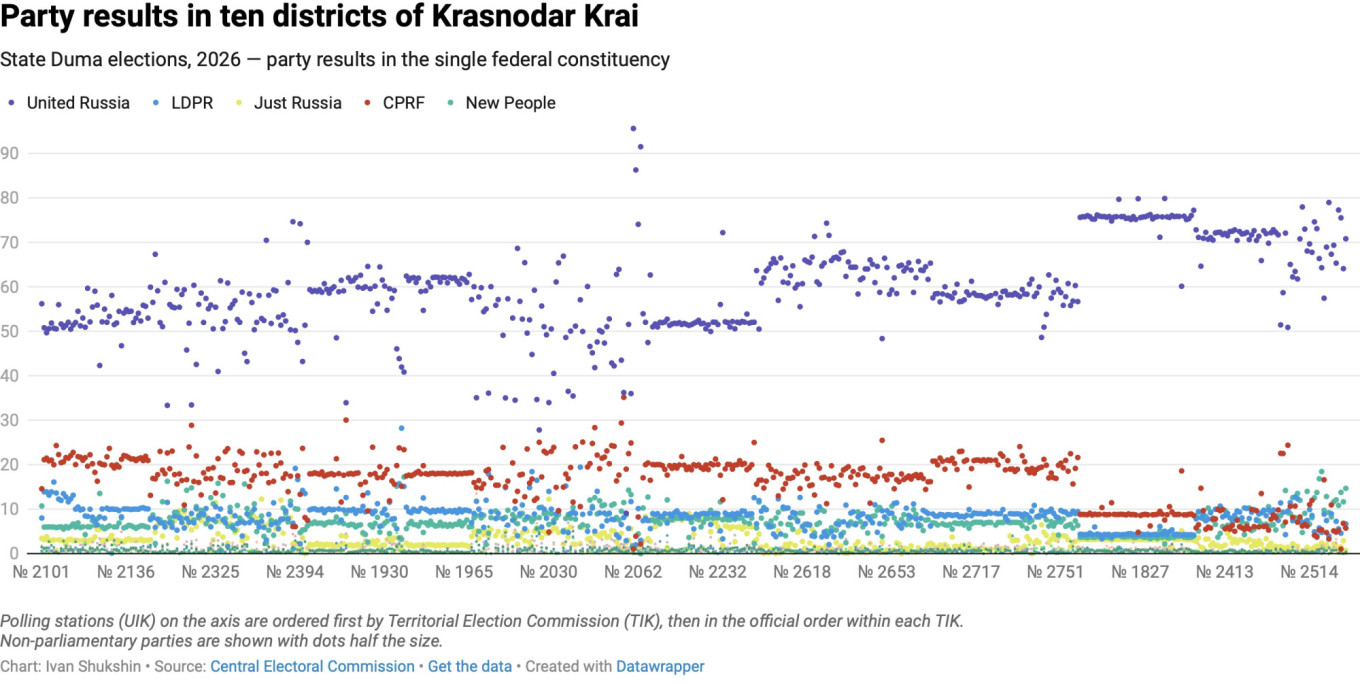
Party results can be completely identical only if those results are being centrally invented. On the graph, this appears as lines. And when not only the United Russia result but all the figures in the results are falsified, we see several parallel lines.
The people who falsified these elections have no imagination whatsoever. And there are no honest election in Russia.
That is exactly what these elections were: dishonest, defined by violations of the rights of observers, ballot stuffing and results rewritten or completely fabricated on orders from above.
A Message from The Moscow Times:
Dear readers,
We are facing unprecedented challenges. Russia's Prosecutor General's Office has designated The Moscow Times as an "undesirable" organization, criminalizing our work and putting our staff at risk of prosecution. This follows our earlier unjust labeling as a "foreign agent."
These actions are direct attempts to silence independent journalism in Russia. The authorities claim our work "discredits the decisions of the Russian leadership." We see things differently: we strive to provide accurate, unbiased reporting on Russia.
We, the journalists of The Moscow Times, refuse to be silenced. But to continue our work, we need your help.
Your support, no matter how small, makes a world of difference. If you can, please support us monthly starting from just $2. It's quick to set up, and every contribution makes a significant impact.
By supporting The Moscow Times, you're defending open, independent journalism in the face of repression. Thank you for standing with us.

Remind me later.