This article was adapted from a post made by the anonymous Telegram channel t-ya. Because The Moscow Times is an "undesirable" organization under Russian law, Russian citizens are banned from working with us.
I just bought a loaf of bread for 100 rubles ($1.18). Nine of those rubles didn’t go to the shop, but to the government budget, with which the Kremlin does whatever it wants.
Living in Russia involves paying a long list of levies. Value-added tax (VAT): 10% on food, 22% on everything else. Income tax starts at 13% and sometimes goes up to 35%.
Then there’s property tax, car tax and a separate tax if you’re self-employed. There are pension fees and then insurance contributions your employer must pay because you exist. All those taxes feed into one budget. The same federal budget that funds the war.
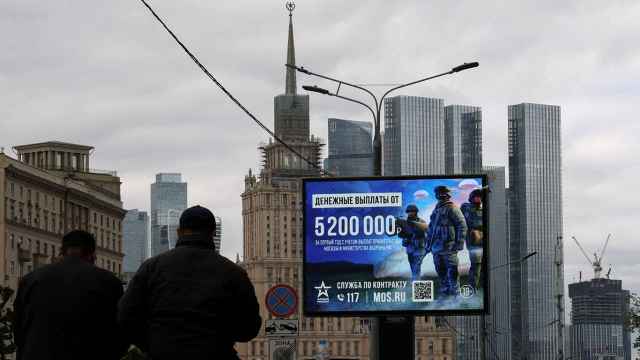
Thus, when I pay taxes, I am paying for the war. When I buy bread, I am paying for the war. When I sell my services and pay the self-employed tax, I am paying for the war.
I don’t want to. But I have no choice. The penalties if I refuse — fines that multiply the debt, court costs. A few hundred rubles easily become thousands. By paying my taxes, I’m ironically keeping my contribution to a minimum. Vendors are in exactly the same position.
What is a crime? Broadly speaking, it’s a violation of the law.
Russian criminal law has a precise word for my case: posobnik. Most legal systems have an equivalent — an accomplice who assists in committing a crime.
But Russian law has been shown to be flexible when politics come into the picture. Article 353 of the Criminal Code criminalizes the planning, preparation, initiation and waging of aggressive war — precisely what our taxes fund. Naturally, no Russian court will ever hear a case on this matter. But if we were to follow the law as it’s written, millions of Russians would be complicit in this crime.
If you use the word “complicity” not as a legal term but as a human one, it is hard to find anyone in Russia who is not participating in this system. Even if you own nothing or are a pensioner, any purchase in a store inherently means paying a tax to the government. Its impact doesn’t change just because we are not donating consciously.
Take the median Russian salary — around 74,000 rubles ($870) a month, according to RBC. The income tax alone comes to 115,000 rubles ($1,352) a year. Add to that VAT, property and car taxes and all other contributions, and the total exceeds half a million ($5,880). And that’s just what a typical Russian pays.
Can one live in Russia and not participate in financing the state budget? My imagination isn’t strong enough to work out how.
But the mere fact of breaking the law doesn’t always mean committing a crime. Russian law recognizes exceptions. Article 39 of the same Criminal Code — extreme necessity: you act because you have no other way to prevent greater harm. There’s also Article 40, which addresses cases of acting under physical or mental coercion.
So if you’re physically unable to leave Russia — you are not guilty. If you have no work in another country, if no one’s waiting for you or you merely have a Russian passport (a sentence in itself) — you’re not guilty.
But where is the line? Where does necessity end and choice begin?
I think about that question every day, but I haven’t found an answer.
The super rich — oligarchs, entertainment stars, top athletes — can leave Russia. They have a choice about whether to stay or split their lives between two countries. I don’t have that choice.
All I did was pay for a loaf of bread. Am I complicit? I don’t know. But I’m certain I don’t want to be an accomplice. And I know I’m not alone.
A Message from The Moscow Times:
Dear readers,
We are facing unprecedented challenges. Russia's Prosecutor General's Office has designated The Moscow Times as an "undesirable" organization, criminalizing our work and putting our staff at risk of prosecution. This follows our earlier unjust labeling as a "foreign agent."
These actions are direct attempts to silence independent journalism in Russia. The authorities claim our work "discredits the decisions of the Russian leadership." We see things differently: we strive to provide accurate, unbiased reporting on Russia.
We, the journalists of The Moscow Times, refuse to be silenced. But to continue our work, we need your help.
Your support, no matter how small, makes a world of difference. If you can, please support us monthly starting from just $2. It's quick to set up, and every contribution makes a significant impact.
By supporting The Moscow Times, you're defending open, independent journalism in the face of repression. Thank you for standing with us.

Remind me later.