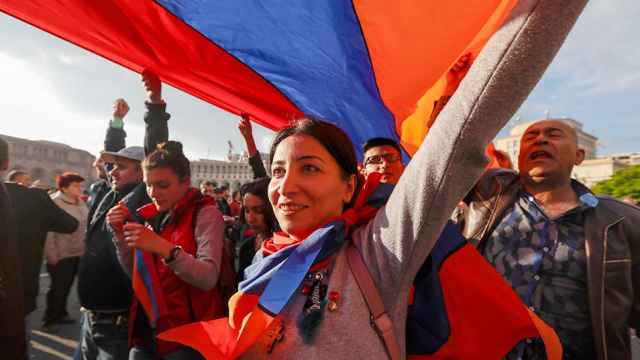

In the aftermath of Armenia's elections in June, much international media coverage framed the result as a decisive victory for pro-Western forces and a development likely to solidify Yerevan's ongoing pivot away from Moscow.
Yet, despite the victory of the European-aligned governing Civil Contract party, such a triumphalist tone fails to capture the scale of the leverage Russia continues to hold over Armenia. Since April, Moscow has rolled out a number of trade restrictions seemingly designed to economically punish the country for its growing ties to Europe.
One lever of Kremlin influence may prove to be the most impactful in the coming months: gas. Nearly all of Armenia's natural gas supply — 82% last year — is provided by Russia. Even Iranian gas, the only other supply available to Armenians currently, is transported via a pipeline operated by Gazprom.
Russian officials have said that if Armenia continues its trajectory of strengthening ties with the European Union, Moscow may reconsider the preferential pricing Yerevan receives from Russia’s gas juggernaut. For the time being, costs remain stable. But Gazprom is scheduled to reconsider its pricing for Armenia this January.
In the meantime, this month Russia announced that it would be suspending gas supplies between September 15 and 25. While officials cited maintenance as the reason for the shortfall, the timing of the announcement was read as a shot across the bow for Armenia.
Armenia’s Central Bank has warned of the potential fallout of a spike in gas prices, saying such a move would cause an "egregious economic shock" that could trigger broader inflation throughout the economy.
The degradation in Armenia-Russia relations dates to Moscow's inaction over Azerbaijani offensives in 2020, 2022 and 2023. In their aftermath, Prime Minister Nikol Pashinyan has sought to deepen political, security and economic ties with the United States, European Union and France in particular.
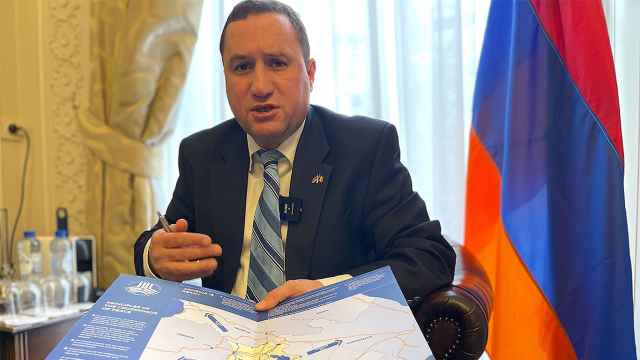
Recent years have seen Armenian politicians green-light proposals around a potential EU membership application and invite the United States to oversee a strategically critical transit corridor linking Azerbaijan to its exclave of Nakhchivan through Armenian territory.
Yet economic ties between Armenia and Russia only began to deteriorate in the run-up to Armenia's June 7 parliamentary election. Beginning in April, Russia banned the import of a number of Armenian goods, citing health and safety regulations.
The trade restrictions have only intensified following the victory of Pashinyan's governing Civil Contract party. Today, nearly every agricultural and foodstuff good produced in Armenia is barred from entry to the Russian market, from strawberries and dairy products to spirits and mineral waters. A September World Bank report found that Armenian vegetable exports had shrunk by 52% in July alone due to these restrictions.
With Turkish markets closed to Armenia since the early 1990s, Russia has been the main destination for Armenian goods since independence. This is especially pronounced for agricultural products, with upwards of 95% of Armenian fruit and vegetable exports destined for Russian shelves in recent years. Shortly after its 2015 founding, Armenia became a member of the Eurasian Economic Union (EAEU), a Russian-backed customs union designed to create a single market between post-Soviet member states.
The European Union has attempted to facilitate Yerevan’s westward turn. Visiting Yerevan this July, EU Commission President Ursula von der Leyen announced plans to liberalize trade restrictions on Armenia and provide millions of in euros to help firms navigate the trade shock. Von der Leyen framed the moves as a testament to Brussels’ reliability, saying, "I’m here with a simple message: Armenia can count on us.”
But commercial patterns take time to adjust, and it remains unclear how much economic damage will be mitigated by these efforts. As much as one-fourth of the Armenian workforce is involved in agriculture, and some degree of economic pain seems inevitable.
The coming months may therefore see two simultaneous crises: a compounding degradation of the agricultural sector and a potential shortage of gas with wide-reaching consequences.
Add to this configuration another element of the June 7 elections: the cementing of Armenia's opposition as an overwhelmingly pro-Russian force.
Pashinyan's Civil Contract party came out on top of the elections, but still underperformed some expectations, winning just under 50% of the vote and falling short of the constitutional supermajority he had sought. Meanwhile, while upwards of a dozen opposition parties contested the elections, only three garnered enough votes to come close to crossing the 4% vote share threshold.
All of those three parties are broadly regarded as pro-Russian forces, likely acting with some degree of coordination with the Kremlin. The largest — Strong Armenia — is led by Armenia's richest man, Samvel Karapetyan, a Russian-Armenian dual citizen and former Gazprom subcontractor.
If Russian coercive action triggers a major economic downturn, it may serve to propel the narratives of opposition figures who warned of such a crisis. That Russia was Armenia's indispensable ally and that Yerevan’s shifting alliances risked Armenia's economy was the explicit argument made by former President Robert Kocharyan during the campaign. His party placed third in June, winning a number of seats in parliament.
Pashinyan appears to be attempting to resolve the trade conflict with Russia. Since his re-election, he has visited Russia, holding talks with Prime Minister Mikhail Mishustin. The Armenian prime minister also met with Putin during Kyrgyzstan's summit of the Shanghai Cooperation Organization. Yet, neither set of talks resulted in the lifting of trade restrictions.
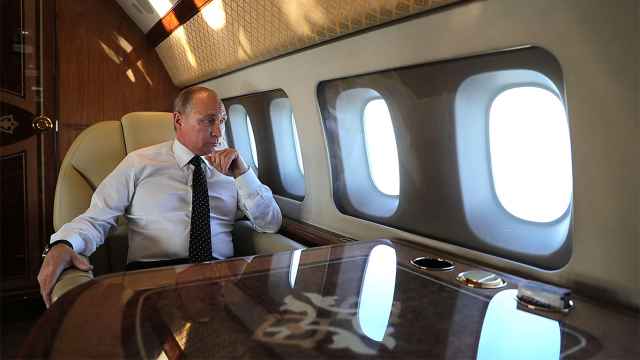
Putin has stuck to his position that Armenia should hold a public referendum on the question of whether Yerevan will pursue European integration or remain in the EAEU. Pashinyan has pushed back on such a demand, arguing that it is Russia violating the terms of the EAEU treaty and that any referendum on EU or EAEU integration is premature.
There are broader signs of Yerevan not backing down from its pivot westward. Alen Simonyan, one of the most publicly anti-Russian members of Pashinyan's party, was named the head of the National Security Council following June's elections.
With neither side prepared to cave in to the demands of the other, it would seem there is little prospect of a coming rapprochement between Yerevan and Moscow. Given the depth of Armenia's economic interconnectedness with Russia, the question is not whether there will be economic pain felt by Armenians, but the degree of it and the effectiveness of measures to minimize the harm.
This winter may therefore prove just as decisive in Armenia's geopolitical trajectory as the parliamentary election, with the Kremlin poised to inflict more pain on the country than it has in any previous period. While such a development may produce anti-Russian feelings, it will also bear out the predictions made by pro-Russian political actors within Armenia’s political scene.
A failure to adequately prepare for, or respond to, a potential economic crisis may strengthen the perception that Pashinyan's pivot westward was a little more than a risky miscalculation.

A Message from The Moscow Times:
Dear readers,
We are facing unprecedented challenges. Russia's Prosecutor General's Office has designated The Moscow Times as an "undesirable" organization, criminalizing our work and putting our staff at risk of prosecution. This follows our earlier unjust labeling as a "foreign agent."
These actions are direct attempts to silence independent journalism in Russia. The authorities claim our work "discredits the decisions of the Russian leadership." We see things differently: we strive to provide accurate, unbiased reporting on Russia.
We, the journalists of The Moscow Times, refuse to be silenced. But to continue our work, we need your help.
Your support, no matter how small, makes a world of difference. If you can, please support us monthly starting from just $2. It's quick to set up, and every contribution makes a significant impact.
By supporting The Moscow Times, you're defending open, independent journalism in the face of repression. Thank you for standing with us.

Remind me later.