
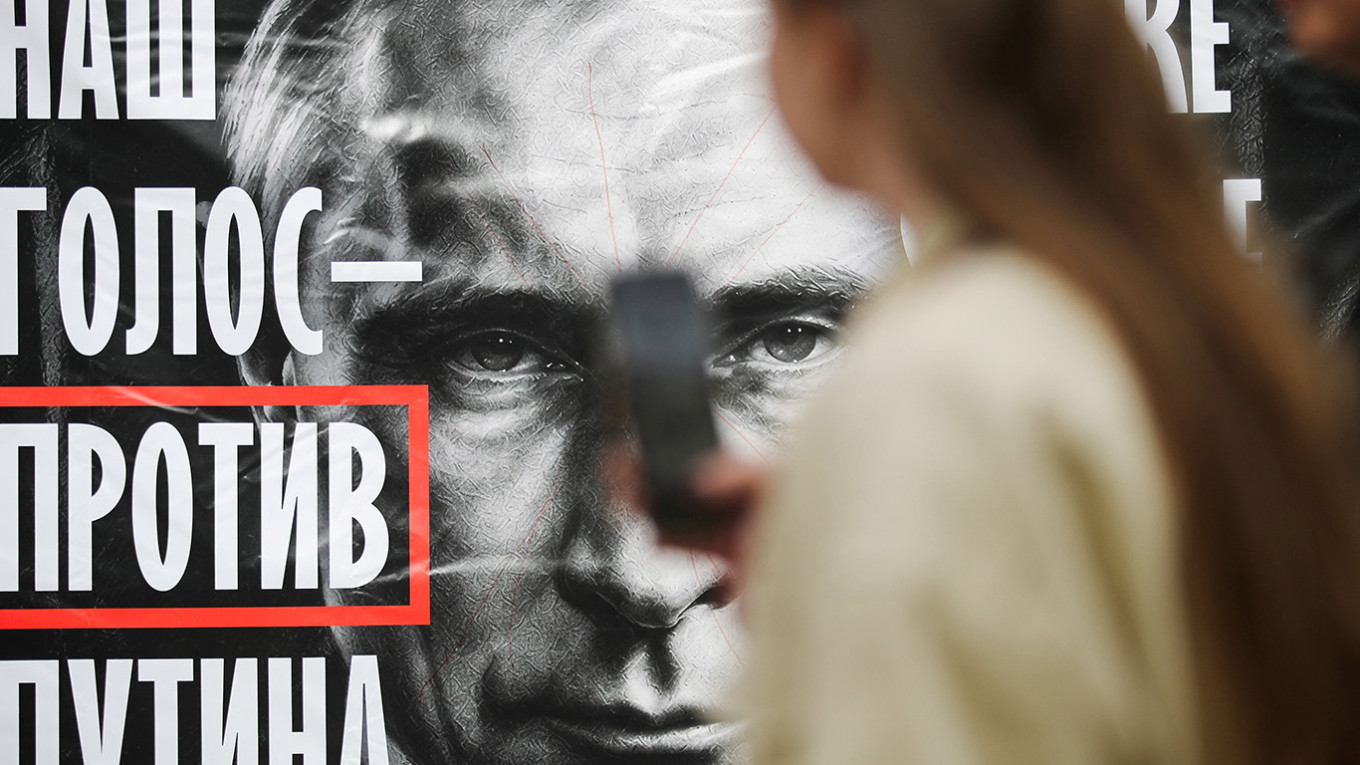
The State Duma elections have taken place and it is already clear that United Russia is on track to win a record number of seats. How did that happen?
For anyone with even the slightest understanding of the situation in Russia, it was obvious that the result of these elections would favor United Russia. The Russian state today has a powerful electoral system designed not to honestly record the will of the people, but to produce the required results.
Where could the idea have come from that these elections, which are completely controlled by the authorities, could somehow be broken or, as one opposition leader who urged people more than anyone else to take part in the vote put it, that it was possible to topple United Russia?
How? The Russian authorities are not some feeble European democracy. These are people who will not give up power under any circumstances: they will have to be torn away from power by force, leaving bloody shreds behind. That is how it works.
The Russian opposition presents protest voting as a very simple and comfortable solution that is also maximally safe. I cannot bring myself to judge anyone who believed them. People genuinely want to express how they feel about what is happening. But wanting change and hoping that such an action can actually bring about that change are completely different things.
But for years, the opposition has been pulling the wool over people’s eyes, sustaining the illusion that a bloody and brutal dictatorship can be dealt with easily and simply. All available experience shows the opposite, but opposition figures ignore it.
We can look back to 2024 to see how this strategy worked out last time. The same people who wanted United Russia to be toppled this year were then calling for people to vote symbolically for the supposedly anti-war candidate Vladislav Davankov. Everyone knew he had no chance of becoming president. But if enough people voted for him, perhaps it would demonstrate how many people opposed Putin and the war.
Nothing came of it. Davankov won 3.85% of the vote to Putin’s official 87% and the opposition had no way to verify whether that pitiful showing for their preferred candidate sent a signal to anyone. What brilliant planning!
Nothing has changed since then. Once again, people turned out to vote at noon and the opposition had no way to tell if their action of choice had any impact.
The approach used by the Russian opposition is infallible by definition. It was no coincidence that Vladimir Kara-Murza, commenting on Yabloko’s removal from the federal list, wrote that it was a victory because it demonstrated that Putin was afraid. A United Russia victory, whether fabricated or not, will likewise be declared a victory for the opposition. The authorities falsify elections because they are very afraid.
They are so afraid that they wage war, put people in prison, remove parties from elections and encounter no serious resistance while doing so.
Calls for protest voting, and protest voting itself, make sense only when people have a clear understanding of what they are going to do after the election. What are they supposed to do with their outrage? Salt it and preserve it in jars?
If people genuinely value their vote, they have plenty of ways to show it: protests, demonstrations, strikes, acts of disobedience. Nobody expects anything like this to happen. Not because of fears of the repression that would follow, but because the opposition has not called for any action of the kind.
The very people who spent years being taught democracy by YouTube channels do not want to stand up for that democracy. And they have been trained not to. They have been taught that they are participating in politics through one simple action, a vote, that has to be performed once every few years. What if the authorities decide to scrap elections altogether? What would the opposition do then? Presumably just avoid the question and continue producing videos.
The opposition is pulling the wool over people’s eyes, unwilling to admit to itself — let alone others — that solving the problem of Putin and authoritarian rule in Russia more broadly is a difficult task with a difficult and painful solution. It will require enormous effort, hard work, serious risks, blood and tears.
It is understandable that ordinary citizens don’t know what needs to be done. But that is precisely the role of politicians and political leaders: to find ways to solve the problem and propose them to people. To say: this is what must be done. A responsible leader should be capable of saying that the proposed solution is unpleasant, difficult and risky, but that the alternatives are even worse.
None of this is happening because the Russian opposition completely lacks political agency and a vision for Russia’s future. The only thing initiatives like Yulia Navalnaya’s forums have produced is that fair elections should be held, an independent judiciary established, private property and human rights protected and so on. These abstract slogans are often completely incomprehensible to ordinary people. You cannot mobilize people to fight for verbal husks that have been ringing in their ears for years.
If you believe that any additional votes inspired by this movement would have gone against United Russia, then you need to prove it. You cannot simply declare the desired result and build an entire political strategy on it.
Democracy, which the opposition professes to love, requires citizens to make decisions themselves, consider the options themselves, choose the candidate who, in their view, best represents their interests, and understand what their own interests are.
But does the Russian opposition offer its audience such practices? Does it explain to people that they need to make decisions for themselves? No. People are told that the opposition has decided everything for them, reproducing Putin’s authoritarian political culture. At least the Kremlin formally says that people have a choice of candidates. The opposition says that anyone who doesn’t vote for their choice is essentially supporting Putin. Very liberal.
So what are democrats supposed to do if the democracy they seek remains inaccessible? The answer, strangely enough, is staring them in the face. If you cannot build democracy in Russia, start building it in exile.
Create a representative assembly of Russian citizens, hold proper elections, give people the opportunity to stand as candidates, campaign, argue about platforms, organize into political groups, vote and choose whom they are willing to trust to represent their interests.
Such an assembly could become a place where a common vision of Russia’s future is developed. The assembly should determine political goals, the sequence of actions, priority areas of work and ways of using limited resources. It could create working groups, bring in experts, commission specific programs, discuss them publicly and make decisions by vote. Politics would then cease to be a collection of the personal opinions of the most high-profile opposition figures and become a process in which procedures and collectively adopted decisions exist.
It could also authorize representatives to negotiate with European governments, parliaments and international organizations. A person arriving in Brussels, Berlin, Paris or Washington would no longer speak merely because he has many YouTube subscribers, a famous surname or good connections, but because a certain number of citizens stand behind him, having elected him and given him a mandate.
Normal political competition could emerge there as well. Some would propose a more liberal economic program, others a social-democratic one. Some would advocate stronger federalization, others the preservation of a more centralized model. Factions, coalitions, majorities and minorities would emerge. People would finally have the opportunity to choose between political programs rather than between the surnames of media bosses.
The very existence of such a mechanism would force Russian democrats to comply with the demands they have spent decades making of the Russian authorities: hold elections, allow competitors to participate, explain sources of funding, account for spending, debate decisions publicly, respect the losing minority, impose term limits and transfer power after electoral defeat.
At first, such an assembly would represent only those who voluntarily agreed to participate in this system and accepted its rules. But even that would constitute real political legitimacy, albeit limited in scale, rather than self-appointment based on media prominence.
Moreover, the political organization could be expanded. Local groups, expert bodies, regional associations, political clubs and party organizations could emerge around elected representatives. People could join them, take part in discussing programs, propose solutions, nominate their own candidates and change the leadership. Those very horizontal connections and that experience of collective action which people today like to talk about in relation to going to the polling station would begin to emerge.
This initiative could — and should — become the embryo of a Russian anti-Putin movement that, having grown stronger in exile, would extend its activities into Russia as well, much as the London-based Free France established contacts with occupied France, sending emissaries to coordinate anti-fascist and anti-Vichy activity. That is the fundamental purpose of political organization: to create it where it is possible, work in Russia and everywhere else where necessary, with a clear ultimate goal — to come to power in Russia and change its system in accordance with its own program.
Politics in general is more difficult than putting out a YouTube video and telling several million viewers where to put a check mark. Who has the right to vote? Establish criteria. Who will count the votes? Create a commission made up of representatives of competing groups. How will the process be checked? Bring in independent auditors and observers. How will verification be ensured? Choose a technical solution and discuss it publicly before the vote. Questions that politics is supposed to solve by creating rules and institutions instead become reasons to do nothing.
It is an interesting situation. Apparently, voting for the New People Party in elections completely organized and controlled by the Kremlin, in which your vote cannot be defended or verified, is necessary. But holding elections yourselves, somewhere the Kremlin cannot interfere with you and where you can organize the process as you see fit — properly, the way you would build it in a free Russia — turns out to be impossible and unnecessary. All that matters is that the public does what it is told.
As long as people dissatisfied with Putin preserve the illusion that he can be fought using Putin’s own instruments, nothing will happen. As long as the Russian public listens to chatterboxes on YouTube who promise to run yet another campaign and topple United Russia, and after failure say, “All right, we’ll topple them next time,” nothing will happen.
As long as people do not start looking for their own mistakes and admitting them, nothing will happen. I can already see numerous comments on social media saying that the opposition did everything right. It just did not work this time, but they still did everything right.
With that approach, you will always do everything right, and you will never achieve anything.
The Russian opposition today is selling not political strategy but cheap copium. It is psychotherapy for the poor: people are sold a soothing pill telling them that the difficult, frightening and bloody problem of dictatorship can be solved easily and safely — indeed, that it will solve itself — and all you have to do is make it to the polling station once every few years and put a check mark in a box. The authorities, supposedly, will see the numbers, get scared and understand everything.
In essence, this activity has turned into a modern form of Zubatovism. At the beginning of the twentieth century, the tsarist secret police created controlled workers’ unions to divert people away from real political struggle and channel their energy into the safe outlet of “permitted petitions.” Today’s YouTube leaders perform the same function. They channel popular discontent into a harmless synchronized action at Putin’s own polling stations. They give people the false sense of having fulfilled their duty before they go home with a clear conscience — to wait for the next elections.
This approach is not merely useless — it directly prolongs the life of the regime. By instilling in their audience the illusion that the situation can be turned around quietly, peacefully and without risk, opposition YouTube stars train society out of real political participation. They lull civic responsibility to sleep and conceal the central, albeit unpleasant, truth: dismantling a brutal dictatorship is exceptionally difficult, dangerous and bloody work, requiring real organization, institutions and a willingness to defend one’s choice.
To have grounds to expect real change, politics itself has to change. To do that, people need to unite and create a genuine political movement with a common understanding of Russia’s future that is attractive to the majority of Russians, formulating a strategy and beginning to act in different areas according to its own timetable and schedule, rather than adapting itself to the Kremlin’s electoral calendar.
A Message from The Moscow Times:
Dear readers,
We are facing unprecedented challenges. Russia's Prosecutor General's Office has designated The Moscow Times as an "undesirable" organization, criminalizing our work and putting our staff at risk of prosecution. This follows our earlier unjust labeling as a "foreign agent."
These actions are direct attempts to silence independent journalism in Russia. The authorities claim our work "discredits the decisions of the Russian leadership." We see things differently: we strive to provide accurate, unbiased reporting on Russia.
We, the journalists of The Moscow Times, refuse to be silenced. But to continue our work, we need your help.
Your support, no matter how small, makes a world of difference. If you can, please support us monthly starting from just $2. It's quick to set up, and every contribution makes a significant impact.
By supporting The Moscow Times, you're defending open, independent journalism in the face of repression. Thank you for standing with us.

Remind me later.