In the first months of the full-scale invasion of Ukraine, Russia took pride in the high quality of its propaganda. Even its enemies and various analysts were forced to acknowledge that this was one of the few high-quality products the country produced.
Four years later, something has broken. It is as if shifting the economy onto a war footing has turned the once-mighty propaganda machine into a rotting pumpkin.
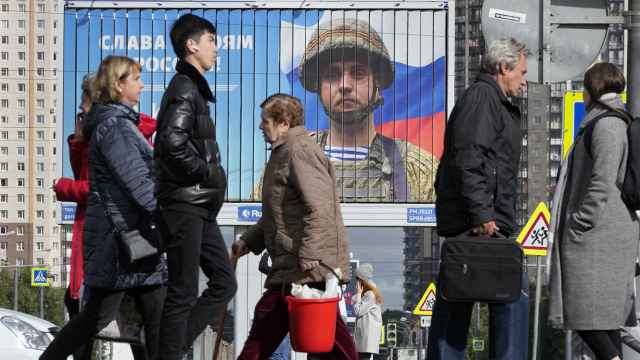
The state-funded, carbon-copy videos urging men to sign military contracts to “protect children’s future” and “influence the country’s destiny” have only one argument: the 204,000 rubles ($2,614) monthly salary for a private deployed to the warzone. The war offers a solution to the financial problems of useless Russian men who have nowhere and no reason to work.
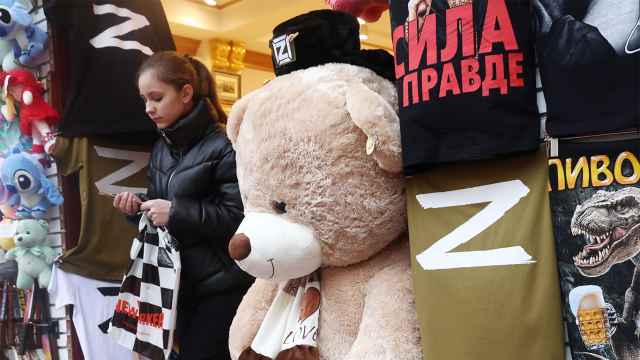
Today’s propaganda is almost too embarrassing to discuss. One video includes a clip from the Russian movie “Brother 2” in which the hero tells a terrified American that “strength lies in truth.” Not that the American had any choice, with all his guards dead. Spliced throughout are clips of women handing out daffodils to suspiciously clean soldiers sitting on tanks that look as if they have just come from a car wash.
The video ends with the uncreative slogan “Join your own in the SVO!” But the weird symbolism throughout the video is what I remember most. Did those daffodils mean anything in particular?
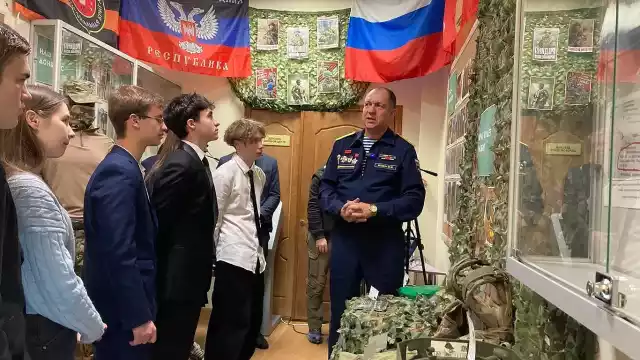
Another example is a series of lurid illustrations from a history textbook and crudely altered photographs from World War II, accompanied by Alexander Klyukvin’s narration: “Historically, we have defended our borders, our people and those who need our help. Although our enemies have spoken different languages and possessed different weapons, their goals have always been the same — to destroy our country, to take away our freedom!”
The Orwellian absurdity is sustained to the end. Attack equals defense; invading a neighbor is protecting one’s own borders. At least going to war over natural resources would have some logic. But no, Russia is at war for “our freedom.” You’d think the job of a hero is to defend that freedom, not attack someone else for it. But not according to the closing slogan — “Become a hero who brings victory closer!”
“Victory” is a blatant trigger word, a concentration of emotion that has lost all meaning. What kind of victory are they even talking about? Over whom? For what purpose? Is it being rewarded with a watch, a car, an airline? Russia has no friends to fight for, only partners to whom the Kremlin feels no real loyalty. What remains is a fight to the bitter end, bringing closer a capital-V victory that you will not see and will never arrive for the exact same reason. Your children need victory only as a symbol to justify the fact that their father is dying in the mud far away.
The mutual indifference of the clients, creators and audience is what immediately stands out and forms the psychological plot of the videos calling men to the war. The Defense Ministry needs more propaganda pumped out to advertise contract service. Production companies that won the tender to make the videos will need to report that the work was done. There is no need to go all out and try to persuade anyone to fight "for the motherland." Even the client does not believe in their work’s message.
During the Covid pandemic, it was like Russians were pre-programmed for social distancing. Their response to the full-scale invasion bore a strange symmetry with that time. Like Germans when Nazi marches started appearing on their streets, many Russians continued their lives with surprisingly little disruption. But Ukraine’s August 2024 incursion into the Kursk region was a shock, even if it didn’t affect the course of the war and even backfired.
Though Ukraine has since lost its foothold on Russian soil, its deep-strike campaign has gone from strength to strength. Precision strikes on Russian energy and logistics facilities inevitably bring mounting costs. Suddenly, death by drone is on Russians’ doorsteps regardless of age, gender or occupation.
Under this new order, bellicose propaganda becomes detached from all those it once directly concerned. Soviet propaganda was stupid and blunt, but it had an unchanging core of meaning. Even now, it is easy to recognize how it divided the world into two halves with mirror-image understandings of good and evil. However false the supposed values of the U.S.S.R. turned out to be, they were at least predictable.
Now it is impossible to use, seriously and without reservations, all those concepts that Russian propaganda continues to string together out of inertia. The total technologization of war, and its transformation into a spectacle even for its participants and victims, has pushed meaning outside the brackets. What remains is a not especially large amount of money that one can try to obtain in the absence of other intelligible forms of employment. And even that only if the soldier is lucky and the state does not cheat him and his family — which, for obvious reasons, it is inclined to do.
In late July 2024, the legendary nightclub Propaganda in Moscow’s Kitai-Gorod district closed. Over its 27 years in operation, it set the standard for Moscow’s world-famous club culture. Its founders said goodbye to generations of fans dryly and evasively, saying that “the time had come” and that “the project had exhausted itself.”
I bring up this sad turn of events because it is strangely symbolic of the decay of Russian propaganda. Regulars mourning their beloved “Propka” wrote online how it now only existed “in people’s heads.” They may not have been thinking about the parallel with Russia’s pro-war propaganda, but its potency now only exists in people's imaginations, not on their screens.
There is no particular need for it to be any other way. The state only demands that these videos be made because it's used to getting its own way. Looking at the wretched specimens that result, the viewer does not burst out laughing only because the outcome for him will be sad anyway: the Kremlin doesn’t need to pump out any propaganda at all to send its citizens to the slaughter. And propaganda will be needed only to drown out the screams of soldiers dragged to the basement for refusing to hand over to their commander whatever he has decided to take from them.
A Message from The Moscow Times:
Dear readers,
We are facing unprecedented challenges. Russia's Prosecutor General's Office has designated The Moscow Times as an "undesirable" organization, criminalizing our work and putting our staff at risk of prosecution. This follows our earlier unjust labeling as a "foreign agent."
These actions are direct attempts to silence independent journalism in Russia. The authorities claim our work "discredits the decisions of the Russian leadership." We see things differently: we strive to provide accurate, unbiased reporting on Russia.
We, the journalists of The Moscow Times, refuse to be silenced. But to continue our work, we need your help.
Your support, no matter how small, makes a world of difference. If you can, please support us monthly starting from just $2. It's quick to set up, and every contribution makes a significant impact.
By supporting The Moscow Times, you're defending open, independent journalism in the face of repression. Thank you for standing with us.

Remind me later.