Russian rock has always been a rather insular space where a narrow circle of artists who rose to fame a good 40 years ago still rule the roost. During this time, a distinctive fan culture developed around the pioneering bands of Russian rock, where a person’s favorite group often reveals a great deal about their character.
If I am talking to a fan of DDT, I can be almost certain that they hold liberal-democratic views, are longtime readers of Novaya Gazeta and are critical of President Vladimir Putin. If I am dealing with an admirer of Korol i Shut or Sektor Gaza, the picture is likely to be quite the opposite. If someone sympathizes with Boris Grebenshchikov or Zemfira, their moderately liberal outlook is usually accompanied by a certain degree of aesthetic sophistication and snobbery.
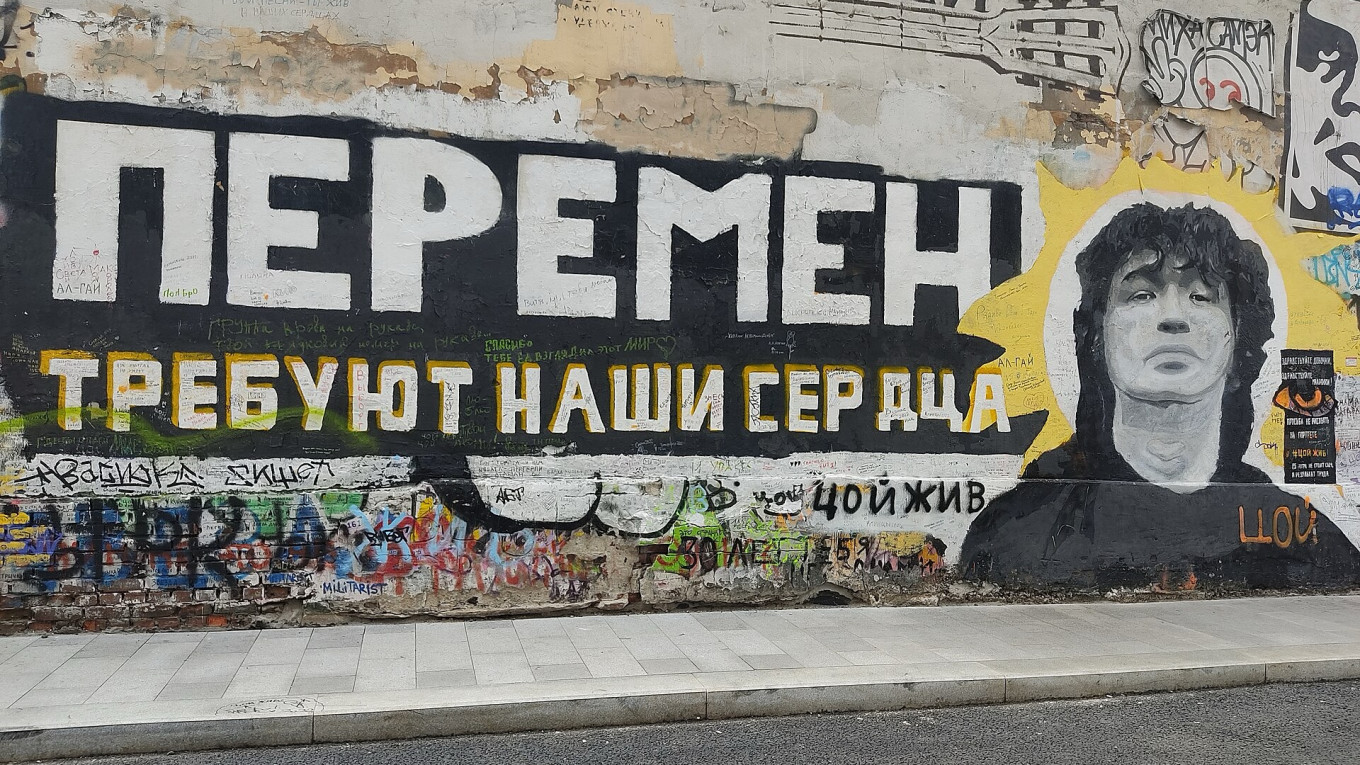
There are almost no exceptions to these character templates. One, however, springs to mind immediately, for it is the most iconic and best-known Russian rock band, both in Russia and abroad. That is, of course, Kino and its frontman, Viktor Tsoi.
The band’s unique status is very easy to observe if you search for Kino’s songs on YouTube. Among the most viewed videos, you will find an incredible number of compilations of footage of the most significant and traumatic events in the history of post-Soviet Russia, with Kino’s best-known hits playing in the background. In particular, the 1991 Soviet coup attempt, the 1993 constitutional crisis, the war in Chechnya and the invasion of Ukraine.
Kino’s songs are sung by both Putin’s supporters at propaganda concerts and his opponents at protests. Yet Tsoi himself died in 1990 at the age of 28 and, during his lifetime, refrained from making any political comments at all.
The man’s worldview is neatly reflected in a conversation with Kino’s guitarist, Alexei Rybin, which the latter recalled in his book “Kino from the Very Beginning.” Rybin and Tsoi were discussing the Soviet way of life when Rybin optimistically suggested that, in time, everything in the country would change and that “things can’t stay like this forever.” Tsoi, however, countered that they actually could and that “we’ll never get out of this.” In his opinion, one should therefore continue making music and not concern oneself with matters of national importance, leaving them to politicians.
Such words may be perceived as utter cynicism from a man who became famous for songs with passionate titles such as “I Want Changes!” and “We’ll Take Action Next,” yet it was precisely this approach that secured Kino’s success and cult status. It is difficult to say whether this was merely an artistic persona or his true nature. But Tsoi’s interviews leave one with the impression that he was not particularly interested in, so to speak, worldly vanities around him.
He invariably answered journalists’ questions with undisguised boredom and came across as a decadent egocentric, insisting that his songs contained neither a protest nor a social message, and that he simply wanted people to “be freer from circumstances”. This applies above all to the famous “I Want Changes!” which has become the defining protest anthem of modern Russia and was unambiguously presented as such in the 1987 film “Assa.”
In its final scene, Tsoi applies for a job as a musician at a restaurant, where a member of staff monotonously recites a typically Soviet, tedious list of a musician’s rights and responsibilities. Eventually, Tsoi stops listening, gets up, and walks into the restaurant hall to perform the iconic song. By the end of the scene, the empty restaurant has transformed into a vast concert venue in Moscow, where he is watched by a crowd of thousands singing along and demanding changes in unison.
One might think that the message here is obvious. However, Tsoi criticized this scene as a “false tooth,” insisting that the song was not about protest at all and that the film had distorted its meaning. This is a highly characteristic statement, and the point is not even that Tsoi was an apolitical cynic detached from the world. Rather, he resisted with all his might any attempt to tie his work to a specific chronological, let alone political, context because he understood what will enable Kino to achieve the unique status and distinguish itself from other Russian rock bands. Namely, the ability to transcend its own era and avoid becoming fixated on the agenda or passing trends.
The journalist Yuri Saprykin captured this idea particularly well in an essay for Kommersant Weekend, where he argued that Kino’s songs are “the perfect frame for future events which its author may have foreseen, but did not live to witness.” As Saprykin put it, “Tsoi provided the lyrics, the riffs, and an overall stoic, dispassionate outlook on life that helped people get through it all — but he himself never experienced any of it.” That is precisely why this ‘frame’ so naturally complements the YouTube edits mentioned above, and why “I Want Changes!” fits just as well at opposition rallies as at concerts by pro-government musicians on Red Square.
Tsoi did everything in his power to ensure that the archetype of the Kino fan did not exist, as a personal identity can be built around paintings, but not around frames. In this sense, Kino’s music is true post-punk not only stylistically but also philosophically. Unlike the more straightforward punk messages found, for example, on the early albums of the band Grazhdanskaya Oborona (another band with a highly distinctive fan base), Kino always left more room for the listener’s own interpretation. There is a certain intellectual ambiguity in Tsoi’s lyrics, and even if a song is called “War” and references the realities of combat, this does not necessarily mean that it is not, in fact, a parable about inner psychological conflict. And the same goes for “I Want Changes!”
On June 21, a throwback Kino concert took place in Moscow, attended by over 60,000 people who had come to hear old songs performed in Tsoi’s digitally restored voice, accompanied by musicians from the band’s original line-up.
I spoke to several people who went and what struck me most was the remark that, in Russia in 2026, it is very refreshing to come to a concert by a band that evokes no associations with any particular political narrative — not just the current one, but those of previous decades as well.
However cynical it may sound, Tsoi really did die at just the right time; his breakthrough coincided with the years of Perestroika and he thus managed to avoid having to adapt to the changing times. This is a unique case in the Russian context, one in which a trendy young Muscovite — who appreciates the lo-fi, niche appeal of Kino’s early albums — might stand for two hours alongside a Z-patriot, for whom the song “Blood Type” is associated with Russia’s military aspirations.
As Tsoi believed, “Music shouldn’t just call on people to storm the Winter Palace. It should be listened to.” Several decades on, it is still being listened to intently by people who, if they were to storm the Winter Palace, would find themselves on opposite sides of the barricades. This universal adoration is arguably the highest form of recognition a musician can receive.
A Message from The Moscow Times:
Dear readers,
We are facing unprecedented challenges. Russia's Prosecutor General's Office has designated The Moscow Times as an "undesirable" organization, criminalizing our work and putting our staff at risk of prosecution. This follows our earlier unjust labeling as a "foreign agent."
These actions are direct attempts to silence independent journalism in Russia. The authorities claim our work "discredits the decisions of the Russian leadership." We see things differently: we strive to provide accurate, unbiased reporting on Russia.
We, the journalists of The Moscow Times, refuse to be silenced. But to continue our work, we need your help.
Your support, no matter how small, makes a world of difference. If you can, please support us monthly starting from just $2. It's quick to set up, and every contribution makes a significant impact.
By supporting The Moscow Times, you're defending open, independent journalism in the face of repression. Thank you for standing with us.

Remind me later.