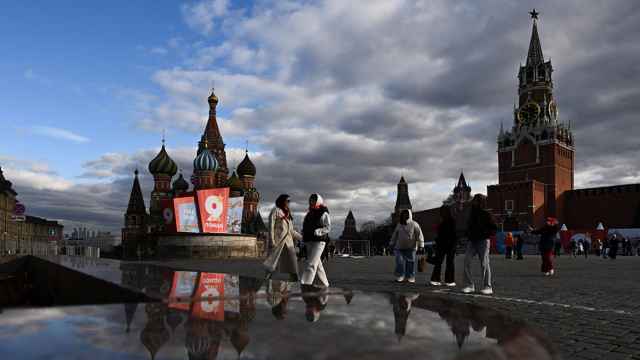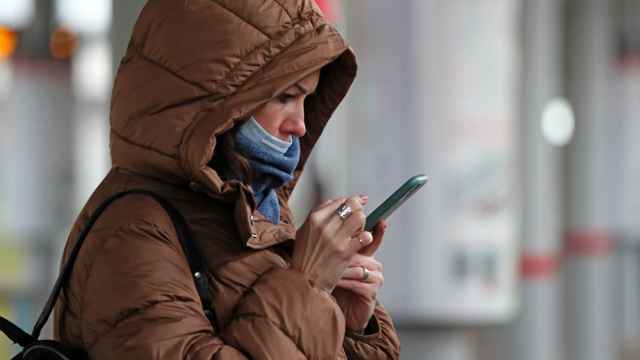


Widespread mobile internet outages in central Moscow since early March saw the return of paper maps and old-school iPods, jokes about using pigeons to send messages and even public toilets being forced out of order.
Weeks later, mobile internet has largely stabilized in the center of the capital and government whitelists are functioning more reliably. But many Muscovites say they are still adjusting to a new reality in which periodic outages are part of daily life.
No panacea
Officials said the outages, which have long been a common occurrence in Russia’s regions, were imposed for security reasons without elaborating further.
Though mobile internet is back online now, Muscovites are living in a situation defined by unpredictability, Vladimir Ryazansky, head of the SobDoma.RF project, told The Moscow Times.
This, in turn, leads to widespread mistrust, he said.
“Internet calls can drop at any moment, even through unblocked services like Zoom. The only stable means of communication for Muscovites are VKontakte and MAX,” he said, referring to the state-backed messenger that the Kremlin has promoted as an alternative to Telegram.
Even white-listed services can glitch unexpectedly, making it impossible for users to predict what might be unavailable at important moments.
Getting on the white list requires navigating a complex bureaucratic process with no guarantee of success, Ryazansky said.
Mikhail Klimarev, the head of the Internet Protection Society, echoed Ryazansky’s points on the white lists, telling The Moscow Times that the outages have led to unexpected consequences.
Some elevators cannot function during the outages because many of their emergency call buttons are operated through mobile networks as a cost-saving measure, Klimarev said. If those buttons don’t work, neither does the elevator.
These inconveniences pile up. Some Moscow residents told The Moscow Times that they now make sure to plan out their entire route to and from their destinations before leaving the house.
‘There won’t be any innovation’
Beyond the inconvenience and uncertainty for ordinary Muscovites, Klimarev noted that the internet outages have had serious economic consequences.
His organization, the Internet Protection Society, calculated that the internet outages in the capital cost the economy 9.6 billion rubles ($120 million) per day. Mobile internet outages alone cost Moscow 4.8 billion rubles ($60 million) per day at their peak.
But because the outages are still intermittent, he estimated the current losses at 1 billion rubles ($12 million) per day.
“Some people are adapting, of course. Some people’s businesses just shut down. Some people change their habits. Some people just leave. People write to me that it’s become impossible to work remotely,” Klimarev said.
Another consequence has been the shift back to cash payments, reversing years of government efforts to promote transparent, cashless transactions, Ryazansky said.
He said he could not envision the city returning back to the way it was before the outages.
“People have realized that any business can be shut down at any moment, or burdened in some way. There won’t be any innovation,” he continued.
‘When the Russian authorities are afraid of something, they’re capable of taking any step’
Neither Ryazansky nor Klimarev could say with certainty whether full-blown outages would become a regular occurrence in the Russian capital, though Klimarev said it was “quite likely.”
“The probability isn’t zero, to put it mildly,” he said. “They can do anything, whether with a whitelist or without one; I don’t even know how to put it more simply. When the Russian authorities are afraid of something, they’re capable of taking any step.”
“They’ve already proven that when it comes to shutting down mobile internet, they couldn’t care less about what people think or how they’re getting by. So they’ve shown they’re capable of doing this, and they’ll keep doing it,” he continued.
“You simply can’t trust the mobile internet,” Ryazansky said.
A Message from The Moscow Times:
Dear readers,
We are facing unprecedented challenges. Russia's Prosecutor General's Office has designated The Moscow Times as an "undesirable" organization, criminalizing our work and putting our staff at risk of prosecution. This follows our earlier unjust labeling as a "foreign agent."
These actions are direct attempts to silence independent journalism in Russia. The authorities claim our work "discredits the decisions of the Russian leadership." We see things differently: we strive to provide accurate, unbiased reporting on Russia.
We, the journalists of The Moscow Times, refuse to be silenced. But to continue our work, we need your help.
Your support, no matter how small, makes a world of difference. If you can, please support us monthly starting from just $2. It's quick to set up, and every contribution makes a significant impact.
By supporting The Moscow Times, you're defending open, independent journalism in the face of repression. Thank you for standing with us.

Remind me later.