

Russian officials said the deal complicates security in Europe and makes obsolete U.S.-Russian consultations on missile defense.
U.S. Secretary of State Condoleezza Rice said the shield is a good deal for the Czech Republic and for Poland, where the United States hopes to place another part of the system, although Warsaw has not yet agreed.
The next U.S. president will have to decide whether and how to go forward with the missile defense system, Rice said, while making the case that the threat from Iran is growing. "It's hard for me to believe that that's not a capability an American president is going to want to have," Rice said.
Rice signed the agreement in Prague along with Czech Foreign Minister Karel Schwarzenberg.
Rice all but ruled out a stop in Poland this week, saying the United States has answered Polish demands for military hardware and the final agreement rests with Polish officials.
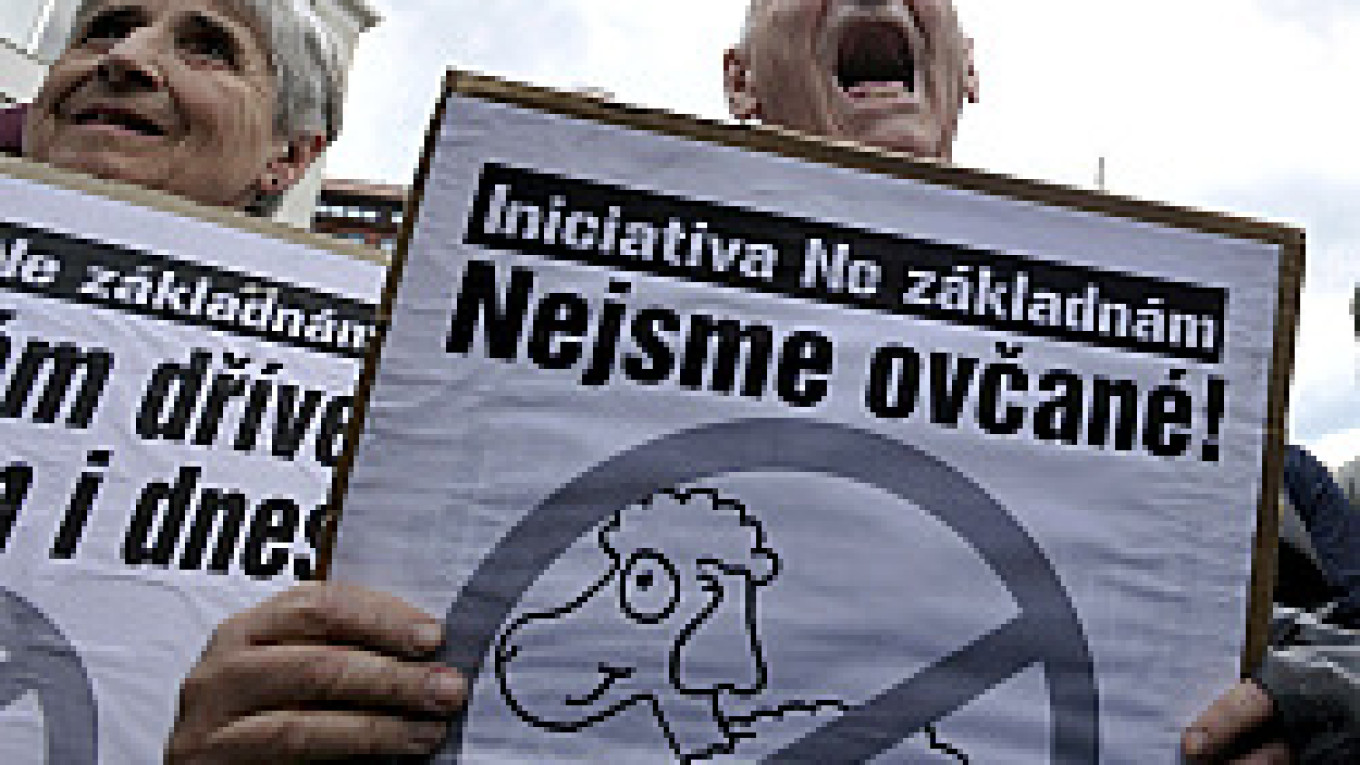
The missile systems, which the United States says are a defense against long-range weapons from the Middle East and especially Iran, are highly unpopular in both the Czech Republic and in Poland.
Russia, however, bitterly opposes the plan, calling it an affront to its sovereignty and a potential threat.
A senior Russian Foreign Ministry official said the U.S.-Czech deal complicates European security and cancels out consultations with Moscow on the missile shield. "A step has been taken ... which in our view has not added to security on the European continent," the unidentified official told Interfax. "More than that, it has complicated problems of security."
Federation Council Speaker Sergei Mironov said that by agreeing to host elements of the U.S. missile shield, "Eastern European leaders are taking responsibility for the destruction of the global strategic balance [and] for the sharp intensification of international military and political tension," Interfax reported.
Tuesday's signing in Prague isn't a guarantee that the United States will be able to build and operate a proposed radar base near the Czech capital. There are still open negotiations on a second treaty dealing with the legal status of U.S. soldiers to be deployed at the planned radar base. Even more difficult will be parliamentary approval for both documents.
About two-thirds of Czechs say they oppose the missile defense deal, according to a number of polls.
AP, Reuters, MT
A Message from The Moscow Times:
Dear readers,
We are facing unprecedented challenges. Russia's Prosecutor General's Office has designated The Moscow Times as an "undesirable" organization, criminalizing our work and putting our staff at risk of prosecution. This follows our earlier unjust labeling as a "foreign agent."
These actions are direct attempts to silence independent journalism in Russia. The authorities claim our work "discredits the decisions of the Russian leadership." We see things differently: we strive to provide accurate, unbiased reporting on Russia.
We, the journalists of The Moscow Times, refuse to be silenced. But to continue our work, we need your help.
Your support, no matter how small, makes a world of difference. If you can, please support us monthly starting from just $2. It's quick to set up, and every contribution makes a significant impact.
By supporting The Moscow Times, you're defending open, independent journalism in the face of repression. Thank you for standing with us.

Remind me later.