

The bombing is the first terrorist attack targeting civilians since Dmitry Medvedev assumed the presidency six months ago and the first to involve a female suicide bomber since the 2004 school attack in Beslan, which is also in North Ossetia.
No one claimed immediate responsibility for Thursday's blast. Security analysts said it bore the hallmarks of an attack by Chechen extremists.
Medvedev ordered the Federal Security Service and the Investigative Committee to carry out a thorough investigation, the Kremlin said.
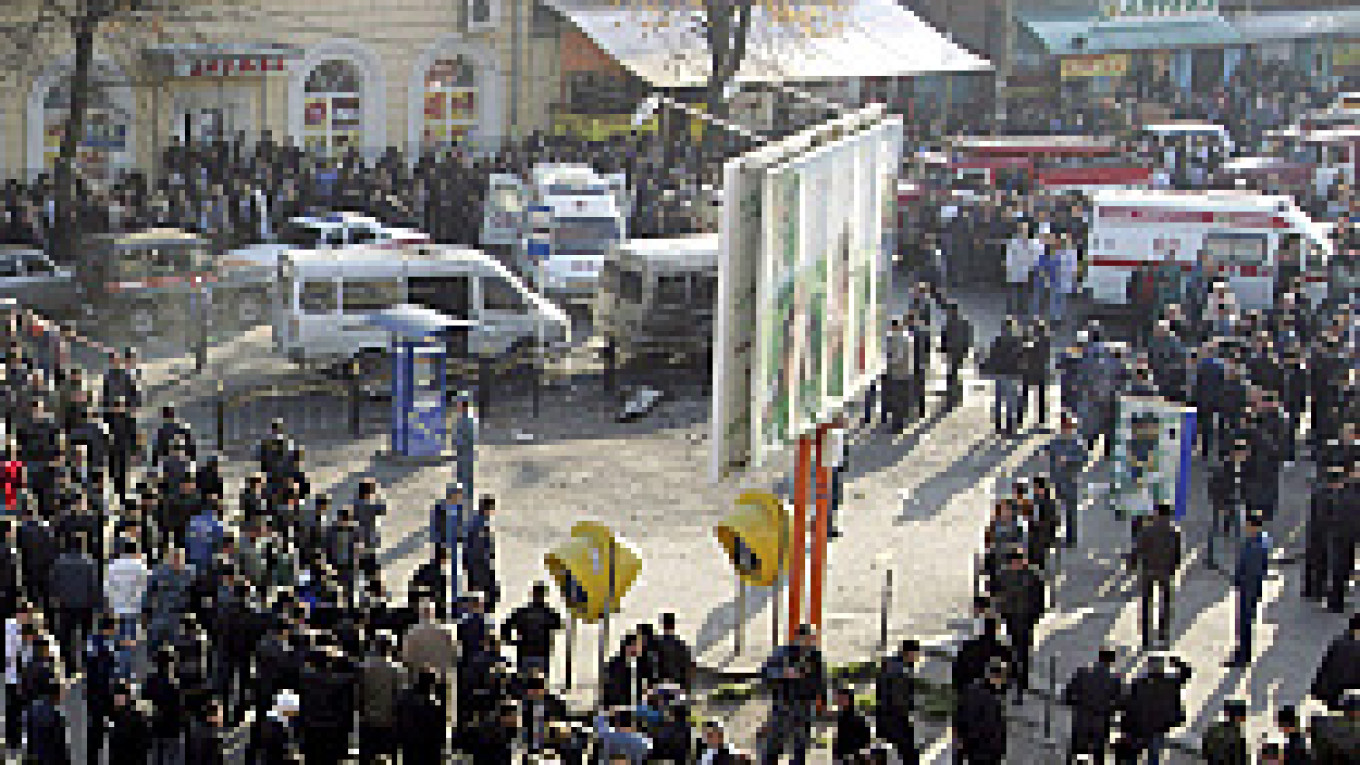
The suicide bomber blew herself up as passengers were getting out of a minibus near Vladikavkaz's main market at around 2:30 p.m., investigators said.
"The head of a woman, of the suspected suicide bomber, was found at the site of the explosion," North Ossetian leader Taimuraz Mamsurov said, Interfax reported.
Mamsurov said the dead included five women, four men and a 15-year-old girl.
Television footage showed two badly damaged white minibuses parked near a market pavilion and what appeared to be charred human remains beside them.
A senior local prosecutor, Chermen Zangiyev, said the bomb had exploded at waist level outside one of the minibuses and that it had contained the equivalent to at least 300 grams of dynamite.
"No doubt it was a terrorist attack because bomb parts were found at the site," Zangiyev told journalists in Vladikavkaz.
Prosecutor General Yury Chaika has taken the investigation into the blast under his personal control, his spokeswoman Marina Gridneva said.
North Ossetian authorities declared Saturday as a day of mourning.
Using female suicide bombers was one of the more horrific tactics developed by Chechen Islamic extremists during the second war in Chechnya. Nicknamed "black widows" by the media, they participated in the biggest terrorist attacks of the past decade, including the seizure of the Dubrovka Theater in Moscow in October 2002 and the downing of two passenger jets and a bombing outside a Moscow metro station in August 2004.
A group of female suicide bombers also participated in the most horrendous attack by Chechen extremists, the Sept. 1 to 3, 2004, seizure of the crowded school in Beslan.
"There is no panic here because people are used to such events by now," Ella Kesayeva, head of the Voice of Beslan group, said by telephone from Beslan. But "we feel fear for our families and bitterness because we know there will be no reaction from the authorities. There will only be tears and grief."
No suicide bombings occurred after Beslan until this August, a lull that security experts linked to the departure of foreign Islamic extremists from the Caucasus to other fronts in their global jihad, mainly Iraq and Afghanistan.
On Aug. 29, two men drove a truck loaded with explosives through the fence of an Interior Ministry base in Chechnya, killing one officer and wounding 11. A month later, a male suicide bomber tried to kill Ingush Interior Minister Musa Medov.
No extremist group had claimed responsibility for Thursday's blast by late evening on the Kavkaz Center rebel web site.
Still, judging by the tactics, the attack is likely to have been carried out by one of them, rather than being a new chapter in simmering rivalries between local clans, a typical problem in most southern republics, said Maxim Agarkov, an analyst with the SK-Strategia think tank.
Insurgents might be trying to revive a long-drawn conflict between Ossetians and the Ingush in neighboring Ingushetia over contested territory on the border between two republics, said Nikolai Silayev, an analyst with the Center of Caucasus Studies at the Moscow State Institute of Foreign Relations. Unlike the Ossetians, the Ingush people have a strong faction in rebel networks in the North Caucasus.
Staff Writer Maria Antonova contributed to this report.
A Message from The Moscow Times:
Dear readers,
We are facing unprecedented challenges. Russia's Prosecutor General's Office has designated The Moscow Times as an "undesirable" organization, criminalizing our work and putting our staff at risk of prosecution. This follows our earlier unjust labeling as a "foreign agent."
These actions are direct attempts to silence independent journalism in Russia. The authorities claim our work "discredits the decisions of the Russian leadership." We see things differently: we strive to provide accurate, unbiased reporting on Russia.
We, the journalists of The Moscow Times, refuse to be silenced. But to continue our work, we need your help.
Your support, no matter how small, makes a world of difference. If you can, please support us monthly starting from just $2. It's quick to set up, and every contribution makes a significant impact.
By supporting The Moscow Times, you're defending open, independent journalism in the face of repression. Thank you for standing with us.

Remind me later.