

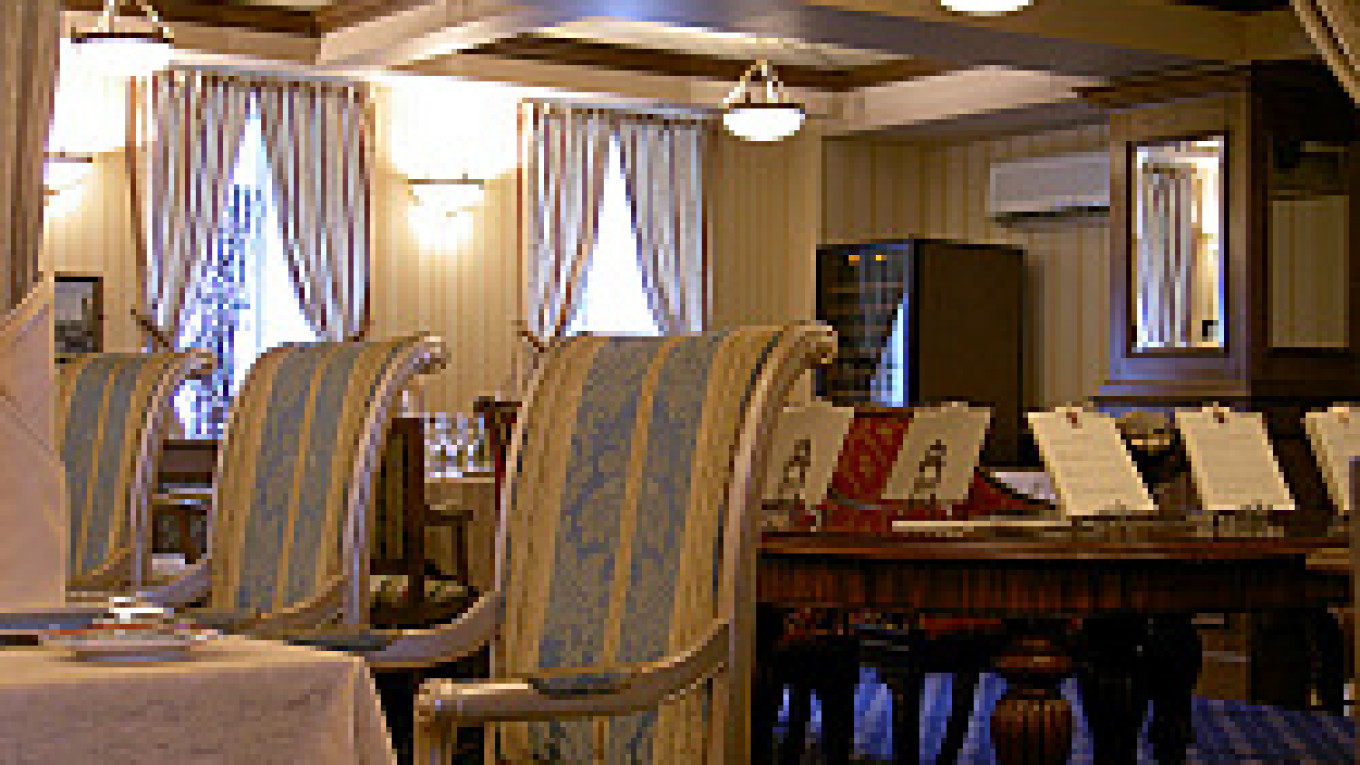
The smelt may be a humble guest on the menu, but SPB is definitely not a modest eatery. The restaurant, named after a common abbreviation for St. Petersburg, is designed in a thoroughly aristocratic style, as if to evoke the grandeur of the old imperial capital. Besides an over-the-top rococo interior with more gilding than the Hermitage, the restaurant is also enormous, with four floors and nine separate halls.
Besides the smelt (360 rubles), which come fried in a feather-light batter, SPB serves a mix of classical French and other European dishes, all, naturally, at hefty prices. Cold appetizers include iberico ham with goat cheese (830 rubles), mille-feuille with giant prawns (830 rubles), sturgeon and crayfish in aspic with fresh herbs made according to historical a recipe of Yekaterina Trubetskaya (1,970 rubles), and black caviar (3,180 rubles).
The smelt are the least expensive hot starter, while the most expensive is glazed goat cheese with foie gras, ginger syrup, artichoke and black truffle at 1,970 rubles. Soups start from 540 rubles for cold borshch with goat cheese or chicken consomme with duck liver, while the most expensive is the asparagus soup with Kamchatka crab and black caviar at 1,210 rubles. Mains start from 1,170 for grilled Atlantic salmon served on a bed of black rice, and meat mains start from 1,470 rubles for duck breast with duck liver served with black truffles and white beans.
Wine starts from 1,260 rubles a bottle or 350 rubles a glass, and if you want a draft beer to wash down your smelt, which are available until the end of June, you'll need 300 rubles for a half-liter of Baltika.
SPB: 17 Bolshoi Golovin Per., 609-6343, noon-midnight, M. Trubnaya.
A Message from The Moscow Times:
Dear readers,
We are facing unprecedented challenges. Russia's Prosecutor General's Office has designated The Moscow Times as an "undesirable" organization, criminalizing our work and putting our staff at risk of prosecution. This follows our earlier unjust labeling as a "foreign agent."
These actions are direct attempts to silence independent journalism in Russia. The authorities claim our work "discredits the decisions of the Russian leadership." We see things differently: we strive to provide accurate, unbiased reporting on Russia.
We, the journalists of The Moscow Times, refuse to be silenced. But to continue our work, we need your help.
Your support, no matter how small, makes a world of difference. If you can, please support us monthly starting from just $2. It's quick to set up, and every contribution makes a significant impact.
By supporting The Moscow Times, you're defending open, independent journalism in the face of repression. Thank you for standing with us.

Remind me later.