

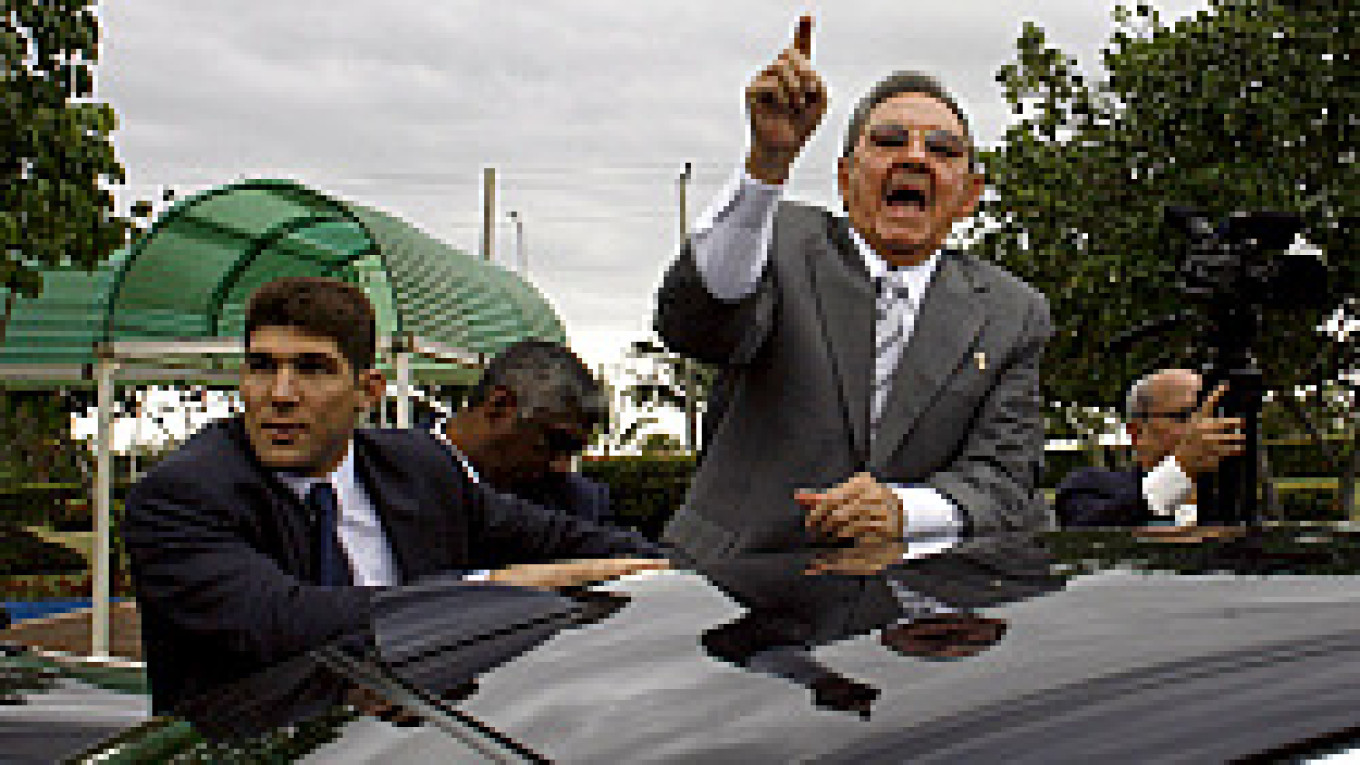
The Foreign Ministry and Cuban Embassy in Moscow said they still had no information about exactly what day Castro's visit would start. The visit will mark another milestone in the improvement of relations, which intensified sharply last year.
Cuba ranks negligibly low in Russian foreign trade, accounting for a mere 0.04 percent of Russian imports and exports, the Economic Development Ministry said in a statement handed out before Sechin's talks.
"Last year saw a search for new forms of interaction," Sechin said in his opening remarks. "I am sure ?€¦ we will be able to raise our relations to a new level."
The Soviet Union provided massive economic aid to Cuba after Fidel Castro came to power through a revolution that ended Jan. 1, 1959. A U.S. economic embargo of Cuba has been in effect since 1962.
Sechin congratulated the Cubans, seated across from him in a marble-floored negotiating room at a recently renovated government estate near the Kremlin, on the 50th anniversary of the revolution before they began the talks.
Sechin has visited Havana four times since he left the Kremlin, where he was deputy chief of staff, to take up his current job in May. He majored in Latin American studies in college and didn't make use of a translation device to listen to a return speech by the Cuban delegation leader, Deputy Prime Minister Ricardo Cabrisas. The Cuban said he hoped that bilateral ties would expand.
Russian exports to Cuba reached a mere $157 million in the first 11 months of last year, comprising mainly of cars, trucks, buses and parts for them, as well as equipment for nickel production. Imports of sugar, rum and medicine came to $82 million.
President Dmitry Medvedev visited Cuba in November. The Foreign Ministry's Cuba Department chief, Ruslan Zainutdinov, and Cuban Embassy spokespeople said they couldn't recall when Fidel Castro last visited Russia. An Internet search suggested that it was in 1972.
A Message from The Moscow Times:
Dear readers,
We are facing unprecedented challenges. Russia's Prosecutor General's Office has designated The Moscow Times as an "undesirable" organization, criminalizing our work and putting our staff at risk of prosecution. This follows our earlier unjust labeling as a "foreign agent."
These actions are direct attempts to silence independent journalism in Russia. The authorities claim our work "discredits the decisions of the Russian leadership." We see things differently: we strive to provide accurate, unbiased reporting on Russia.
We, the journalists of The Moscow Times, refuse to be silenced. But to continue our work, we need your help.
Your support, no matter how small, makes a world of difference. If you can, please support us monthly starting from just $2. It's quick to set up, and every contribution makes a significant impact.
By supporting The Moscow Times, you're defending open, independent journalism in the face of repression. Thank you for standing with us.

Remind me later.