

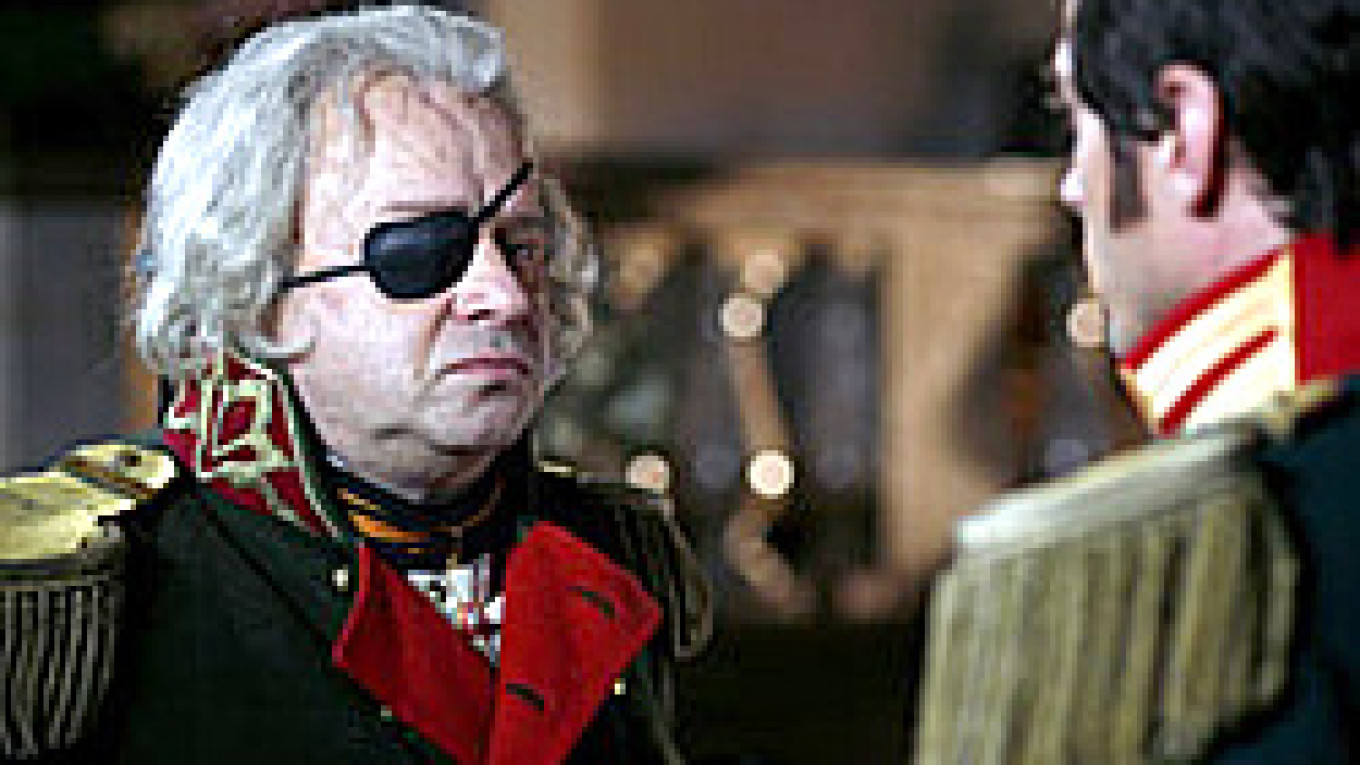
Frankly, I wasn't expecting much from a co-production of five countries that was scripted by Italians, then translated into stilted English, and finally dubbed with unnatural Russian. I anticipated that the dearth of Russian actors in the cast would result in stereotypical local color taken to silly extremes. I expected that the large-scale scenes wouldn't be up to Tolstoy's standards, and certainly nowhere near those in the monumental, Oscar-winning Soviet version of 1968 by Sergei Bondarchuk. I understood the necessity of shortcuts and omissions, even though the series is eight hours long. But I didn't expect that the result would be so abysmal.
Where to start? All the plot lines are scrambled. Natasha Rostova falls for Prince Andrei Bolkonsky the very moment she sets eyes on him -- which, a total impossibility in the world of Tolstoy's novel, is when he's accompanied by a pregnant wife. The wife, by the way, known as "the little princess" in the book, towers over the husband. Bolkonsky's sister, Princess Maria, is transformed from an ugly spinster into a standard Hollywood belle. His father isn't the most sympathetic character in the novel, to be sure, but he is certainly not the clown played by Malcolm MacDowell.
Anachronisms and historical mistakes in such movies are really not worth mentioning -- they are inevitable and ubiquitous. For example, according to the film, the Russian army of 1805 consisted of teenagers, just like today's Russian army, while in reality soldiers served for 25 years and, thus, many of them would be well into middle age. Aristocrats wear the type of garb which is perceived as "typically Russian" in the West but is never found in Russia.
I am not a huge fan of Tolstoy. I find his moralizing irritating, and his style rather heavy. But you can't escape the fact that "War and Peace" is one of the greatest books ever written. It's one of those books that every Russian reader returns to at different stages of his or her life, finding new depths with every new approach. Adaptations like this one trivialize that greatness. Nothing is left of the feeling of destiny, of Tolstoy's philosophy, of the intricate web of human interaction. The entertainment value of the film, as it happens, is minimal. Why should today's viewers care about a handful of exotic aristocrats from the early 19th century?
A Message from The Moscow Times:
Dear readers,
We are facing unprecedented challenges. Russia's Prosecutor General's Office has designated The Moscow Times as an "undesirable" organization, criminalizing our work and putting our staff at risk of prosecution. This follows our earlier unjust labeling as a "foreign agent."
These actions are direct attempts to silence independent journalism in Russia. The authorities claim our work "discredits the decisions of the Russian leadership." We see things differently: we strive to provide accurate, unbiased reporting on Russia.
We, the journalists of The Moscow Times, refuse to be silenced. But to continue our work, we need your help.
Your support, no matter how small, makes a world of difference. If you can, please support us monthly starting from just $2. It's quick to set up, and every contribution makes a significant impact.
By supporting The Moscow Times, you're defending open, independent journalism in the face of repression. Thank you for standing with us.

Remind me later.