

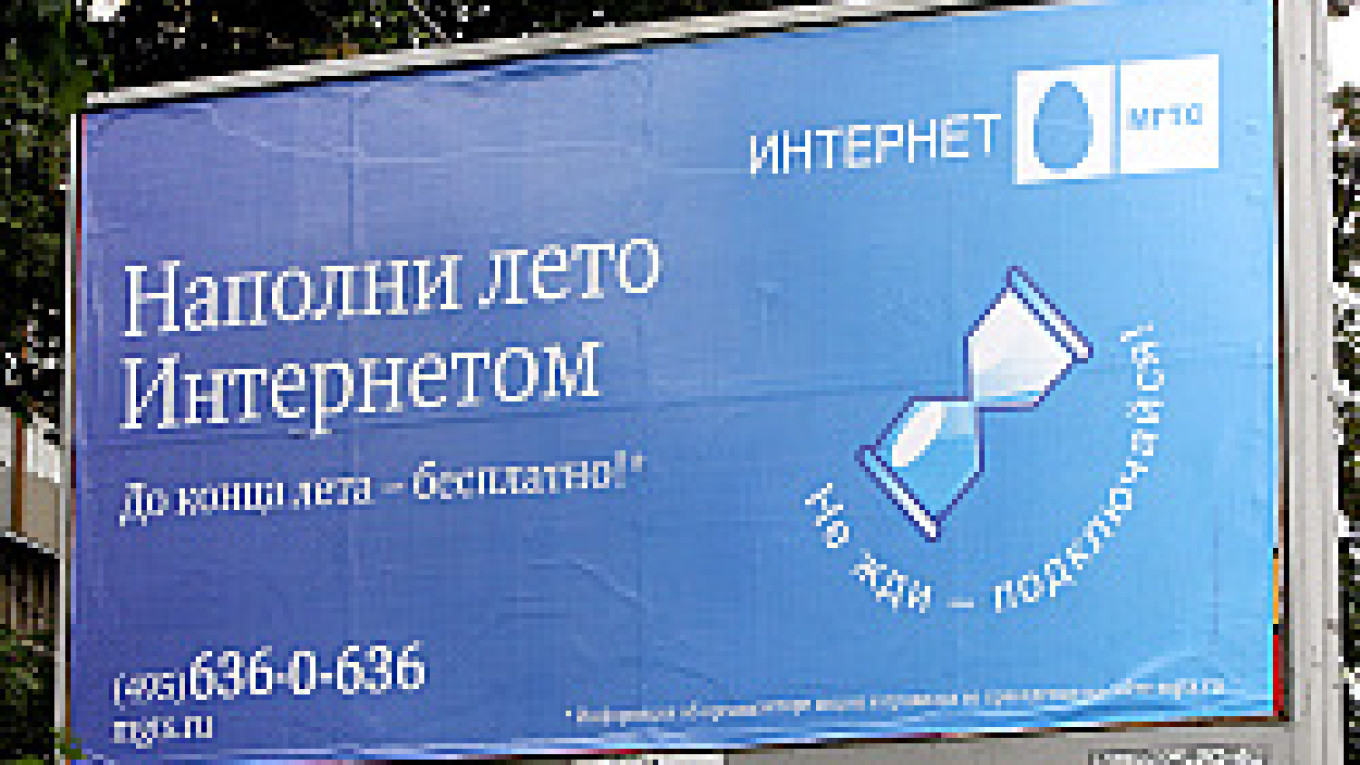
Foreign automakers now spend an average of 20 percent of their Russian ad budgets online, underscoring the huge preference media buyers now place on the Internet at the expense of traditional media, the report said.
Companies with considerable Internet ad budgets for Russia include Ford Motor, which plans to spend $4.6 million online this year, General Motors ($2 million), Peugeot Citro--n ($1.6 million) and Nissan ($1.5 million), according to MindShare.
Also among the country's big online spenders are the top three mobile operators -- Mobile TeleSystems, with $2.5 million, MegaFon ($2.3 million) and VimpelCom, $1.9 million. Samsung, Honda and Procter & Gamble all plan to spend from $1.1 million to $1.3 million on Russian Internet ads this year, the report said.
The number of Internet users in the country approached 37.7 million people this year, or 29 percent of the population, according to figures released by Public Opinion Foundation. Around 15.7 million, or 14 percent, go online daily.
Cheaper broadband access has led to an annual growth rate of 25 percent in the number of Internet users in the country, said Andrei Chernyshov, general director of the AdWatch advertising agency.
"Advertisers are attracted by the Internet because the medium offers instant feedback, and it is easier to monitor how users behave," he said.
"With the introduction of social networks such as Odnoklassniki and Vkontakte, the cost of advertising on the Internet has been halved," Chernyshov added.
The exponential growth in online advertising has cast a pall over more traditional media, which have seen ad revenues falling.
"With a new array of technical possibilities, the Internet in Russia would draw away media buyers from print publications," said Vladimir Yevstafiyev, vice president of Russian Association of Communication Agencies.
"But just as cinema and TV never destroyed the newspapers, newspapers and news magazines will continue to occupy a niche in the advertisement market."
Soon all mass media will have to rely heavily on online ads for their economic survival, Yevstafiyev said.
Since 2006, newspaper advertising volume grew just by 23 percent and advertising in periodicals by only 12 percent, according to the Russian Communications Agencies Association, which tracks the industry.
At the same time, spending for online advertising has surged 53 percent, to 2.7 billion rubles ($115 million) last year from 1.8 billion rubles in 2006.
While the country's newspapers are still learning to harness the potential of online advertising, the Internet ad market is not yet elastic enough to accommodate all players, analysts said.
"So far in Russia, most of the online ads are distributed among three major search portals -- Yandex, Rambler and Google, which recently acquired Begun," said Chernyshov, of AdWatch.
"Newspapers or news magazines so far have little space to maneuver in terms of using their portals as a platform for hosting context ads."
A Message from The Moscow Times:
Dear readers,
We are facing unprecedented challenges. Russia's Prosecutor General's Office has designated The Moscow Times as an "undesirable" organization, criminalizing our work and putting our staff at risk of prosecution. This follows our earlier unjust labeling as a "foreign agent."
These actions are direct attempts to silence independent journalism in Russia. The authorities claim our work "discredits the decisions of the Russian leadership." We see things differently: we strive to provide accurate, unbiased reporting on Russia.
We, the journalists of The Moscow Times, refuse to be silenced. But to continue our work, we need your help.
Your support, no matter how small, makes a world of difference. If you can, please support us monthly starting from just $2. It's quick to set up, and every contribution makes a significant impact.
By supporting The Moscow Times, you're defending open, independent journalism in the face of repression. Thank you for standing with us.

Remind me later.