

For many years, the Soviet Union was considered one of the most educated countries in the world. In 1991, the United Nations Educational, Scientific and Cultural Organization, or UNESCO, ranked higher education in the Soviet Union as the third best. But by 2007, Russia had dropped to 27th place.
We are witnessing an alarming trend in the country’s educational system over the past decade. Strangely enough, a lack of financing is not the largest contributing factor. Russia spends 3.8 percent of its gross domestic product on education — higher than the 3.6 percent of GDP spent in Japan (but less than the 5.7 percent spent in the United States and 4.6 percent allocated in Germany.)
More important, however, is the educational system’s inability to keep pace with the sharp rise of students enrolled in universities. As of Sept. 1, there were 7.47 million students enrolled in higher educational institutions, compared to only 2.79 million in the mid-1990s. That represents a 270 percent increase. Meanwhile, there are only 340,000 professors and instructors. This 22:1 professor-to-student ratio is significantly higher than in the United States. It is clear that Russia has far too few professors to teach the rising number of students. And as long as the salaries paid to faculty remains as low as they are, Russia will have trouble attracting the necessary number of new professors.
The other problem is the subjects that students are studying. In 2008, 35.7 percent of the country’s GDP came from manufacturing, natural resource mining, agriculture, construction and housing and utilities. But only 14 percent of today’s students will major in engineering, 3.2 percent in geology and 2.9 percent in agriculture science. At the same time, 45 percent of students will choose business, management and law as their major focus of study. The problem is that Russia’s financial and legal sectors account for only about 8 percent of GDP. Clearly, there are not enough jobs for all of these students dreaming of becoming wealthy — or even middle-class — bankers and lawyers.
Moreover, higher education has lost much of its value. In Moscow in 2007 and 2008, 10 percent of university graduates — 90 percent of them women — did not work at all after graduating, and another 24 percent took jobs that did not require a higher education. Fewer than 50 percent started careers in their area of study. The situation is the reverse in the United States, where 94 percent of graduates holding degrees in business administration found jobs in their profession, 86 percent of engineers did likewise, as did 76 percent of those specializing in agriculture. What’s more, the percentages were the same for the first three years after graduation. If these statistics apply to Moscow — where an excessively high percentage of the country’s business activity and wealth are concentrated — just imagine how worse the situation is in the regions.
Thus, Russia is churning out far more graduates than it needs, and they are trained in fields that are not in demand. With the current glut of students, the quality of the education they receive will inevitably suffer, and the significance of their degrees and titles will be diminished. According to the State Commission for Academic Degrees and Titles, the overall number of doctoral students more than doubled from 1996 to 2006. Of that number, the Central Federal District saw only a 70 percent increase in Ph.D.s, while the number of doctoral students in the Southern Federal District grew by almost 10 times. Today, that district produces more scholars than the Northwestern Federal District, which includes St. Petersburg.
Russia cannot modernize its economy without first modernizing its entire educational system — and its universities, in particular. Russia needs to move away from the goal of “higher education for the masses” and restructure the system to train specialists who can help the country gain a strategic global position in manufacturing and innovation-driven sectors. One place to start is for colleges and universities to make their admissions requirements stricter, which will lower the number of students admitted. This is the best way to move from high quantity to high quality.
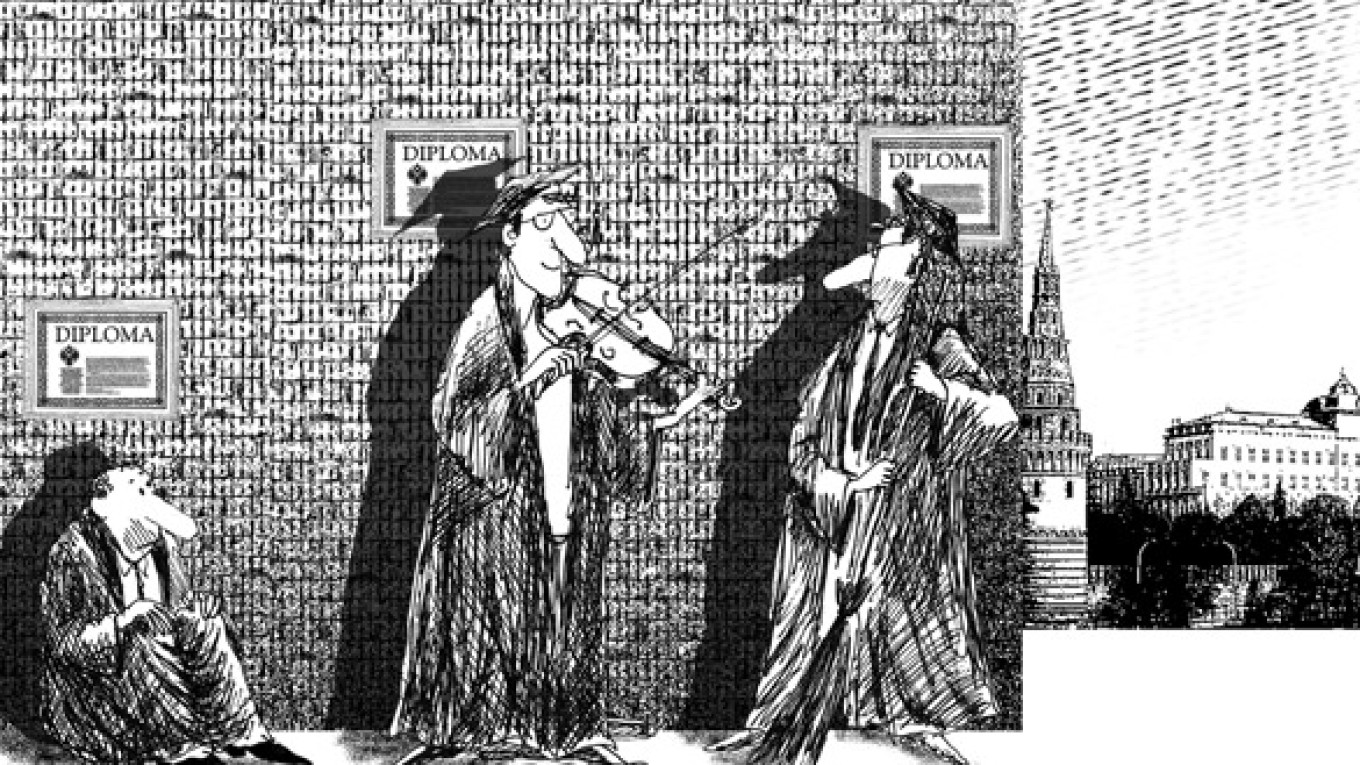
Russian universities need to once again become world-renowned centers of academic research and learning, and not socialist diploma mills for the masses.
Vladislav Inozemtsev, the director of the Centre for Post-Industrial Research, is the publisher and editor-in-chief of Svobodnaya Mysl magazine. This comment appeared in Vedomosti.
A Message from The Moscow Times:
Dear readers,
We are facing unprecedented challenges. Russia's Prosecutor General's Office has designated The Moscow Times as an "undesirable" organization, criminalizing our work and putting our staff at risk of prosecution. This follows our earlier unjust labeling as a "foreign agent."
These actions are direct attempts to silence independent journalism in Russia. The authorities claim our work "discredits the decisions of the Russian leadership." We see things differently: we strive to provide accurate, unbiased reporting on Russia.
We, the journalists of The Moscow Times, refuse to be silenced. But to continue our work, we need your help.
Your support, no matter how small, makes a world of difference. If you can, please support us monthly starting from just $2. It's quick to set up, and every contribution makes a significant impact.
By supporting The Moscow Times, you're defending open, independent journalism in the face of repression. Thank you for standing with us.

Remind me later.