

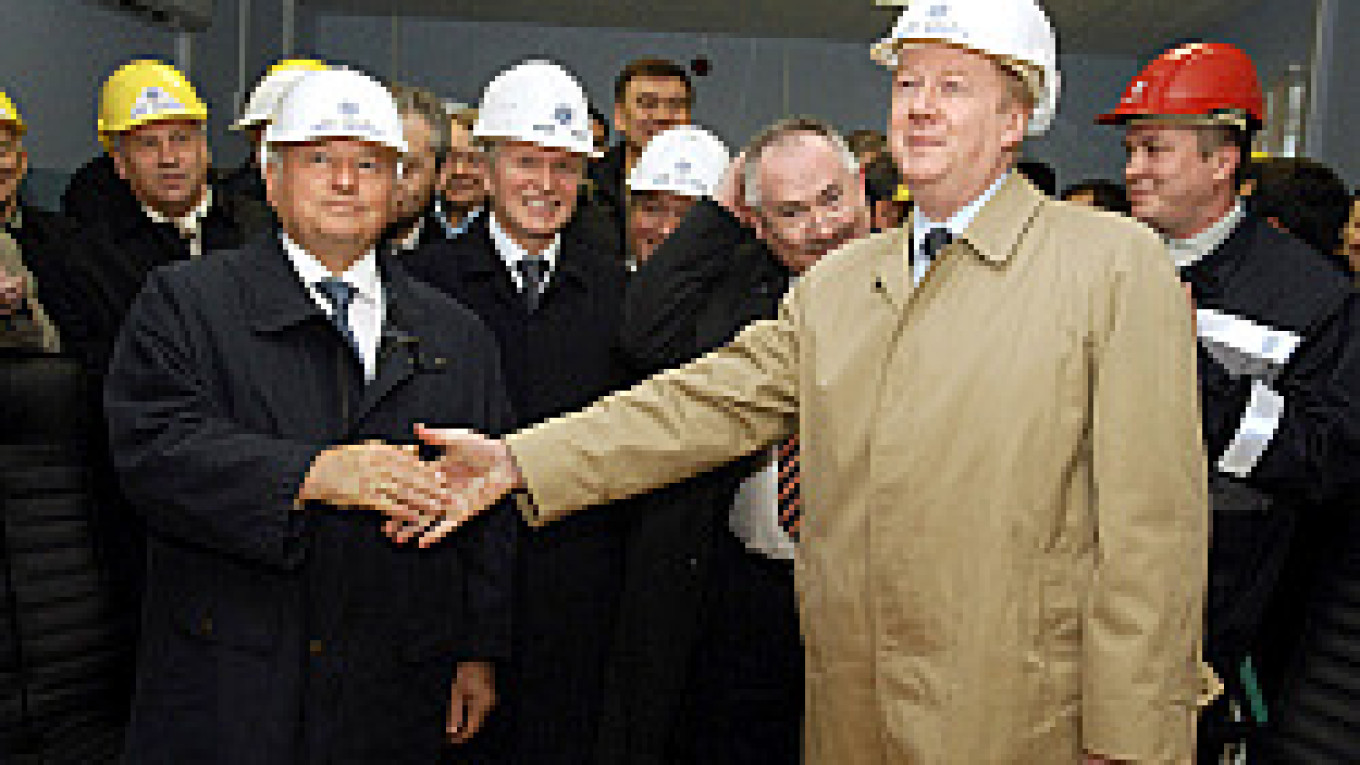
Chubais and Mayor Yury Luzhkov, a longtime political adversary, signed an amended version of the power grid's investment plan, under which 898 billion rubles ($39 billion) will be spent in the capital through 2010, up from the 2006 agreement between City Hall and UES to spend 430 billion rubles on upgrades and new infrastructure.
The signing took place at the opening of a 500-kilowatt Siemens-produced power unit at the Beskudnikovo transformer station on the northern outskirts of Moscow.
"The money will first of all come from the budgets of the companies controlling the networks," Chubais said. "Another part of the investment will be funded by tariffs and the fee for connection to the grid."
Fourteen major elements of the Moscow electricity distribution network will be financed by state-run VTB, the country's second-largest bank, Luzhkov said Saturday without elaborating.
VTB subsidiary VTB-Kapital Stolitsa said in July 2007 that it was planning to invest 30 billion rubles in Moscow electricity distribution through 2010.
The country's electricity network companies, united under the Federal Grid Company, will remain under state control after UES ceases to exist on July 1.
The agreement signed Saturday said transformer capacities would increase from 17,700 megawatts to 32,900 megawatts by 2010. It will also help provide for the capital's energy security, creating a reserve capacity of 1.5 megawatts to 2 megawatts by 2012, Luzhkov said.
The standoff between UES and City Hall first surfaced in 2001, when Luzhkov publicly attacked the power-sector reform undertaken by Chubais and resisted the ouster of then-Mosenergo chief Alexander Remezov, a Luzhkov ally.
Tensions hit a low during a major blackout in May 2005, which Luzhkov and then-President Vladimir Putin blamed on Chubais. After a fire at a substation, a rolling blackout saw as many as 2 million people in the capital plunged into darkness for several hours. It also closed metro lines and disrupted everything from the stock market to water supplies.
Luzhkov and Chubais were ultimately forced to work out their differences in January 2006, when bitterly cold weather threatened to send temperatures to minus 30 degrees Celsius.
Despite better relations lately, Luzhkov and Chubais couldn't help but using the seemingly neutral event Saturday to stir up old disputes.
"It is a great pity that, despite all common sense, the Moscow power stations have to supply the region," Luzhkov said, glaring at Chubais. The distribution network for the capital and the Moscow region was designed in the Soviet era.
Chubais fired back that it would be "unjust if it were not heat," adding that Moscow is the stations' primary heat consumer.
The dispute ended moments later, however, when a loud boom thundered through the station. Several reporters cried out in fright, but a smiling Chubais seemed at ease.
"Don't worry," a mechanic said, reassuring startled visitors. "That just means the transformer has been activated."
A Message from The Moscow Times:
Dear readers,
We are facing unprecedented challenges. Russia's Prosecutor General's Office has designated The Moscow Times as an "undesirable" organization, criminalizing our work and putting our staff at risk of prosecution. This follows our earlier unjust labeling as a "foreign agent."
These actions are direct attempts to silence independent journalism in Russia. The authorities claim our work "discredits the decisions of the Russian leadership." We see things differently: we strive to provide accurate, unbiased reporting on Russia.
We, the journalists of The Moscow Times, refuse to be silenced. But to continue our work, we need your help.
Your support, no matter how small, makes a world of difference. If you can, please support us monthly starting from just $2. It's quick to set up, and every contribution makes a significant impact.
By supporting The Moscow Times, you're defending open, independent journalism in the face of repression. Thank you for standing with us.

Remind me later.