

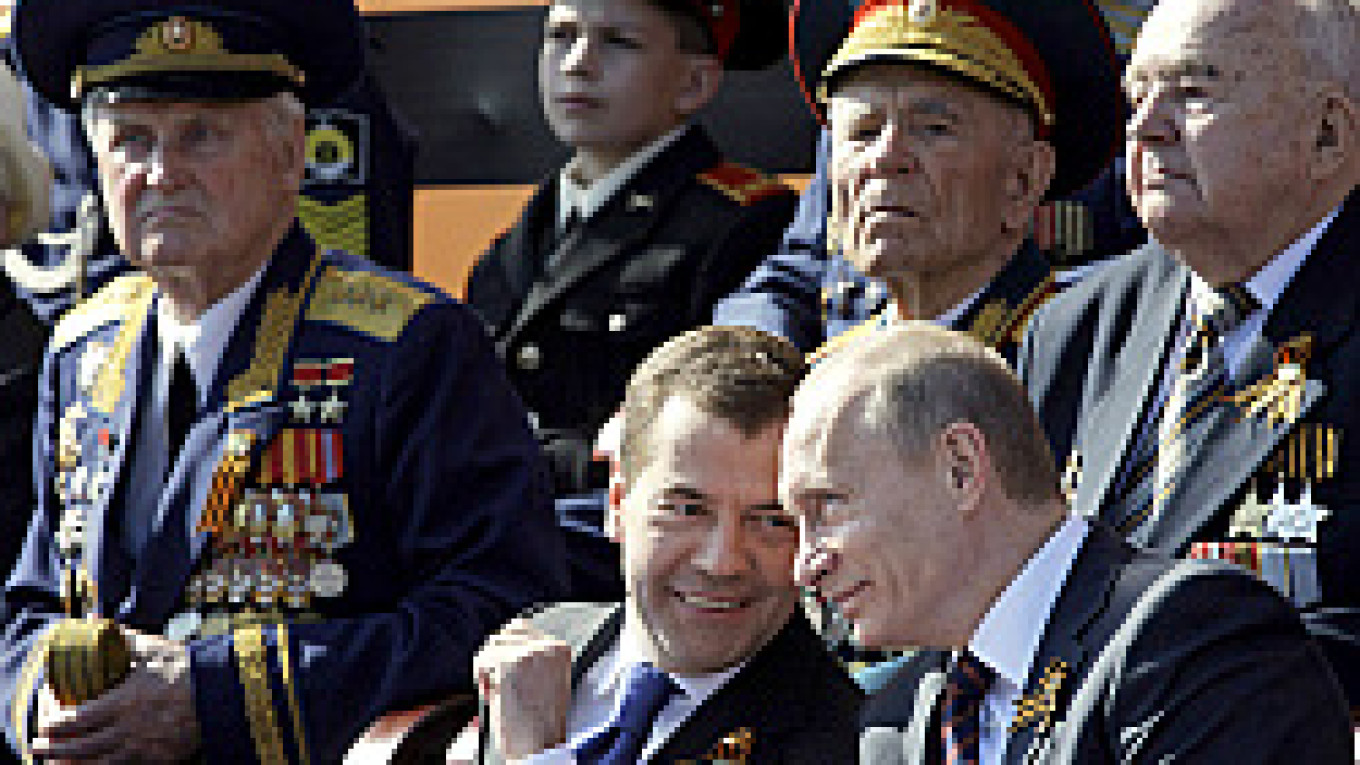
In his Victory Day address on Red Square on Saturday, Medvedev did not directly mention the five-day war with Georgia last August, but he clearly referred to it more than once.
"Russia's defense is our holy duty. ... Any aggression against our citizens will be rightfully repelled," he said.
Moscow has put the full blame for the war on Tbilisi, which had tried to retake the separatist region of South Ossetia, and Medvedev appeared to accuse Georgia of brinkmanship, saying: "Victory over fascism is a stark lesson to all peoples. It remains acute today, when again there are those who engage in military adventurism."
He also seemed to praise those who participated in the Georgia war by noting that the soldiers taking part in the Victory Day parade included "those who have proven the high capability of Russia's current military."
Saturday's parade with 9,000 troops and more than 100 combat vehicles was the biggest since the Soviet collapse.
The military showed off its Iskander rockets, which Medvedev has threatened to station in Kaliningrad in response to a planned U.S. missile defense shield in Central Europe, and the S-400 Triumf air-defense missiles that officials say are unrivaled in combat capability.
Scores of fighter jets, helicopter gunships and a giant An-124 cargo plane flew over Red Square, where Medvedev and the country's political and military leadership exchanged traditional congratulations for the day that marks the defeat of Nazi Germany and is the country's most important secular holiday.
Medvedev also sent congratulatory messages to the leaders of South Ossetia and Abkhazia, which Russia has recognized as independent, and to all the heads of former Soviet states except the Baltics and Georgia, the Kremlin said.
He told South Ossetian leader Eduard Kokoity that "our traditional support for each other stood the test of time and manifested itself again during the tragic events of August 2008, when we had to withstand together the aggression against South Ossetia."
While Georgian President Mikheil Saakashvili was notably absent from the list of recipients, Medvedev issued special congratulations to Georgian veterans, whom he told that loyalty to a common historical heritage could help mend ties damaged by the war. "The common fight against Nazi invaders is one of the most memorable and heroic pages in the multicentury book of Russian-Georgian friendship," Medvedev said.
Meanwhile, Prime Minister Vladimir Putin lashed out at NATO war games that started last week in Georgia, saying they put further strains on ties with the West instead of "resetting" them as initiated by the administration of U.S. President Barack Obama.
"So, why hold military exercises there which give such a clear signal of support to the ruling regime? We consider this is movement in the opposite direction," Putin said in an interview with Japanese media released Sunday.
Asked about Washington's efforts to reset relations with Moscow, Putin said the exercises are "a signal in the other direction."
NATO has said Russia was fully informed about the exercises, planned well before last summer's war.
But Putin also said there have been positive signals from Washington on disarmament efforts.
Both Foreign Minister Sergei Lavrov and the country's NATO envoy, Dmitry Rogozin, said Moscow was ready to go ahead with restoring ties with NATO.
Rogozin suggested that the recent expulsions of two Russians from Brussels and two alliance officials from Moscow, along with the NATO exercises, could be part of a plot to sabotage Obama's policy of improving relations.
"It is time to put a full stop in this story and restore relations as soon as possible," Rogozin said Friday.
Lavrov said after talks with Obama and Secretary of State Hillary Clinton on Thursday that "artificial obstacles" should be removed from the work of Russia and NATO. Obama will make his first visit to Russia on July 6 to 8, the Kremlin said Monday.
A Message from The Moscow Times:
Dear readers,
We are facing unprecedented challenges. Russia's Prosecutor General's Office has designated The Moscow Times as an "undesirable" organization, criminalizing our work and putting our staff at risk of prosecution. This follows our earlier unjust labeling as a "foreign agent."
These actions are direct attempts to silence independent journalism in Russia. The authorities claim our work "discredits the decisions of the Russian leadership." We see things differently: we strive to provide accurate, unbiased reporting on Russia.
We, the journalists of The Moscow Times, refuse to be silenced. But to continue our work, we need your help.
Your support, no matter how small, makes a world of difference. If you can, please support us monthly starting from just $2. It's quick to set up, and every contribution makes a significant impact.
By supporting The Moscow Times, you're defending open, independent journalism in the face of repression. Thank you for standing with us.

Remind me later.