

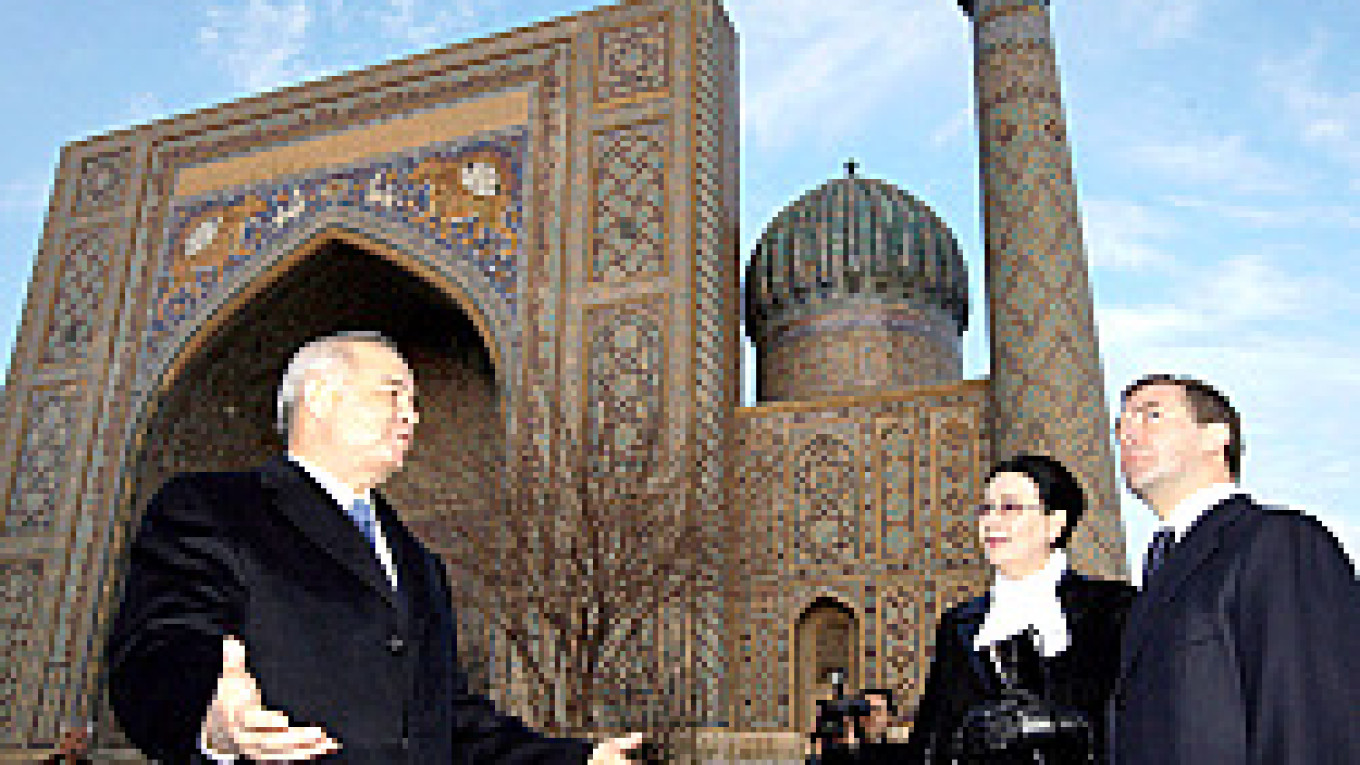
Karimov told President Dmitry Medvedev that Uzbekistan had offered to sell 16 billion cubic meters of gas to Russia this year and could double that amount within the next decade.
"We are ready to work with Russia on the construction of new pipelines that would enable us to boost exports and transit of gas," Karimov told reporters in the Uzbek capital Tashkent.
Uzbekistan has troubled Moscow by seeking better ties with the West. Analysts say Medvedev's visit is part of a push to reassert Russian influence in the region.
The European Union, alarmed by a two-week disruption in Russian gas supplies via Ukraine this month, wants Central Asia to feed its Nabucco pipeline project, which would bypass Russia. It would also use gas from the Caspian.
Karimov, however, said Uzbekistan was happy with a new price formula offered by Moscow and would back the new pipeline.
The two pipelines are not mutually exclusive, and Uzbekistan last year started work on another route to China.
Gazprom buys Central Asian gas and sells it on to Europe. Moscow wants to protect its control over these flows and relies on a steady supply of Uzbek, Turkmen and Kazakh natural gas.
Karimov said actual sales of Uzbek gas to Russia this year would be lower than the 16 billion cubic meters offered because of technical limitations.
But he said Uzbekistan could export twice as much in the future once LUKoil starts producing 16 billion cubic meters of gas per year there by 2015.
Karimov, who withdrew Uzbekistan from a Moscow-led regional economic cooperation group, assured Medvedev that he saw the Kremlin as the key player in Central Asia.
"Russia is a country which has always been present in this region and a country which has defined politics and the balance of forces here," he said.
He also took Medvedev on a tour of the ancient city of Samarkand, in central Uzbekistan, where they visited a bazaar, carpet weaving shop and mosque.
Uzbekistan became Moscow's closest ally in the region after the West imposed sanctions in 2005 in response to a security crackdown in the Uzbek town of Andijan.
The Uzbek authorities said they were putting down an uprising by armed militant Islamists, but witnesses said many of the victims were unarmed civilians.
Tashkent, which denied civilian deaths, evicted a U.S. military air base. But after some sanctions were lifted, U.S. troops were allowed to use another Uzbek air base.
A Message from The Moscow Times:
Dear readers,
We are facing unprecedented challenges. Russia's Prosecutor General's Office has designated The Moscow Times as an "undesirable" organization, criminalizing our work and putting our staff at risk of prosecution. This follows our earlier unjust labeling as a "foreign agent."
These actions are direct attempts to silence independent journalism in Russia. The authorities claim our work "discredits the decisions of the Russian leadership." We see things differently: we strive to provide accurate, unbiased reporting on Russia.
We, the journalists of The Moscow Times, refuse to be silenced. But to continue our work, we need your help.
Your support, no matter how small, makes a world of difference. If you can, please support us monthly starting from just $2. It's quick to set up, and every contribution makes a significant impact.
By supporting The Moscow Times, you're defending open, independent journalism in the face of repression. Thank you for standing with us.

Remind me later.