

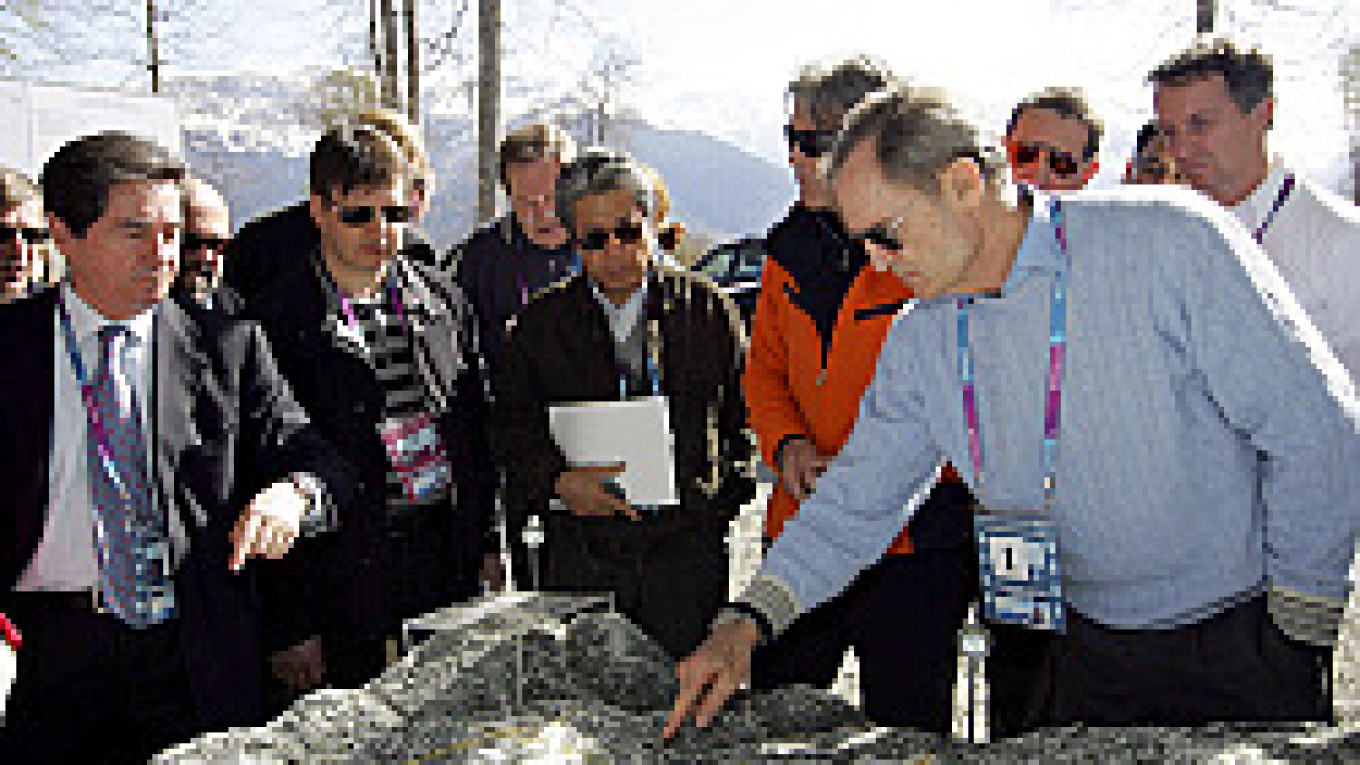
"It's a special situation and we will have to do a lot," Jean-Claude Killy, chairman of the IOC's coordination committee for the games, said during a meeting with Prime Minister Viktor Zubkov and other government officials responsible for the Olympic preparations.
Killy, a French Alpine skiing legend, made his comments after touring some of the prospective construction sites in Sochi and Krasnaya Polyana, the planned main ski venue near the city, earlier Tuesday with a delegation of 13 other IOC members.
Sochi suffers from an almost complete lack of Olympic-class facilities, and their construction will largely have to start from scratch. Some 200 facilities, including roads and electricity lines, need to be built, an effort that will require at least $12 billion in investment.
Semyon Vainshtok, the head of the Olimpstroi state corporation responsible for preparing Sochi for the games, resigned abruptly Thursday, amid accusations of mismanagement and cost overruns.
Vainshtok's departure, just seven months after being appointed to the job, came after months of criticism from lawmakers and state officials over ballooning costs as real estate prices in Sochi have soared.
But Killy said Tuesday that he was impressed by the preparations so far and was "absolutely sure" that Russia and the IOC would succeed in organizing the Olympics.
In a report on the IOC visit, Channel One television's evening newscast showed a motorcade of black sport utility vehicles raising dust as they sped along a winding road on their visit to the Krasnaya Polyana resort. Zubkov joined the IOC delegation for part of their reconnaissance mission, the channel said.
Sergei Grigoryev, a spokesman for the Olimpstroi corporation, said IOC commission members were shown sites in Sochi and nearby Krasnaya Polyana, where developers plan to build an Olympic village and skiing routes. They were also shown designs for future facilities and an existing ski resort built by Gazprom, he said.
The commission was also scheduled to receive a progress report on upgrading the Sochi airport, the Sochi 2014 Organizing Committee said in a statement on its web site.
IOC officials are to give their impressions of their visit at a news conference Wednesday.
The IOC visit is the first since Sochi was picked to host the 2014 games at an IOC meeting last July in Guatemala, where President Vladimir Putin lobbied hard for Sochi's bid and promised that the government would invest heavily in the area's infrastructure.
The IOC delegation will visit next in 2009.
When Vainshtok resigned last Thursday, government officials said the change in command had been planned in advance and would not affect the pace of preparations.
But a flurry of subsequent media reports suggested that Vainshtok had quit because he realized the task was too unwieldy.
"It is very difficult to make Sochi an Olympic city," an unidentified official said, RIA-Novosti reported. "There are many infrastructure limitations -- no electricity, no roads, no way to get cargoes there needed for building."
The new chief of Olimpstroi, former Sochi mayor Viktor Kolodyazhny, said Tuesday that he wasn't going to reshuffle his staff.
"Why would I do that?" Kolodyazhny said. "It's professionals that work there. They suit me."
The corporation has already started designing a bobsled run for the Olympics and aims to complete the work next January, he said.
The bobsled route and some other planned facilities for the Olympics would run through a nature reserve, which has angered environmentalists, including Greenpeace and the World Wildlife Fund.
A Message from The Moscow Times:
Dear readers,
We are facing unprecedented challenges. Russia's Prosecutor General's Office has designated The Moscow Times as an "undesirable" organization, criminalizing our work and putting our staff at risk of prosecution. This follows our earlier unjust labeling as a "foreign agent."
These actions are direct attempts to silence independent journalism in Russia. The authorities claim our work "discredits the decisions of the Russian leadership." We see things differently: we strive to provide accurate, unbiased reporting on Russia.
We, the journalists of The Moscow Times, refuse to be silenced. But to continue our work, we need your help.
Your support, no matter how small, makes a world of difference. If you can, please support us monthly starting from just $2. It's quick to set up, and every contribution makes a significant impact.
By supporting The Moscow Times, you're defending open, independent journalism in the face of repression. Thank you for standing with us.

Remind me later.