

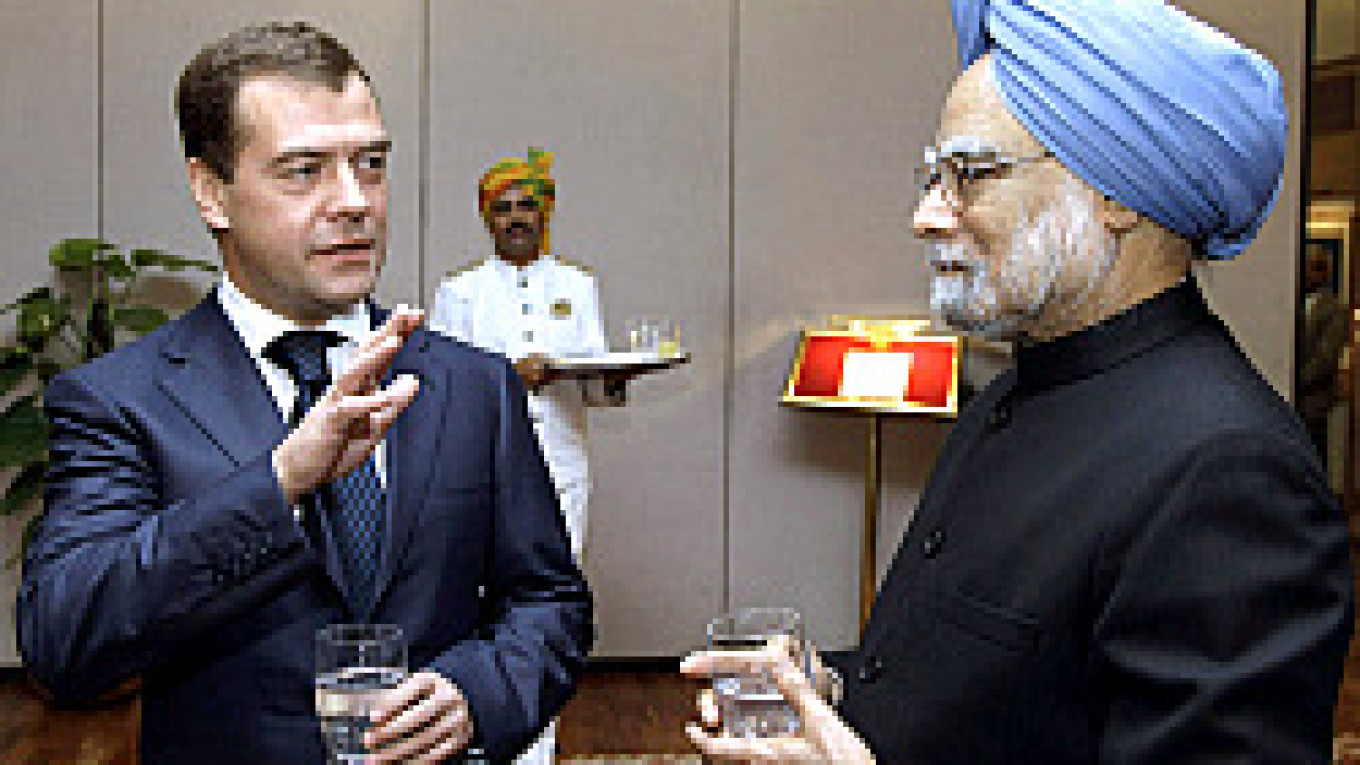
Medvedev, talking to Indian television before the visit to India, also said Moscow stood ready to help with the investigation of militant attacks in Mumbai that killed 171 people and with broader questions on fighting terrorism.
"We are prepared for cooperation on all fronts with the aim of preventing such terrorist attacks, in the investigation of the recent terrorist attack and the creation of a global defense system against terrorism in the world," Medvedev said.
He spoke of deepening defense industry ties, which reached their high during the Soviet era.
"We are talking also about cooperation in the sphere of leasing atomic submarines," Medvedev said.
A spokesman for India's defense ministry declined immediate comment.
Russia is one of the world's major arms exporters. It has a fleet of nuclear-powered but conventionally armed submarines besides its strategic nuclear-armed vessels, which are not sold abroad.
Trade between India and Russia -- who are now among the world's biggest emerging market economies -- is set to rise to $7 billion this year from $5 billion in 2007, Medvedev said.
He said Russia and India's growing economic and strategic clout meant that the world needed to take them into account and that they could boost cooperation along with China and Brazil as part of the BRIC grouping.
"Today, we cannot even imagine that any of the most important global problems would be considered, for example, without Russia or India," he said.
Indian media have reported that New Delhi was interested in leasing nuclear submarines including the Nerpa, the scene of an accident last month in the Sea of Japan in which 20 people were killed. The Russian military denied reports that the submarine was to be leased to India.
Medvedev said the accident aboard the Nerpa was probably caused by human error and that any worries about the safety of Russian submarines were misplaced.
India, along with China, is one of Russia's biggest clients for arms sales, but New Delhi has been upset by delays in the delivery of an aircraft carrier.
Moscow has delayed the delivery of the carrier to 2012 and pushed up the price. Medvedev said both sides needed to agree on the final outline for the refitting of the Admiral Gorshkov.
The two countries are also expected to sign a nuclear cooperation agreement Friday, said Anil Kakodkar, chairman of India's Atomic Energy Commission.
The agreement will allow state-owned Rosatom to compete for supplier contracts in India, which plans to add 40,000 megawatts of nuclear capacity by 2020.
India needs nuclear technology and fuel to add electricity-generating capacity and help cut peak power shortages that may widen to 18.1 percent in the year to March as demand outstrips supply.
Russia agreed in January 2007 to help India in the construction of four energy blocks at the atomic plant in Kudankulam and nuclear power plants at new sites in India.
(Reuters, Bloomberg)
A Message from The Moscow Times:
Dear readers,
We are facing unprecedented challenges. Russia's Prosecutor General's Office has designated The Moscow Times as an "undesirable" organization, criminalizing our work and putting our staff at risk of prosecution. This follows our earlier unjust labeling as a "foreign agent."
These actions are direct attempts to silence independent journalism in Russia. The authorities claim our work "discredits the decisions of the Russian leadership." We see things differently: we strive to provide accurate, unbiased reporting on Russia.
We, the journalists of The Moscow Times, refuse to be silenced. But to continue our work, we need your help.
Your support, no matter how small, makes a world of difference. If you can, please support us monthly starting from just $2. It's quick to set up, and every contribution makes a significant impact.
By supporting The Moscow Times, you're defending open, independent journalism in the face of repression. Thank you for standing with us.

Remind me later.