

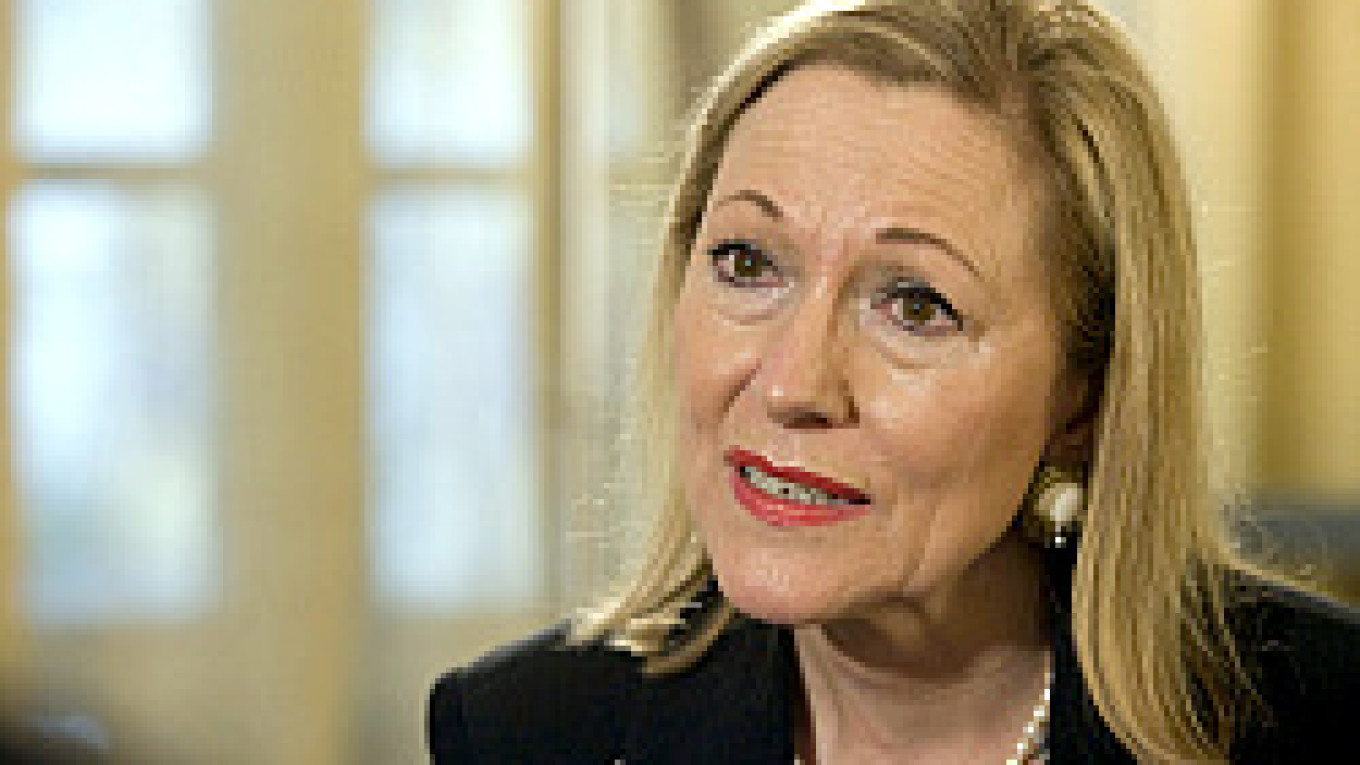
"The EU is concerned that recent Russian moves in Georgia in particular might threaten to undermine stability on Russia's southern border, particularly relevant with the Sochi Olympics on the horizon," External Relations Commissioner Benita Ferrero-Waldner told State Duma deputies. "Greater instability in the region is clearly not in our mutual interest," she added, according to a transcript of her speech.
The unusually strong warning echoes remarks made by Georgian officials and carried in the national media that the unsolved conflict threatened to disrupt the Winter Games. Sochi is only a few kilometers away from the border with Abkhazia, which broke away from Georgia after a bloody conflict in 1993.
Ferrero-Waldner said the EU continued its approach based on full respect for Georgia's territorial integrity but that confidence-building measures should be conducted together with Russia.
"It is important to listen to the Georgians, and it is important to listen to the Russians and then in particular the Georgians must have a real dialogue with the Abkhazians," Ferrero-Waldner told reporters at a briefing before returning to Brussels late Wednesday.
Georgian and Abkhaz officials have warned of renewed risk of war after a series of incidents including the shooting-down of an unmanned Georgian spy plane, which the UN has said was carried out by a Russian fighter jet.
The recent crisis has triggered a flurry of diplomatic activity by the United States and Europe. The EU's Foreign Policy chief Javier Solana is expected for talks in Tbilisi on Thursday and will also meet Abkhaz officials in the regional capital, Sukhumi.
Ferrero Waldner also met Foreign Minister Sergei Lavrov for talks over a new cooperation agreement between Moscow and Brussels, negotiations for which are to start after a EU-Russia summit later this month.
A Message from The Moscow Times:
Dear readers,
We are facing unprecedented challenges. Russia's Prosecutor General's Office has designated The Moscow Times as an "undesirable" organization, criminalizing our work and putting our staff at risk of prosecution. This follows our earlier unjust labeling as a "foreign agent."
These actions are direct attempts to silence independent journalism in Russia. The authorities claim our work "discredits the decisions of the Russian leadership." We see things differently: we strive to provide accurate, unbiased reporting on Russia.
We, the journalists of The Moscow Times, refuse to be silenced. But to continue our work, we need your help.
Your support, no matter how small, makes a world of difference. If you can, please support us monthly starting from just $2. It's quick to set up, and every contribution makes a significant impact.
By supporting The Moscow Times, you're defending open, independent journalism in the face of repression. Thank you for standing with us.

Remind me later.