

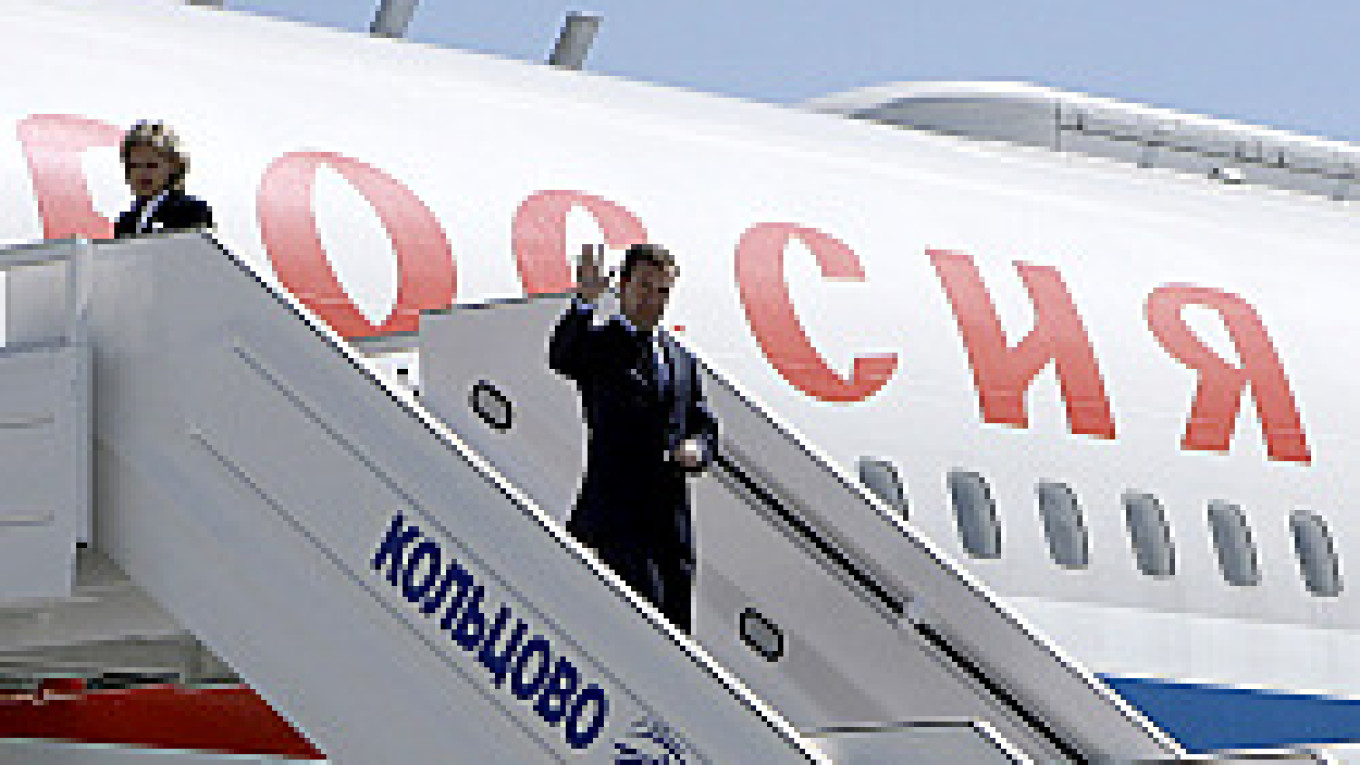
The one-day gathering in Yekaterinburg will be the first individual summit of the four largest emerging economies, known collectively as BRIC.
Medvedev, Brazilian President Luiz Inacio Lula da Silva, Chinese President Hu Jintao and Indian Prime Minister Manmohan Singh will look at the "prospects for dialogue between the Group of Eight and its traditional partners on the reform of international financial institutions," the Kremlin said in a statement Monday.
Sergei Prikhodko, the Kremlin's top foreign policy aide, said Sunday that reforming the international financial order would be most prominent on the agenda. Prospects for a new reserve currency to compete with the dollar will not be discussed, he said.
The BRIC countries want more say in the International Monetary Fund, where they cumulatively hold 9.7 percent of the votes despite accounting for 15 percent of the global economy. The IMF, in which the United States enjoys virtual veto power, has scheduled a revision of voting rights for 2011.
China, Russia and Brazil recently said they would buy $70 billion worth of IMF bonds, which many economists saw as a step to increase their profile on the international financial scene. India may announce a similar move Tuesday, said Jan Randolph, head of sovereign risk analysis at IHS Global Insight in London.
"Buying the IMF bonds is a clear signal that they are putting money down to buy influence, essentially," he said by telephone.
The countries also share gripes about the dominance of the dollar and some of the global trade and investment rules, Randolph said. While they can do little to change the current world order, they can increase trade among themselves. As big commodity exporters, Russia and Brazil complement the hefty resource needs of China and India, he said.
"I think it's ... an opportunity for them to explore what they have in common and how they deal with each other. It's not always immediately obvious, except they do have similar frustrations with the world order," he said.
The Kremlin said the leaders would also discuss ways to combat the economic crisis and international policy issues, such as regional conflicts and terrorism. They will also exchange opinions on energy and food security.
But the four countries may find that they have as many differences as they have things in common.
"I don't expect any big breakthroughs," said professor Maxim Bratersky, director of the world politics department at the Higher School of Economics. "They are very diverse countries. There will be problems, and they will be big."
Brazil stands out for having the strongest economic dependency on the United States, he said, while India and China vie for influence in Asia. Russia -- perhaps unfairly -- is suspicious of a bustling China near its sparsely populated Far East, he said. Moscow and Beijing also compete for influence in Central Asia, he said.
In a sign of their particularly busy relationship, Prime Minister Vladimir Putin and Hu will meet in Moscow on Wednesday.
A Message from The Moscow Times:
Dear readers,
We are facing unprecedented challenges. Russia's Prosecutor General's Office has designated The Moscow Times as an "undesirable" organization, criminalizing our work and putting our staff at risk of prosecution. This follows our earlier unjust labeling as a "foreign agent."
These actions are direct attempts to silence independent journalism in Russia. The authorities claim our work "discredits the decisions of the Russian leadership." We see things differently: we strive to provide accurate, unbiased reporting on Russia.
We, the journalists of The Moscow Times, refuse to be silenced. But to continue our work, we need your help.
Your support, no matter how small, makes a world of difference. If you can, please support us monthly starting from just $2. It's quick to set up, and every contribution makes a significant impact.
By supporting The Moscow Times, you're defending open, independent journalism in the face of repression. Thank you for standing with us.

Remind me later.