

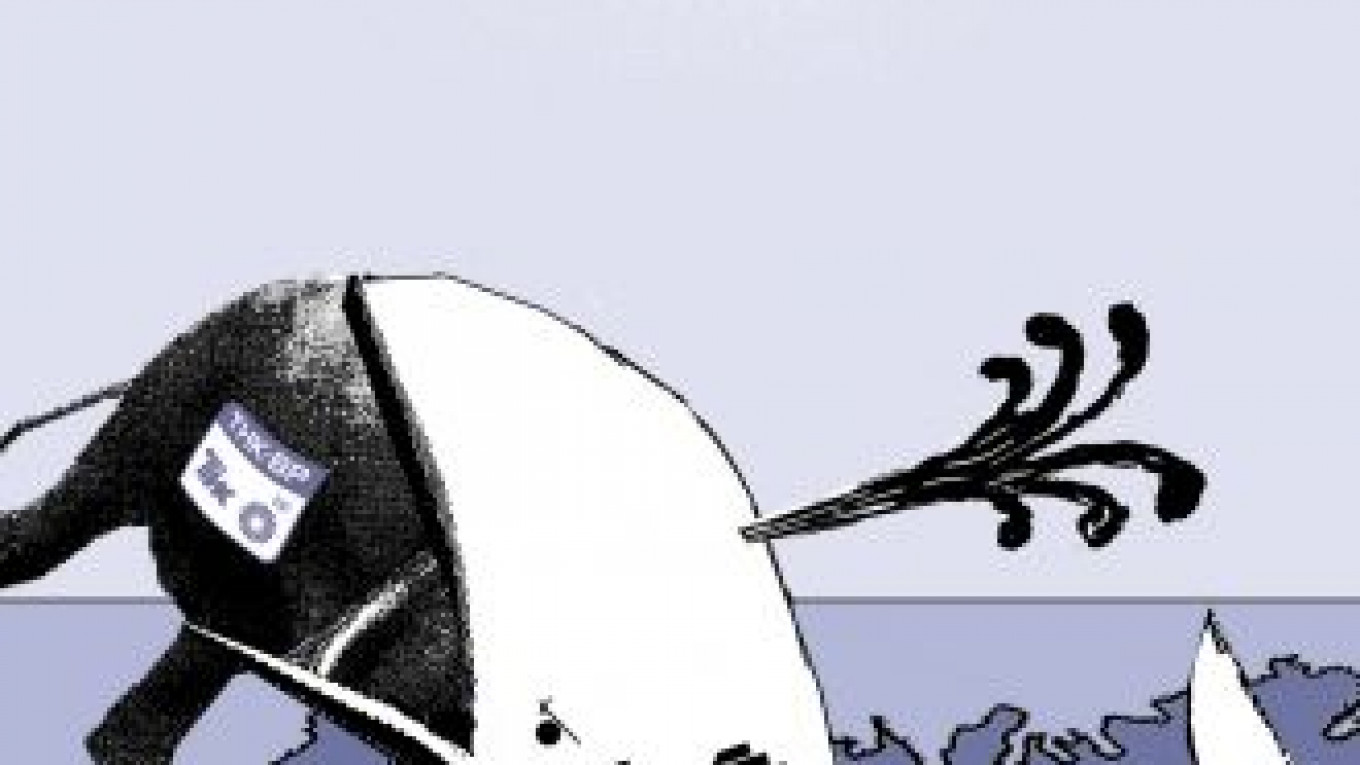
Rosneft confirmed on Monday that it will acquire full control of TNK-BP in separate deals concluded with international oil major BP and AAR, the investment vehicle owned by several Russian billionaires. The total cost to Rosneft will be close to $60 billion. The size of the deal ranks it as the third-largest ever done in the history of the global oil industry and is consistent with Russia's "size-matters" mentality. The deal is great for the Kremlin as it promotes Rosneft and its management into the big league of major oil producers. It also comes as a relief for the embattled BP management and is Christmas come early for the billionaire owners of AAR.
It would seem that everyone is a winner in the deal. But thousands of investors in Rosneft, BP and Russia have reason to question this. While the deal is undoubtedly great for the politicians, billionaires and the oil men, it is much less obviously so for common investors. Instead of following the promised path of divesting assets and pulling back from direct participation in the economy, the Kremlin is instead creating yet another huge state corporation to dominate one of the country's strategic industries. Given the past performance, reputation and investment return from other big state-controlled enterprises such as Gazprom, the Rosneft purchase certainly gives many reasons to be concerned.
For the Kremlin, though, this is a good deal for four key reasons. First it means that the target set for raising privatization revenues for 2012 is achieved. BP has agreed to use $4.8 billion of the cash it will receive from Rosneft to buy additional shares directly from the state. That, along with the $5.2 billion recently received from the sale of Sberbank shares, brings the total for the year to $10 billion.
Second, BP, previously one of the biggest investors in the country, stays in Russia. Most important, BP, it can be assumed, will now be the partner of choice, if not the exclusive partner, for Rosneft in future new projects. In addition, BP can account for a 20 percent share of Rosneft's new total oil production, or 1 million barrels per day, and will receive a dividend from Rosneft shares. If BP had walked away, even with a handsome profit, it would have sent a negative signal to other potential investors at a time when the country needs to bring many more in.
Third, the deal takes AAR out of the oil industry and ends the threat of even more bad press about the risks of doing business in Russia.
Fourth, the deal gives much greater visibility to the Kremlin's position as the world's most important energy player. Russia is the biggest gas exporter, has been the world's largest oil producer for some time, and alternates with Saudi Arabia as the largest exporter of oil and oil products. The emergence of Rosneft makes that leading position much clearer and does no harm to the Kremlin's geopolitical ambitions.
For the management in Rosneft and BP, the deal is also good. Rosneft acquires in-house expertise in technology and has effectively established the mechanism by which it may eventually become more globally diversified. For BP management, the deal ends a long period when the frequent disputes with AAR have pressured the share price and, along with the consequences of the Gulf of Mexico disaster, called into question the company's future independence. Exchanging their Russian corporate "poison pill" for cash only might easily have left BP vulnerable to predators. AAR will walk away with $28 billion, which speaks for itself as to how they come out ahead in the deal.
But what do investors of the respective oil companies and in Russia in general get out of the deal? The answers are much less obvious. BP investors are giving up a steady dividend stream and a predicable oil flow for a potentially more lucrative future. At the same time, though, they will have less medium term cash flow and a lot of uncertainty. Of course, it can be argued that the deal was inevitable once it became clear that BP's relationship with AAR had irrevocably broken down. Also, realistically the only way that the company can get access to future major production growth — anywhere on the planet ?€” is alongside a Russian state-controlled company.
Investors in Rosneft now need to worry more about the oil price because of the huge increase in the company's debt as a result of the deal. Officials in the Finance Ministry are in a similar position as there is now a much bigger chunk of debt interest to be paid ahead of the ministry's corporation tax calculation.
The main concern about the deal, however, is that it means that the state will have an even bigger role in the country's key industry at a time when the pre-election talk was all about the state's divestment and the encouragement of a greater private enterprise role in the economy. In the past, state-controlled enterprises have been among the least efficient in the economy. The pessimists will focus on the inefficiency factor as evidence that we should expect little reform and that the economy will remain in a status quo regime until we reach the next crisis.
Yet there still may be hope to be optimistic for a broader dividend. First, there may be a positive contagion to Rosneft from the BP integration. We have seen that happen already in the auto sector with the Renault-AvtoVAZ partnership. If it also occurs in the oil sector, Rosneft will emerge as a global oil champion, and investors will do very well.
Second, although there is no doubt that the Kremlin is intent on retaining direct control over the country's strategic energy companies, that does not automatically preclude more pragmatic efforts to improve the business and investment climate in the rest of the economy. It is clear that Russia needs more investment and greater participation by experienced foreign industry investors in key sectors such as agriculture, food and manufacturing. The Rosneft-TNK deal does not in any way preclude that from happening.
The success of the Rosneft deal will ultimately depend on whether it marks a transition from state bureaucracy to international best practice in the oil sector and whether the Kremlin is able to attract the same amounts of investment into the broader economy.
Chris Weafer is chief strategist at Sberbank Investment Research.
Related articles:
A Message from The Moscow Times:
Dear readers,
We are facing unprecedented challenges. Russia's Prosecutor General's Office has designated The Moscow Times as an "undesirable" organization, criminalizing our work and putting our staff at risk of prosecution. This follows our earlier unjust labeling as a "foreign agent."
These actions are direct attempts to silence independent journalism in Russia. The authorities claim our work "discredits the decisions of the Russian leadership." We see things differently: we strive to provide accurate, unbiased reporting on Russia.
We, the journalists of The Moscow Times, refuse to be silenced. But to continue our work, we need your help.
Your support, no matter how small, makes a world of difference. If you can, please support us monthly starting from just $2. It's quick to set up, and every contribution makes a significant impact.
By supporting The Moscow Times, you're defending open, independent journalism in the face of repression. Thank you for standing with us.

Remind me later.