

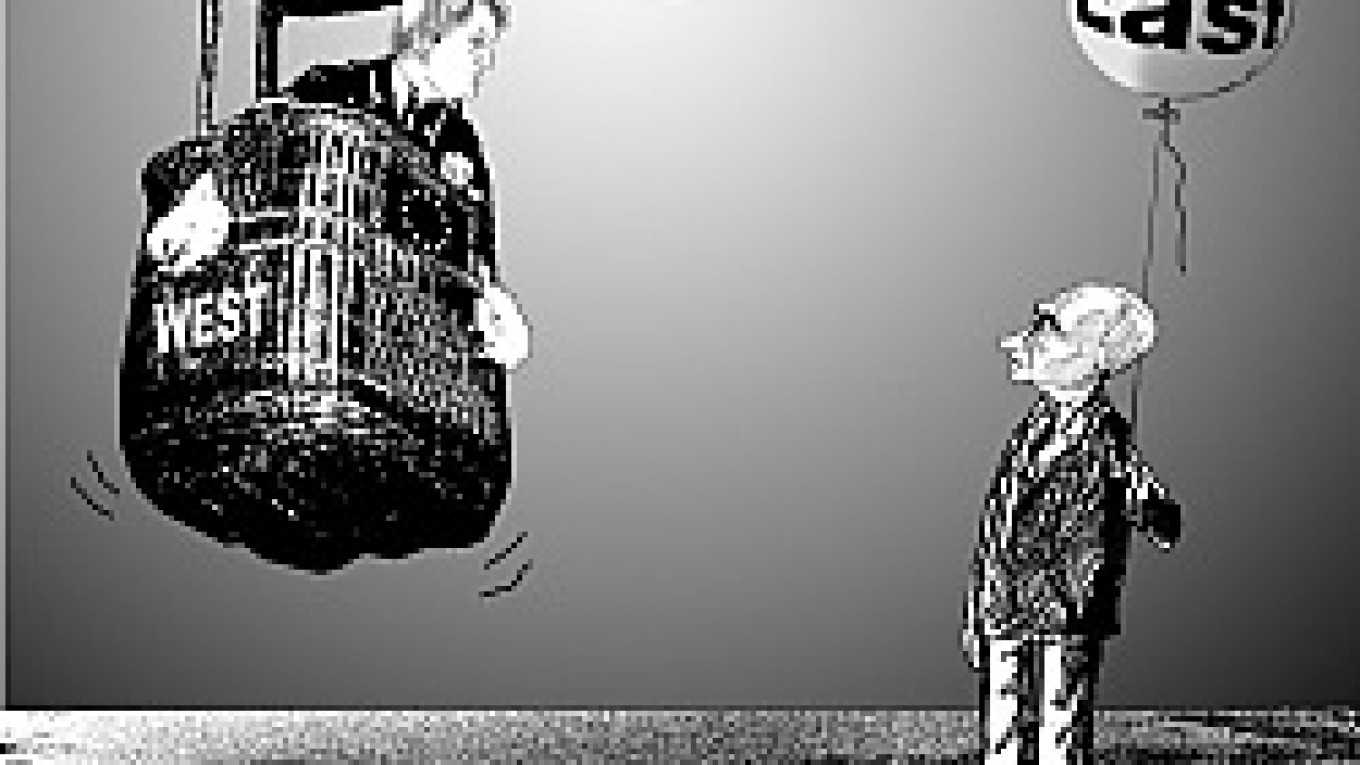
In the past, however, the Kremlin's sharp anti-Western turns were reversed -- usually out of simple necessity -- after relations reached rock bottom. Not this time. On the contrary, the current deterioration of the relationship has developed a momentum of its own.
There are four reasons for this. First, the Russia's "defeat" in the Cold War -- and its loss of imperial and superpower status -- has created a deep and so far unresolved crisis in the collective mentality of the country's political class. Russian leaders continue to perceive the West as a phantom enemy, in opposition to which all the traditional mythologies of Russian foreign policy are being resurrected.
Second, by the end of Vladimir Putin's second term as president, Russia's modernizing dreams had been shattered. Modernization, indeed, simply turned out to be yet another redistribution of property to those on top, particularly those who came out of the St. Petersburg Mayor's Office and the Federal Security Service The image of the West as an enemy has become the only ideological excuse for Putin's model of the corporate state.
 | To Our Readers |
The Moscow Times welcomes letters to the editor. Letters for publication should be signed and bear the signatory's address and telephone number. |
Finally, a series of Western mistakes and misfortunes, a crisis in trans-Atlantic relations, a lack of leadership, and the growing threat of Islamic fundamentalism (in both the Middle East and Europe) have led Russian leaders to believe that the West is a sinking ship, to be abandoned as soon as possible.
While this belief unfortunately does have some validity, there is one problem: Russia is part of that ship. Moscow can make advances to Hamas, Hezbollah and Iran, and it can remind the Arab world that the Soviet Union helped it develop and offered it protection in the United Nations Security Council. But in the eyes of most Islamic extremists, Russia is part of that same "Satanic" West -- indeed, its most vulnerable part. Therefore, it is Russia, with the soaring birth rate among its Muslim citizens, that is the most attractive country for expansion and takeover.
But Moscow's self-destructive confrontation with the West can be halted, and its centuries-old debate between Westernizers and the Slavophiles can be put to rest once and for all. This, however, will depend on Ukraine's success on the path of European development it chose in the Orange Revolution of 2004 and 2005.
Ukraine does present a threat, but not to Russia's security, as Kremlin propagandists claim. The real threat is to the Putin model of a corporate, authoritarian state, unfriendly to the West. For the Kremlin it is a matter of life and death that countries that were once part of the Soviet Union but chose a different model of development -- Ukraine being the chief example -- should never become attractive to ordinary Russians.
The example posed by the Baltic nations does not threaten the Kremlin much because they are perceived as foreigners. Indeed, in Soviet films, Baltic actors were usually cast in the roles of Nazi generals and U.S. spies. Ukrainians, on the other hand, are close to us in their culture and mentality. If they made a different choice, why can't we do the same?
Ukraine's success will mark the political death of Putinism -- the squalid and bankrupt philosophy of "KGB capitalists." If Ukraine succeeds in its European choice, if it is able to make it work, it can settle the question that has bedeviled Russian culture for centuries -- Russia or the West? So the best way to help Russia today is to support Ukraine's claim that it belongs to Europe and its institutions. This will influence the Kremlin's political mentality more than anything else.
If the Kremlin's anti-Western paranoia continues and its Eurasian fantasy of allying with China lasts another 10 to 15 years, Russia will end up seeing China swallowing its Far East and Siberia. Indeed, the weakened Russia that will be Putin's legacy will then also lose the Northern Caucasus and the Volga region to their growing Muslim populations.
The remaining lands would then have no other choice but to attach themselves to Ukraine, which should by then have become a successful member of the European Union.
After 1,000 years, Russia will have come full circle, returning to Kievan Rus after wandering on the roads of the Mongol hordes, the Russian Empire, Soviet communism and farcical Putinism.
Andrei Piontkovsky is a visiting fellow at the Hudson Institute in Washington. ?© Project Syndicate
A Message from The Moscow Times:
Dear readers,
We are facing unprecedented challenges. Russia's Prosecutor General's Office has designated The Moscow Times as an "undesirable" organization, criminalizing our work and putting our staff at risk of prosecution. This follows our earlier unjust labeling as a "foreign agent."
These actions are direct attempts to silence independent journalism in Russia. The authorities claim our work "discredits the decisions of the Russian leadership." We see things differently: we strive to provide accurate, unbiased reporting on Russia.
We, the journalists of The Moscow Times, refuse to be silenced. But to continue our work, we need your help.
Your support, no matter how small, makes a world of difference. If you can, please support us monthly starting from just $2. It's quick to set up, and every contribution makes a significant impact.
By supporting The Moscow Times, you're defending open, independent journalism in the face of repression. Thank you for standing with us.

Remind me later.