

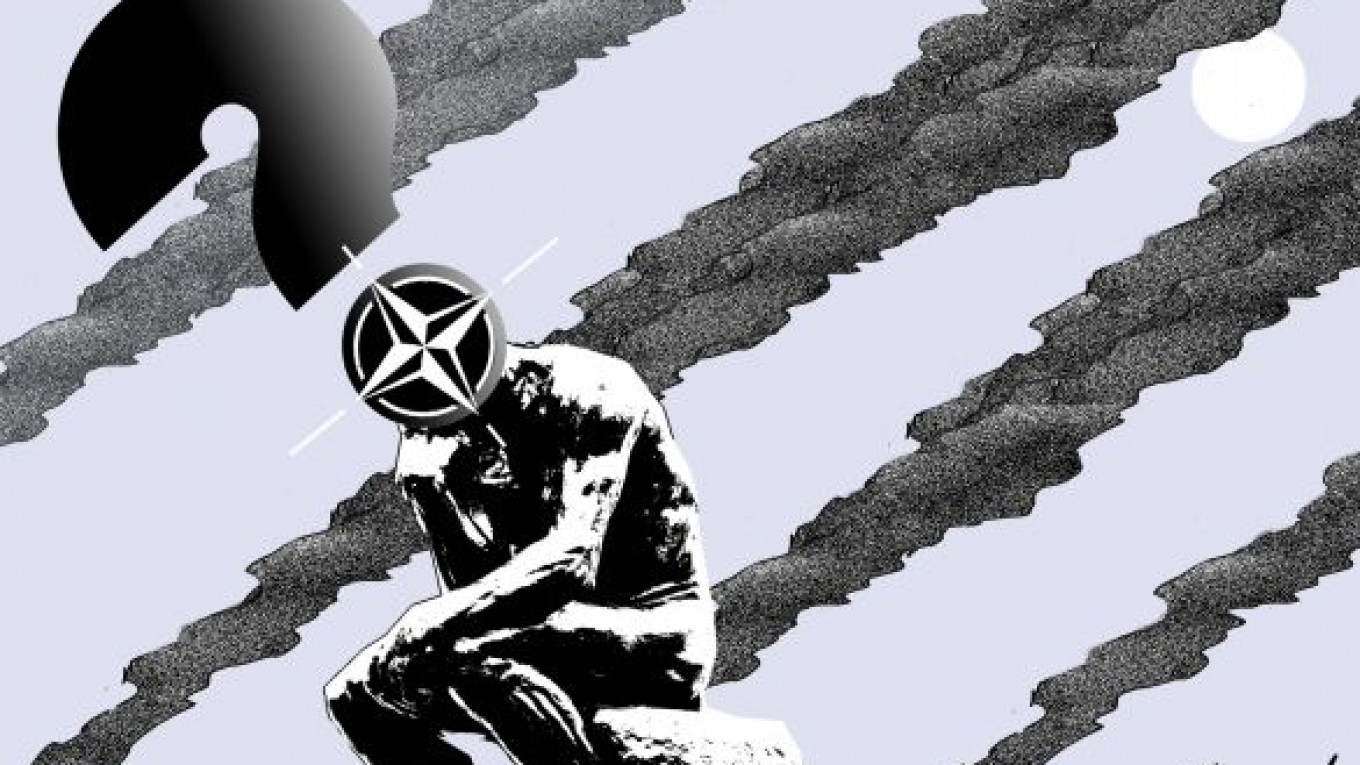
As NATO officially wraps up its military mission in Libya, there are still many unanswered questions about the alliance’s future security role on the global arena.
According to knowledgeable sources, Libya was one of the main issues Russian officials discussed with James Appathurai, NATO’s deputy assistant secretary-general, during his visit to Moscow last week. It turns out that Russian diplomats were extremely interested in learning whether Moammar Gadhafi’s ouster was an exception, or whether the alliance intends to use force to rid the world of other authoritarian leaders who still remain in power. For Russia’s leaders, the question of whether NATO will fulfill the role of global policeman has become more relevant than ever.
In reality, however, NATO is trying to extricate itself from a deep identity crisis. Thanks to Lord Ismay, NATO’s first secretary-general, we all know that NATO was intended “to keep the Russians out, the Americans in and the Germans down.” But the last 20 years have made these goals largely irrelevant. Germany has become the backbone of the European Union, and Russia is no longer a threat to Europe. Moreover, NATO cooperation with Moscow has become indispensable for the alliance’s operations in Afghanistan, and Russia will remain important to NATO’s broader security concerns in the region long after coalition forces leave Afghanistan.
What’s more, as the United States more frequently takes an independent path on military matters, “keeping the Americans in” has also become more difficult. Washington took the leading role in NATO operations in Afghanistan and Yugoslavia. In Iraq, however, the United States was unable to gain agreement from every NATO member country and, thus, led the campaign on its own with the help of a hodgepodge of coalition partners. But the NATO operations in Libya were the first in the alliance’s history in which the United States deliberately chose to play a secondary role.
NATO was created to ensure that Western European nations would receive immediate support from the United States in the event of a Soviet invasion, but that threat disappeared forever with the collapse of the Soviet Union.
And now NATO officials are faced with the difficult task of explaining why they must preserve a military and political alliance whose raison d’etre no longer exists. The solution they settled on was not very convincing. The NATO member states drove themselves into a corner when they adopted a strategy last year that states: “Where conflict prevention proves unsuccessful, NATO will be prepared and capable to manage ongoing hostilities. NATO has unique conflict management capacities, including the unparalleled capability to deploy and sustain robust military forces in the field. NATO-led operations have demonstrated the indispensable contribution the alliance can make to international conflict management efforts.”
We should probably take this NATO strategy seriously — if only because this may become the alliance’s new raison d’etre. If so, NATO will essentially commit itself to intervening in every major internal conflict.
During the Arab Spring, North Africa’s leading dictators were forced out with little or no bloodshed, but in others cases they have managed to hold on to power. Libya was the only country in which the dictator felt compelled to initiate an all-out war against his own people. NATO would have looked weak had it ignored the Libyan opposition’s urgent pleas for assistance. At the same time, Washington had no desire to become entangled in another war in the Greater Middle East. But under pressure from its NATO allies, the United States led the first stage of the operation, launching more than 100 cruise missiles and bombing Gadhafi’s? air defense installations. After that, Washington, refusing to take responsibility for the final result, transferred military command to NATO. This decision had a direct negative impact on how Operation Odyssey Dawn was carried out.
Ever since the Soviet Union collapsed 20 years ago, Western European military analysts and politicians have enjoyed speculating on how NATO might look with limited U.S. participation. They debated endlessly about the European basis of NATO and the European rapid-deployment forces that would take the field if Washington did not take part in a particular military operation.
Now we know how that scenario looks in practice. In place of a massive air strike that would have nullified the enemy’s defenses in several days, we saw eight months of half-hearted strikes. As a result, NATO’s air superiority did not translate into a quick, decisive military victory over Gadhafi’s forces.
To make matters worse for NATO, Gadhafi’s death will not stop the cycle of violence in Libya. A protracted civil war among the many Libyan factions and tribes is likely. They may have joined forces in February to fight a common enemy, but now that Ghadafi has been eliminated, there are bound to be power struggles among the coalition forces. If a civil war does break out, there would be no support from the United Nations Security Council or other international organizations for another NATO intervention.
Although the United States, the sole remaining superpower, has had a formidable military alliance at its disposal, Russia doesn’t. This is an ongoing source of envy that only aggravates Russia’s inferiority complex. But the Libyan operation has shown again that superpower status is actually a double-edged sword. It is often a heavy burden to bear, one that even the world’s wealthiest country cannot shake off.
In a world in which superpowers need to create “wars of choice” to justify their status, there are no victors. We all lose in this great game.
Alexander Golts is deputy editor of the online newspaper Yezhednevny Zhurnal.
A Message from The Moscow Times:
Dear readers,
We are facing unprecedented challenges. Russia's Prosecutor General's Office has designated The Moscow Times as an "undesirable" organization, criminalizing our work and putting our staff at risk of prosecution. This follows our earlier unjust labeling as a "foreign agent."
These actions are direct attempts to silence independent journalism in Russia. The authorities claim our work "discredits the decisions of the Russian leadership." We see things differently: we strive to provide accurate, unbiased reporting on Russia.
We, the journalists of The Moscow Times, refuse to be silenced. But to continue our work, we need your help.
Your support, no matter how small, makes a world of difference. If you can, please support us monthly starting from just $2. It's quick to set up, and every contribution makes a significant impact.
By supporting The Moscow Times, you're defending open, independent journalism in the face of repression. Thank you for standing with us.

Remind me later.