

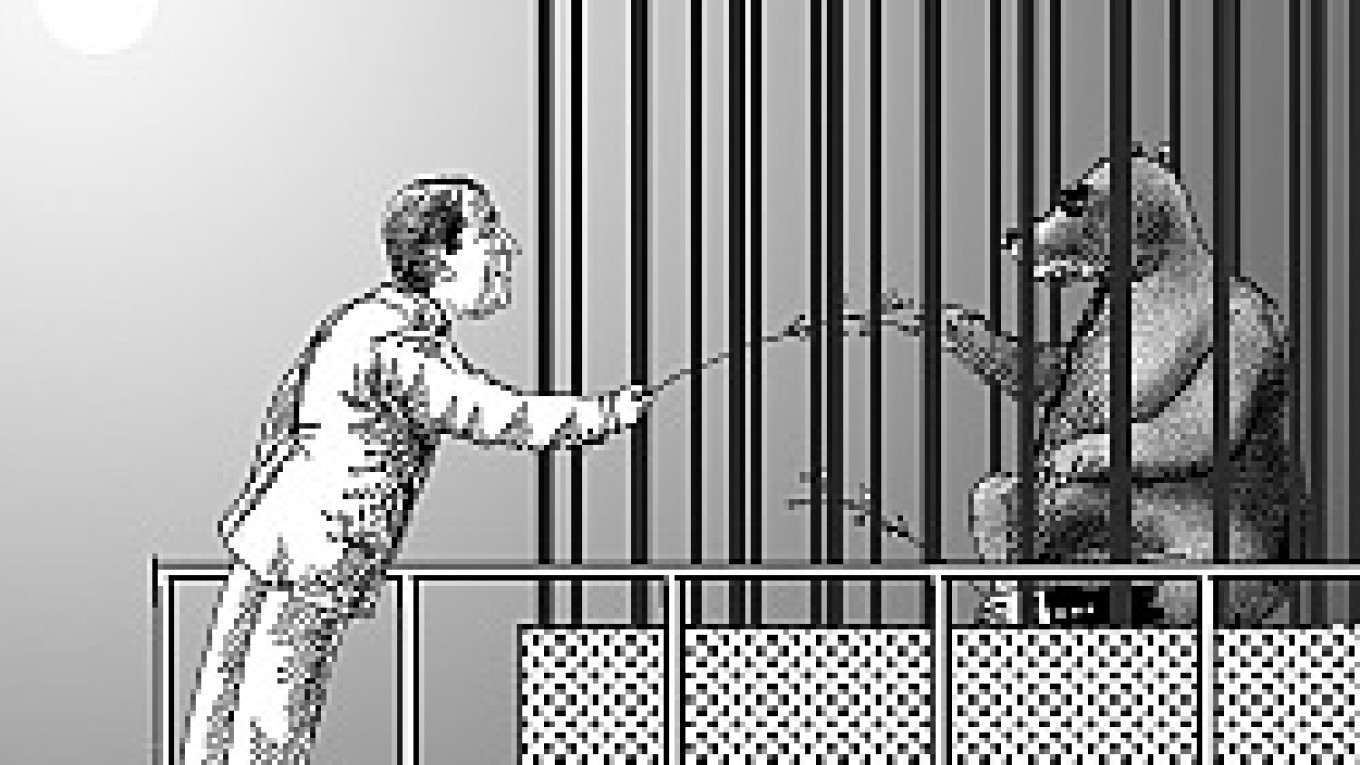
Suffice to say that the Valdai meetings did little to alleviate my concerns. The Russian presenters, with the exception of opposition figure Garry Kasparov, were all singing from the same song sheet: "We don't want a new era of confrontation, but the choice is yours" -- the United States'.
And from the U.S. side, Secretary of State Condoleezza Rice made a powerful speech on Sept. 18, concluding, "The decision is Russia's and Russia's alone." Obviously both Moscow and Washington have choices, but I have little confidence U.S. leaders will make the right ones that will enhance the security of the United States and Europe, let alone Russia. What Washington needs right now is not megaphone diplomacy with Moscow, but real diplomacy.
While the United States may deplore the Kremlin's decision to invade Georgia -- and certainly their choice to rapidly and unilaterally recognize South Ossetia and Abkhazia was wrong -- the consensus among Russian politicians and most people is that the Kremlin was right and justified. Although government propaganda on television is partially responsible for this national consensus, it also reflects the country's catharsis after more than 15 years of perceived relentless geopolitical expansion of the West at Moscow's expense.
President Dmitry Medvedev told us that when he spoke with U.S. President George W. Bush on the phone during the hostilities with Georgia, Bush asked him, "What do you need this for?" Medvedev responded, "George, I had no choice, and if you were in my shoes you would have done exactly the same, only more brutally." Medvedev went on to say that if Washington chooses to expand ties with Georgia and arm it, Washington does so "at its own risk."
When Medvedev said at Valdai, "We will not tolerate any more humiliation, and we are not joking," I believed him. Russian history tells us that we should not underestimate the willingness of Moscow to spill blood to defend the country's interests as it sees fit. At this moment, the United States needs to focus on that prospect rather than spend so much energy defending past policy.
 | To Our Readers |
|
The Moscow Times welcomes letters to the editor. Letters for publication should be signed and bear the signatory's address and telephone number.
|
For years since the Cold War, I have believed that war with Russia had a likelihood of close to zero. Today, that probability seems, while obviously difficult to quantify, between 1 and 2 percent and rising. Frankly, I find that an unnecessarily risky proposition that requires some bold, creative and ultimately wise thinking on the U.S. part to reduce the risk.
If the U.S. desire is for a more liberal and democratic Russia that is at peace with its neighbors, who really believes that a policy of isolation and confrontation -- the current U.S. course -- will help achieve those goals? After spending the past 30 years studying Russia and working with Russians, I am convinced that the answer is "no." When the Kremlin tells us that the current global security structure is not working, it is right. It is entirely wrong, however, to insist on spheres of influence and "privileged relations with our neighbors."
But the Bush administration's approach that presses every Kremlin red button and crosses every one of its "red lines" is also dangerously failing. For example, does rapid NATO expansion and deployment of missile-defense components in the Czech Republic and Poland really advance U.S. security interests at this moment? Now is not the time to freeze the Russians out but to engage them more seriously than the United States ever has since the collapse of the Soviet Union.
The United States may well find itself surprised with how engagement and respect may lead to deeper cooperation with the Kremlin on global security challenges and a more pluralistic and open Russia that is at peace with its neighbors. I know that sounds counterintuitive and certainly runs against the political mood in the United States, but the fact is that Washington has never tried such an approach in the post-Soviet period.
This does not by any measure mean appeasing the Kremlin or giving it a veto over anything. But it does mean treating Russia more like a real partner to achieve long-term objectives in the interests of all parties. If the United States continues its current policy toward Russia, it increases the likelihood of a head-on collision between two global powers.
Andrew C. Kuchins is director and senior fellow of the Russia and Eurasia program at the Center for Strategic and International Studies.
A Message from The Moscow Times:
Dear readers,
We are facing unprecedented challenges. Russia's Prosecutor General's Office has designated The Moscow Times as an "undesirable" organization, criminalizing our work and putting our staff at risk of prosecution. This follows our earlier unjust labeling as a "foreign agent."
These actions are direct attempts to silence independent journalism in Russia. The authorities claim our work "discredits the decisions of the Russian leadership." We see things differently: we strive to provide accurate, unbiased reporting on Russia.
We, the journalists of The Moscow Times, refuse to be silenced. But to continue our work, we need your help.
Your support, no matter how small, makes a world of difference. If you can, please support us monthly starting from just $2. It's quick to set up, and every contribution makes a significant impact.
By supporting The Moscow Times, you're defending open, independent journalism in the face of repression. Thank you for standing with us.

Remind me later.