

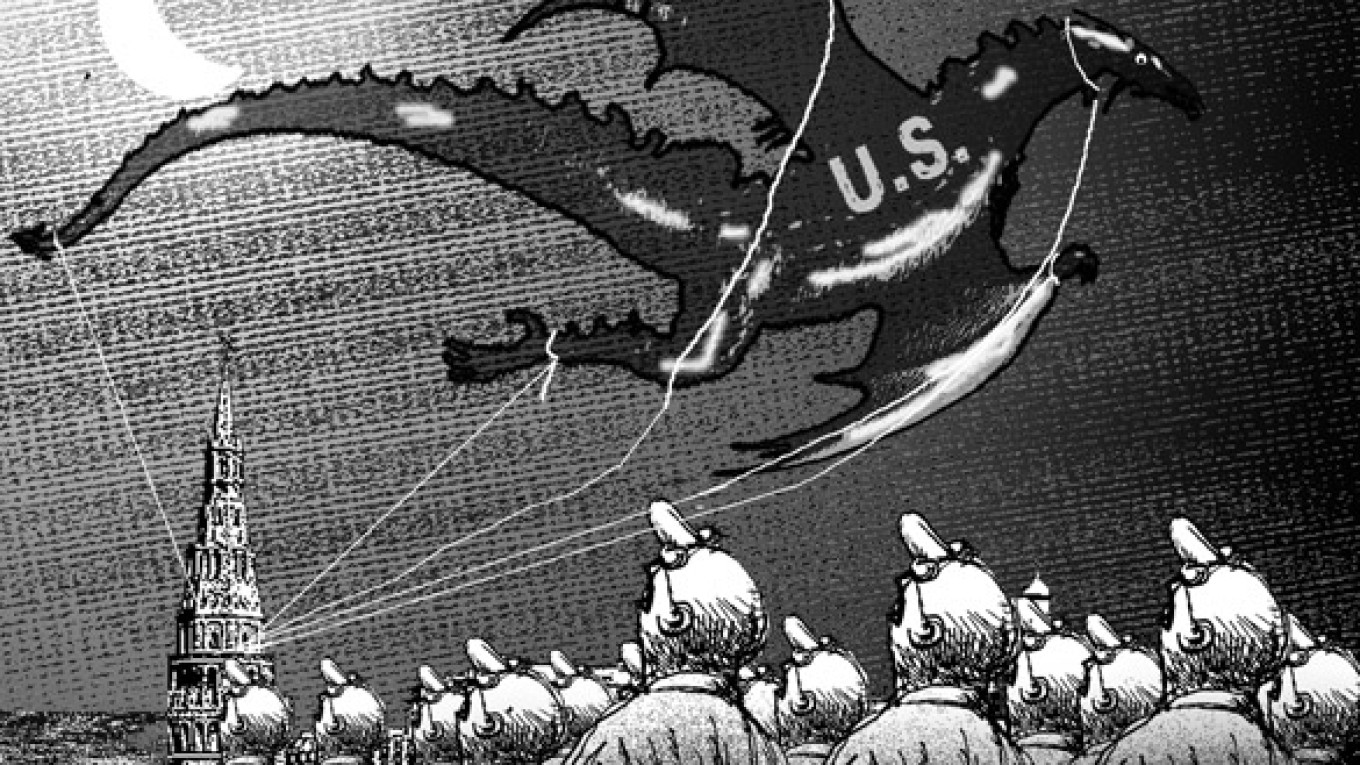
In his speech before the United Nations General Assembly last week, U.S. President Barack Obama said we are entering a new historical era. He declared that the United States would cease taking unilateral actions and called on all people of all nations to join together in combating the challenges facing the world. Obama said we need the “cooperative effort of the whole world.” His foreign policy leitmotif has become the call to cooperate based on shared values. He made similar appeals during visits to Prague, Cairo and Moscow.
In his Moscow speech in July, Obama extended the hand of friendship to Russia, declaring that the United States “needs a powerful, peaceful and prosperous Russia” and called Moscow to a “global partnership.” In recent months, the White House and the Kremlin have taken a series of steps to meet each other halfway as part of what Obama has referred to as the “reset” of U.S.-Russian relations. But if Obama had only extended his hand in friendship directly to the Russian people, he probably would have gotten a firm “nyet” in response. This is because most Russians look at the United States as an enemy. Moreover, this feeling is growing, despite the change in leadership in Washington and Obama’s many efforts to the contrary.
A recent survey by the Levada Center revealed that only 2.1 percent of all Russians consider the United States a friend, but 50.2 percent see Belarus as one, 17.6 see China that way and 17.4 percent consider Germany a friend. By contrast, 61.8 percent of respondents considered Georgia as Russia’s enemy, with the United States in second place at 45.4 percent.
The survey also found that 50.4 percent of Russians had either a “basically bad” or “very bad” attitude toward the United States, with only 1.4 percent holding a “very good” attitude and 34 percent feeling “basically good” toward Washington. What is most surprising to me is that Russians’ attitudes toward the United States have actually worsened during Obama’s first year in office compared with what they were during the administration of former U.S. President George W. Bush, Russia’s heretofore-favorite whipping boy. Only 24.7 percent of respondents felt Russia should respond to Obama’s call for both sides to reduce the number of nuclear warheads and delivery vehicles in their arsenals, while 56 percent were opposed.
Russian respondents were positive that the United States is to blame for the main problems in the world today. A significant 25.5 percent hold the opinion that it was the United States — not Israel, Hamas, Islamic fundamentalists or terrorists — that is primarily responsible for the bloodshed and instability in the Middle East.
Anti-U.S. sentiment has been steadily rising in Russia over the past few years. Russian public opinion toward the Unites States first swung decidedly toward the negative in 1999, when U.S. President Bill Clinton authorized the bombing of Serbian forces in Yugoslavia. That was followed by Washington’s unilateral actions in Iraq, the expansion of NATO, the courting of Ukraine and Georgia to become new NATO members, U.S. plans to deploy elements of its missile defense batteries in Central Europe, the recognition of Kosovo’s independence and the heated debate over Russia’s recognition of independence for Abkhazia and South Ossetia. All of that was accompanied by anti-U.S. propaganda by the Kremlin-controlled media, as well as officially sponsored growing nostalgia for the Soviet past and for Josef Stalin, who shortly before his death called the struggle with the United States the main goal of Soviet foreign policy.
Russia’s growing isolation from the West — and the United States in particular — has exacerbated the problem. According to a national survey conducted by Bashkirova and Partners in June, 85 percent of Russians, as well as their friends and relatives, have never been to the United States, and only 9 percent have relatives and friends who have been there at least once. A little more than 2 percent have been to the United States once or twice. This large number of Russians has developed perceptions of the United States from decades of Soviet propaganda or from negative events in recent years. An overwhelming 95 percent of respondents said they had either never had any form of contact with an American, only a brief encounter. Fully 35 percent of those questioned said that Russia is the United States’ greatest rival, and 22 percent believed that the America is trying to undermine Russia’s international influence. As many as 15 percent think the United States would like to destroy Russia.
It is telling that a single Russian television channel broadcast Obama’s speech in July, leaving most Russians completely unaware of the U.S. leader’s friendly overture to them. Apparently, the Kremlin has no intention of providing at least minimum public support for Washington’s desire to reset U.S.-Russian relations.
Vladimir Ryzhkov, a State Duma deputy from 1993 to 2007, hosts a political talk show on Ekho Moskvy radio.
A Message from The Moscow Times:
Dear readers,
We are facing unprecedented challenges. Russia's Prosecutor General's Office has designated The Moscow Times as an "undesirable" organization, criminalizing our work and putting our staff at risk of prosecution. This follows our earlier unjust labeling as a "foreign agent."
These actions are direct attempts to silence independent journalism in Russia. The authorities claim our work "discredits the decisions of the Russian leadership." We see things differently: we strive to provide accurate, unbiased reporting on Russia.
We, the journalists of The Moscow Times, refuse to be silenced. But to continue our work, we need your help.
Your support, no matter how small, makes a world of difference. If you can, please support us monthly starting from just $2. It's quick to set up, and every contribution makes a significant impact.
By supporting The Moscow Times, you're defending open, independent journalism in the face of repression. Thank you for standing with us.

Remind me later.