

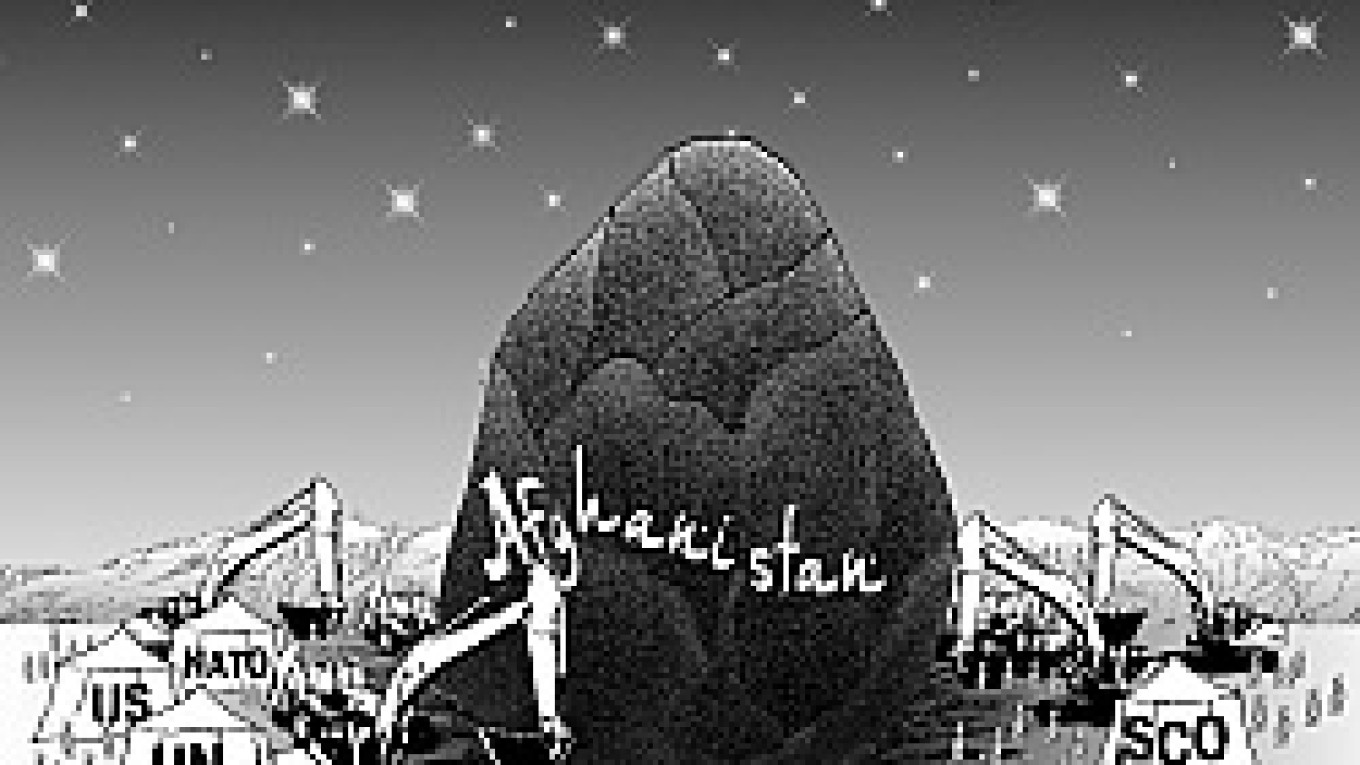
According to U.S. intelligence, the Sept. 11, 2001, terrorist attacks were organized by the Taliban from their bases in Afghanistan. Washington enlisted the support of its NATO allies and a few other countries and quickly occupied Afghanistan, destroying its main terrorist bases. That type of swift, heavy response was understandable, but Washington's underestimation of the complexity of Afghanistan's internal situation, its history and particularly the poor track record of previous attempts to force a regime on the Afghan people had disastrous consequences for all sides.
 | To Our Readers |
|
The Moscow Times welcomes letters to the editor. Letters for publication should be signed and bear the signatory's address and telephone number.
|
The SCO includes Russia, China, Kazakhstan, Kyrgyzstan, Uzbekistan and Tajikistan as full members, and India, Iran, Pakistan and Mongolia as observers. One of the key objectives of the Friday SCO conference is to team up with the West and international organizations to address the Afghanistan problem. Among the participants will be: UN Secretary-General Ban Ki-moon; Mark Perrin de Brichambaut, secretary-general of the Organization for Security and Cooperation in Europe; U.S. Deputy Assistant Secretary for South and Central Asian Affairs Patrick Moon; and NATO Secretary-General Jaap de Hoop Scheffer. In addition, there will be representatives from the Group of Eight countries, the Collective Security Treaty Organization, the European Union and the Organization of The Islamic Conference.
The participation of NATO and its allies at the SCO conference indicates a significant shift in their approach to the Afghanistan problem. There is a good reason for this. NATO understands that it has a better chance of getting what it wants from Russia and other SCO members by cooperating with them rather than by confronting them. The U.S. and NATO wish list includes finding an acceptable format to somehow bring Iran into the dialogue. It also includes securing transit routes for nonmilitary -- and ultimately military -- supplies to coalition forces in Afghanistan through SCO countries and placing NATO troops on the territories of SCO member states.
The SCO member states are also interested in stabilizing the situation in the region and are willing to meet the Western organizations halfway. At a press conference in Kabul on March 16, Foreign Minister Sergei Lavrov expressed Russia's readiness to "assist in increasing the effectiveness of international forces providing security," referring to Moscow's decision to initiate the transit of Afghanistan-bound nonmilitary freight through Russian territory.
At the conference, the SCO needs to explain in clear terms its position regarding the political situation in Afghanistan. At a recent meeting with Russian foreign policy analysts, Patrick Moon suggested that the situation in Afghanistan is much better than the negative picture that the mainstream media creates. He also said one of the main barriers to stabilizing the situation in Afghanistan is the country's lack of democracy -- a hole that will be partially filled when the country holds a presidential election later this year. Russian analysts painted a far more pessimistic picture and advised their U.S. colleagues to be more pragmatic by using, for example, the "Kadyrov option" -- that is, to identify a powerful and loyal local leader capable of imposing order on the country and only afterward address other issues.
Washington's desire to hold its own conference on Afghanistan, planned for March 31 in the Hague, suggests that the United States wanted to control the process. But then it seemed that the organizers thought again and realized that such a format would be too limited. The United States later expanded the conference to fall under the auspices of the UN. U.S. President Barack Obama will probably use the gathering to present his administration's strategy on Afghanistan and to invite as many countries as possible to participate by contributing financially and militarily. There is urgency to the task because even some of Washington's closest allies are currently planning to withdraw their forces from Afghanistan.
In contrast to the upcoming conference in the Hague, the Moscow SCO conference will have a regional and more practical character. Its main objective is to put aside old disagreements and increase cooperation among Russia, Afghanistan's neighbors and the West. This broad approach offers the best opportunity to stabilize Afghanistan.
Alexander Lukin is director of the Center for East Asian and Shanghai Cooperation Organization Studies at Moscow State University for International Relations.
A Message from The Moscow Times:
Dear readers,
We are facing unprecedented challenges. Russia's Prosecutor General's Office has designated The Moscow Times as an "undesirable" organization, criminalizing our work and putting our staff at risk of prosecution. This follows our earlier unjust labeling as a "foreign agent."
These actions are direct attempts to silence independent journalism in Russia. The authorities claim our work "discredits the decisions of the Russian leadership." We see things differently: we strive to provide accurate, unbiased reporting on Russia.
We, the journalists of The Moscow Times, refuse to be silenced. But to continue our work, we need your help.
Your support, no matter how small, makes a world of difference. If you can, please support us monthly starting from just $2. It's quick to set up, and every contribution makes a significant impact.
By supporting The Moscow Times, you're defending open, independent journalism in the face of repression. Thank you for standing with us.

Remind me later.