

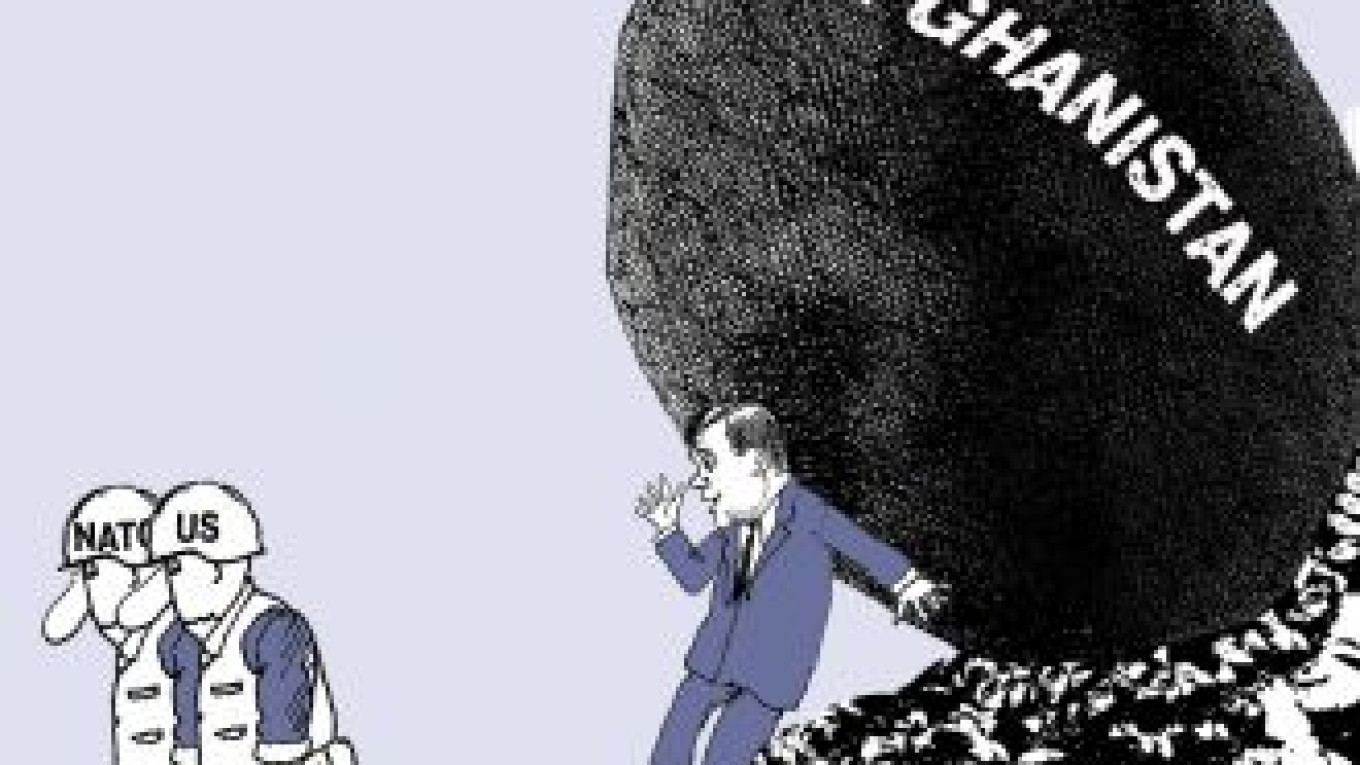
As usual, the good news comes with the bad. First the good news: The Kremlin has finally acknowledged that when U.S. and coalition forces withdraw from Afghanistan in three years, the former Soviet republics in Central Asia and Russia itself will be faced with a serious security threat from the south. The bad news is that Moscow is using the threat largely as an excuse to badger the West.
It is clear from a meeting held Friday in Dushanbe among the leaders of Tajikistan, Afghanistan, Pakistan and Russia that the Kremlin understands that the withdrawal of Western coalition forces from Afghanistan could lead to a catastrophe in Central Asia and Russia. There is little doubt that Islamic extremists, strengthened and inspired by their victory over the Western coalition in Afghanistan, will try to expand their influence into neighboring regions. The weak authoritarian regimes of Central Asia to the north are the ideal place to start. The poverty and ethnic conflicts in Tajikistan, Uzbekistan and Kyrgyzstan is a ripe breeding ground for extremism. ?
To try to fend off the looming threat, Moscow is taking great pains to form a collective rapid deployment force within the Collective Security Treaty Organization, or CSTO, an organization that includes Russia, Belarus, Armenia, Tajikistan, Kyrgyzstan, Kazakhstan and Uzbekistan. Moscow is motivated by a desire to use the CSTO to legitimize military intervention at an early stage to put down future conflicts.
That is precisely why it has been extremely difficult to create a collective rapid deployment force. First, the leaders in Central Asia are reluctant to acknowledge their weakness and admit that they cannot maintain their independent hold on power. Further, by agreeing to join the collective rapid deployment force, these dictatorships would concede some of their sovereign right to exercise absolute authority over their own people.
Belarussian President Alexander Lukashenko, who currently chairs the CSTO, recently tried to exploit those problems for his own benefit. He proposed to CSTO Secretary-General Nikolai Bordyuzha that the collective rapid deployment force be used to put down internal disorder in member states. “The collective rapid reaction forces should be used not only in the case of attack by nonmember states, but also in the case of interference by those states within the CSTO. … Of course, no country or forces will initiate a frontal assault against us, but many are itching to organize a coup,” Lukashenko said.
If Lukashenko’s proposal is accepted, the CSTO will act as a police force for all the former Soviet republics and Lukashenko will, in theory, have the right to call in Russian troops to quell popular demonstrations against his rule. In this situation, Lukashenko has exploited the greatest weakness of the CSTO. In essence, the military alliance is a hodgepodge of separate bilateral military agreements Russia has with Belarus, Armenia, Tajikistan, Kyrgyzstan, Uzbekistan and Kazakhstan. But there is no common threat that justifies forming a full-fledged military alliance among them. It is difficult to imagine that Belarussian army units would be dispatched to ensure stability in Kyrgyzstan or Tajikistan. If Lukashenko needed any formal justification to not send Belarussian soldiers to Central Asia, he could always point to the country’s constitution that prohibits sending troops abroad.
But how can Moscow persuade Central Asia to ensure security for Russia without having to suppress every legal popular protest against their authoritarian regimes in the region? How can it avoid turning rapid reaction forces into a brute internal forces to suppress the opposition and popular protests?
I can see only one solution. Military intervention should first be approved by the international community through a United Nations Security Council mandate. This is a position Moscow has always insisted on when the United States or NATO initiates military operations in other countries, and the same principle should apply to Russia.
Moreover, Moscow should propose that the United States and NATO take direct responsibility for what will happen in Central Asia even after they have withdrawn all of their troops from Afghanistan. The Kremlin must soberly accept the fact that Russia and Central Asian countries do not have the means by themselves — even collectively — to ensure stability in the region. Thus, a broader security strategy? in Central Asia after the coalition forces leave Afghanistan should involve cooperation with the West rather than confrontation.
But it seems like the Kremlin behaves as if its most important goal is to irritate the West and remove it from further participation in settling the situation in Afghanistan rather than providing security to the region.
President Dmitry Medvedev perhaps put it best in his remarks during Friday’s Dushanbe meeting: “In the long run, the responsibility for what happens in our region will anyway lie with Russia, Tajikistan, Pakistan and Afghanistan. Those partners who are currently helping solve a variety of tasks in the region are, of course, very important and much depends upon them, but they are ‘extra-regional powers.’”
I suspect that these “extra-regional powers” — that is to say the United States and its Western European allies — will be more than glad to walk away from Afghanistan and forget once and for all about the latest failed attempt to create a democratic state in the Greater Middle East. Nonetheless, Russia has to do everything in its power — including giving up a strategic interest, if necessary —? to convince the United States and NATO to cooperate with Russia to provide security in the region.
Regardless of its grand ambitions to become an independent, strong regional power in Central Asia, Russia simply does not have the resources or the authority to deal with the serious security threats in the region on its own. And Russia’s weak partners in the CSTO will be of little help in this regard.
Alexander Golts is deputy editor of the online newspaper Yezhednevny Zhurnal.
A Message from The Moscow Times:
Dear readers,
We are facing unprecedented challenges. Russia's Prosecutor General's Office has designated The Moscow Times as an "undesirable" organization, criminalizing our work and putting our staff at risk of prosecution. This follows our earlier unjust labeling as a "foreign agent."
These actions are direct attempts to silence independent journalism in Russia. The authorities claim our work "discredits the decisions of the Russian leadership." We see things differently: we strive to provide accurate, unbiased reporting on Russia.
We, the journalists of The Moscow Times, refuse to be silenced. But to continue our work, we need your help.
Your support, no matter how small, makes a world of difference. If you can, please support us monthly starting from just $2. It's quick to set up, and every contribution makes a significant impact.
By supporting The Moscow Times, you're defending open, independent journalism in the face of repression. Thank you for standing with us.

Remind me later.