

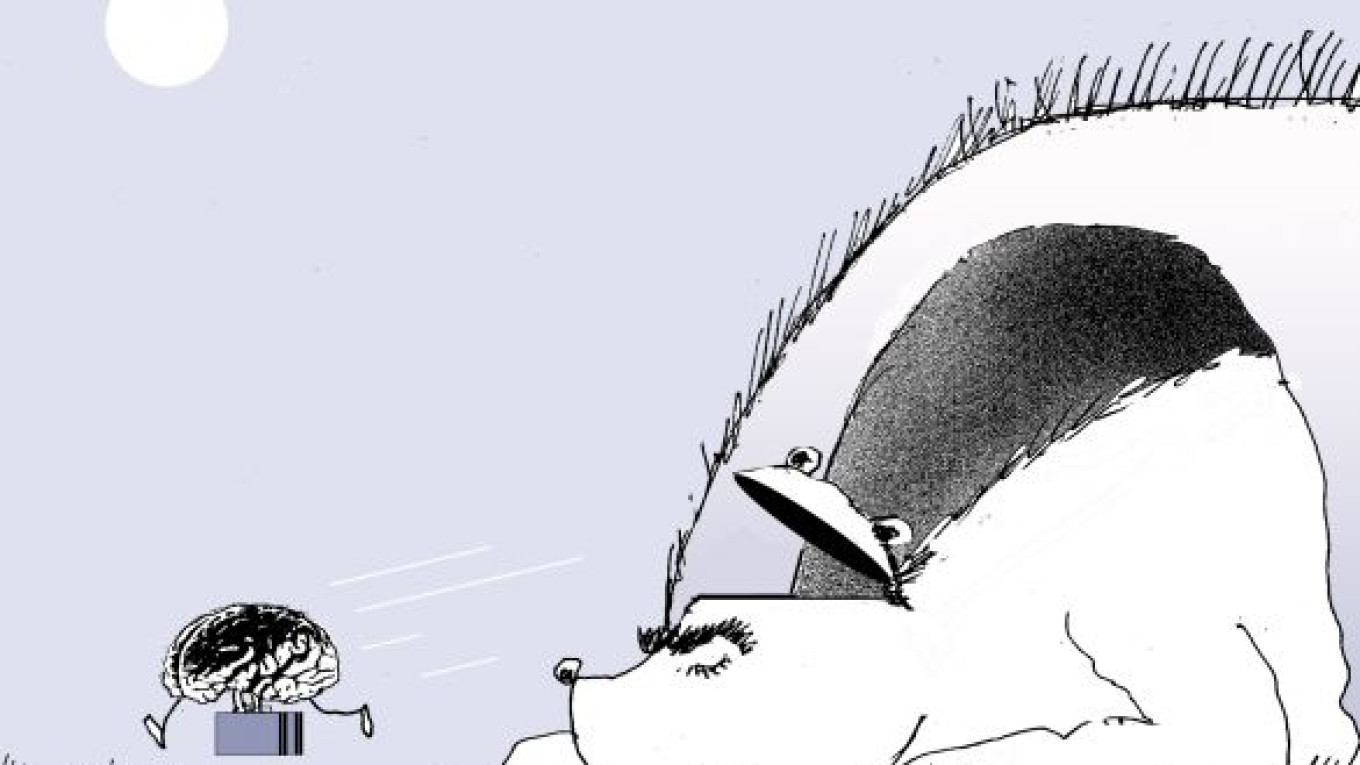
The Soviet Union was always a contradiction. It clung to an outdated 19th-century ideology, and it was ruled mostly by know-nothing Communist Party hacks. But it was also rooted in a belief in progress, intellect, culture and scientific exploration. Moreover, after World War II, it became a superpower and had to shoulder a set of military and economic responsibilities. It developed an excellent educational system and research establishment and had a large number of scientists, engineers, writers and artists, forming a class that in Russian is called the intelligentsia.
The relationship between the intelligentsia and the government was never easy. The intelligentsia produced a steady trickle of dissidents. Even those members of this group who were not in active opposition to the Soviet state were typically malcontents. Still, the Soviet government not only had to contend with the intelligentsia but had to strive to increase its ranks by graduating more specialists from colleges and universities, while also maintaining research institutes and subsidizing cultural institutions.
When communism came to an end, Russian scientists, mathematicians, researchers and computer programmers had an opportunity to leave the country. They started emigrating in large numbers in the early 1990s, and the outflow of talent continues to this day.
The spread of the Russian-speaking diaspora has been one of the most significant effects of the collapse of the Soviet Union on the rest of the world. When I first came to the United States in the mid-1970s, Americans found it hard to believe that I was born in the Soviet Union. Most of the time, I was the first person from Russia they had ever met. Today, it is almost impossible to walk two blocks in New York without overhearing a conversation in Russian. I’ve bumped into former Soviet citizens in some pretty unlikely places in the United States and other countries.
There is a fair share of Russian blue-collar workers, but it is the influx of the intelligentsia that has been the most remarkable. The United States, thanks to its relatively open immigration policies, has been the greatest beneficiary of Russia’s brain drain. There are now thousands of Russian-speaking doctors and medical researchers. Russians are prominent in Silicon Valley and in other high-tech hubs around the country. The most famous former Russian in Silicon Valley is Google co-founder Sergey Brin, but several levels below him there are thousands of Russians working in the country’s high-tech sector. Many of them have started and sold several high-tech companies.
It would be very hard to find a U.S. college or university that doesn’t have a Soviet-born professor, and Russian students are well represented at the country’s top universities.
As a rule, Soviet-educated scientists, engineers and other techies have far broader cultural horizon than their colleagues in the United States. That’s because the term “intelligentsia” in Russian comprises far more than just professional or university education, but also a great diversity of intellectual and artistic interests and pursuits. It is still a source of pride for me to hear so much Russian spoken by the audiences every time I go to Carnegie Hall, Lincoln Center, theaters and museums. The arrival of highly educated immigrants from the former Soviet Union gave a huge boost to U.S. cultural and intellectual life and sciences. It is comparable only to the large influx of Jewish refugees from Germany, Austria, Hungary, Czechoslovakia and other parts of Europe in the 1930s.
And what about Russia? Moscow’s cultural life doesn’t seem to suffer from any particular brain drain. It seems more diverse and vibrant today than at any time since the Bolshevik Revolution. But members of the “creative intelligentsia” — artists and writers — have left Russia in far fewer numbers than the “technical intelligentsia” — that is, from the sciences.
The creative intelligentsia, of course, is more closely tied to the Russian language and the cultural environment. But even more important, Russia has become the backwaters of the world’s artistic and cultural scene. Few people even know any contemporary Russian writers, and there are no Russian-trained artists, architects, cinematographers, theater directors or designers who are in the forefront of today’s international artistic development.
The intelligentsia tends to be a self-perpetuating class, meaning that educated people usually bring up well-educated children. But I expect Russia’s intelligentsia to shrink in coming decades. Maybe not the artistic kind, who will continue to thrive — albeit in their provincial way — as long as petrodollars flow and censorship remains lax. But certainly the technical intelligentsia is already becoming less numerous. Russia’s economy is overly dependent on oil, gas and other natural resources, and its backward manufacturing sector no longer can use so many scientists and engineers.
In short, Russia is no longer a superpower. Its government doesn’t need so many educated people, who tend to be more trouble to the ruling elite than they’re worth. Not surprisingly, the most popular colleges in Russia are now the ones that prepare future bureaucrats, as well as policemen, Federal Security Service agents and other siloviki.
Alexei Bayer, a native Muscovite, is a New York-based economist.
A Message from The Moscow Times:
Dear readers,
We are facing unprecedented challenges. Russia's Prosecutor General's Office has designated The Moscow Times as an "undesirable" organization, criminalizing our work and putting our staff at risk of prosecution. This follows our earlier unjust labeling as a "foreign agent."
These actions are direct attempts to silence independent journalism in Russia. The authorities claim our work "discredits the decisions of the Russian leadership." We see things differently: we strive to provide accurate, unbiased reporting on Russia.
We, the journalists of The Moscow Times, refuse to be silenced. But to continue our work, we need your help.
Your support, no matter how small, makes a world of difference. If you can, please support us monthly starting from just $2. It's quick to set up, and every contribution makes a significant impact.
By supporting The Moscow Times, you're defending open, independent journalism in the face of repression. Thank you for standing with us.

Remind me later.