Install

Get the latest updates as we post them — right on your browser

Today's paper. Last Updated: 05/28/2012

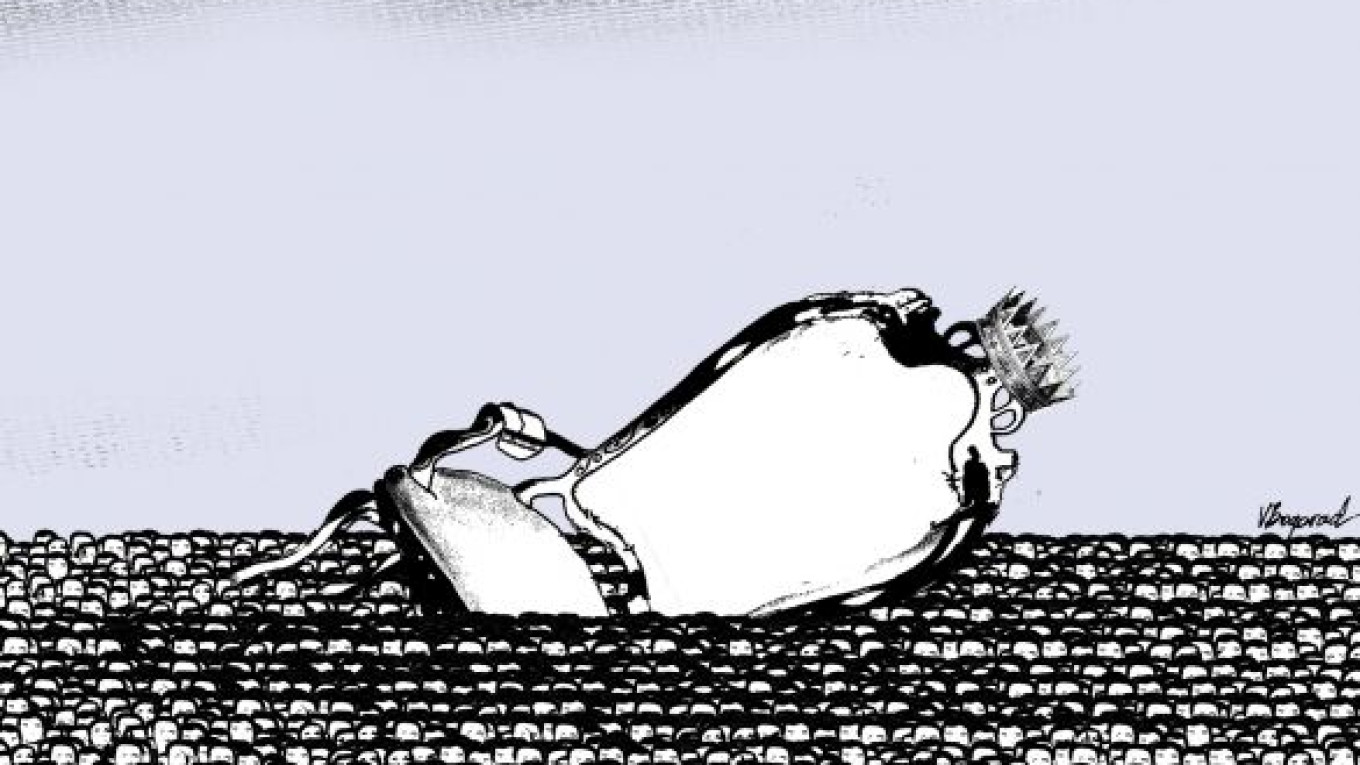
Putin's Feet of Clay

Editorial

Liberal politician Vladimir Ryzhkov in his comment on these pages on Tuesday made a convincing argument that the Egyptian scenario is not applicable to Russia — mainly because of stark demographic, religious and cultural differences between the countries. But this is no reason for the Kremlin to rest assured. The million-strong protests in Egypt demanding that President Hosni Mubarak step down and last month’s uprising in Tunisia serve as important reminders to the Kremlin of how vulnerable an autocracy is to a coup.

Despite the differences, there are still many parallels between Russia, Tunisia and Egypt: a monopolization of political power, a low per capita gross domestic product, limited economic opportunities, human rights abuses, a lack of free elections and restricted media freedoms, rampant corruption and nepotism, and a huge gap between the rich and poor with an insignificant middle class.

Mubarak served 29 years in office, and former Tunisian President Zine El Abidine Ben Al was in power for 23 years — the same number of years Putin will be in power, assuming he remains national leader (whether president or prime minister) for the next two presidential terms.

The Tunisian street protests started in December when a 27-year-old street vendor set himself on fire. He died several weeks later from his injuries. Notably, his chief complaint was that corrupt police expropriated his goods when he refused to pay bribes. Sound familiar?

The Tunisian revolution differs little from all the other revolutions against corrupt autocratic regimes, whether it be the 1986 overthrow of Philippine President Ferdinand Marcos, the multiple anti-Communist revolutions in 1989 in Eastern Europe, the 1998 uprising in Indonesia that forced President Suharto to resign or the ouster of Kyrgyz President Kurmanbek Bakiyev in April.

Since World War II, more than 125 authoritarian regimes have collapsed. There are 55 autocracies left, according to the Democracy Index. Despite all the hype last year among political analysts about the so-called fading of Western democracy and the rise of the autocratic model (read: China and Singapore), history is not on autocracy’s side. For every China and Singapore, there are many more Suhartos, Marcoses and Mubaraks, whose regimes last about 30 years before they collapse.

Because autocracies, by definition, lack legitimacy, they are inherently unstable. When millions of people finally reach their boiling point and take their anger onto the streets, there will never be enough police or soldiers to repress popular movements demanding basic liberty, freedoms and economic opportunity, especially when the police and soldiers share the same complaints.

The pensioners’ protests in 2005 and the 10,000-strong protest in Kaliningrad a year ago were Russia’s first serious wake-up calls during Vladimir Putin’s 10-year reign. These protests, of course, were mild compared with Egypt and Tunisia, but Russian protests could easily intensify if there is a sharp rise in inflation, for example, and if corruption and lawlessness continue unabated while the people’s standard of living continues to fall.

Russia differs little from other autocracies that have a small layer of corrupt and extremely wealthy political and business elite, a large lower class and a miniscule middle class that is crucial to provide a political, social and economic buffer. As long as the Russian elite continue to build mansions — both at home and abroad — while millions of Russians have trouble making ends meet with monthly incomes of $500 or less, this is a ticking time bomb for social unrest and street protests.

The Kremlin is making the same mistakes that all fallen autocratic regimes have made. By controlling the main media, manipulating elections and excluding opposition forces from the political process, Russia’s leaders can easily radicalize the people. As Elliot Abrams wrote in a Jan. 20 comment in The Washington Post, “Regimes that make moderate politics impossible make extremism far more likely.”

Indeed, as history often shows, when living conditions become intolerable under autocracies and people have no hope for the future, they first hit the streets with banners and slogans. If this doesn’t work, they return with Molotov cocktails.

The Manezh rioting in December and the weekly killings of policemen in the North Caucasus are two examples of how hopelessness and anger can turn into violence and extremism. This is inevitable when there are no other civil mechanisms available to bring about change in an ossified kleptocracy that is unwilling to reform itself or break its monopolistic hold on power.

Let’s hope the Kremlin draws the correct lessons from the Jasmine Revolution in Tunisia and the unrest in Egypt. Of course, Russia is under no immediate threat of revolution, and this has led the country’s leaders to become complacent with the status quo. It seems that the Kremlin under Putin’s leadership believes that Russians will tolerate low standards of living, corruption and government abuses forever. But, then again, so did Suharto, Marcos, Mubarak, Ceausescu and all of history’s other fallen autocrats.


This article has 4 comments on TheMoscowTimes.com and 0 comments on Facebook.

Leave a comment


Discussion
The Moscow Times welcomes your comments and invites you to discuss topics with other readers. Your comment will be posted automatically to enable a live discussion. If you aren't familiar with our comments policy, you can read it here.

If you're a registered user, you can start typing your comment below. If not, take a moment to sign up. and then return to the article.

If your comment doesn't appear, contact us by using our web form.

Comments


Putin's Feet of Oil

The article does point out some similarities between the situation in the arab world and Russia. However, it wrongly claims that Putin has created the gap between rich and poor in Russia. In reality, this happened during Yeltsin era and the the difference has been stabilized after Putin became a president. The difference is similar to that in USA, where this is not considered to be critical for the stability of the USA. The other issue, which is completely missing in this article is the fact that during Putin years the Russian economy has been growing markedly resulting average salary to grow more than ten fold. The violent crime and suicide rates have dropped to less than half and life expectance of men has risen by 6 years from 57 to 63. Overall death rate is decreasing and birth rate steadily increasing. Foreing organizations hve reported notable reduction in the number of kids living on the street. While there are sporadic terrorist acts, the scale has reduced dramatically form the theater siege in 2002 or Beslan 2004. Not to mention the bloody wars in Chechenia. The Yeltsin administration created massive poverty and demographic problems, which are far from over. Putin didn't create oil that has allowed Russia to reborn, but he has managed to spent the money wisely. The recent economic crisis was greatly buffered by the currency reserves gathered by Putin's goverment. I think Russian people do realize these facts, which is why Putin/Medvedev are so popular.

Putin's Feet of Clay

I have been to Egypt several times, I do also spend a lot of time in Russia.You cannot compare the population of Egypt to the people of Russia. Obviously you have never visited Egypt.  In the Middle-East in General and Egypt in particular, opportunities only existed for the few elites asociated with the ruling regime.  However, Russia has plenty of opportunities for everyone who desires to embark on any venture, take a chance and work hard at achieving his goals. Russia has equal opportunities as the USA and more than most of Europe.  The Russian Public is starting to realize it, and educate itself in order to best benefit from such vast opportunities.  I see no similarities between the ME/Egypt and Russia, although more similarities exist between the USA and Russia with a gap that is being steadily breached. 

Putin's Feet of Clay

"Putin's Feet of Oil" You describe a Russia that I don't recognise and neither will most Russians. You state the Putin / Medvedev are "so popular". Where is your evidence? Ask (almost) anyone in Moscow and they will roll their eyes or make some negative comment about "the tandem" (my own personal view is the Putin should go and let Medvedev get on with the job of democratising Russia). Crimes levels may have fallen but that is only the reported crimes. As can be read throughout the pages of Moscow Times there are many, many more crimes that aren't reported due to a lack of faith with the militsia or for other more nefarious reasons. As for your spelling of Chechenia — Would I be correct in assuming that you are not a native Russian?

RE: Putin's Feet of Clay

Yes, I am not a native Russian, but I have visited the country regularly, I have Russian friends, and I follow closely news from Russia using as many sources as I can find. In my own country the media often highlights various facts about how badly things are in Russia. However, they never mention anything about the development, or how much worse everything was in the Yeltsin times. Before Putin became the president, Russias death rate had already increased by 30%, birth rate had decreased almost by half, Russia was wiped with HIV, hepatitis and tuberculosis epidemics. The privatization created monstrously rich oligarchs, tens of millions of people were condemned in poverty and the state was bancrupt. Not to mentions, millions of kids living on the street. Infrastructure was totally neglected and science had collapsed. The whole economy of Russia was smaller than that of Sweden! Medvedev got a totally different package from his predecessor than Putin. The violence is still very high in Russia, but nevertheless the mortality is decreasing steadily in Russia. I don't have illusions that Putin/medvedev would be celebrated, but there are several polls done (by Levadia center for example) that show their policy to have support from the majority of Russian people. Russia has been in crisis since 1990 and even the situation is much better now, many indicators are still below those of the Soviet time. It is very hard to stop the corruption in a country that has been several years in anarchy. I think many people still believe in magical changes that would bring prosperity in overnight. In reality, the only way to success is a slow but stable progress. And this is something that Putin/Medvedev have already proven they can do.

Report Inappropriate Comment


Comments via Facebook


Also in Opinion

There's Just One Nationality — Mathematician

Nationalism is an infantile disease. It is the measles of mankind."

Russia's New Propaganda Minister

After Monday's announcement that historian Vladimir Medinsky was appointed the culture minister, critics quickly labeled him the new propaganda minister. Medinsky's academic ethics and historical distortions may raise serious questions, but for the Kremlin, he has three important attributes that are much more important: He is a model United Russia leader, a firm Putin loyalist and a skilled sophist.

Spinning Medvedev's Government

Were this 2008 and not 2012 — and had Dmitry Medvedev been named prime minister without having first served a full term as president — then the composition of his new government might have created a generally positive impression.

New Government Faces Old Problems

A longstanding platitude shared by both the Kremlin as well as domestic and foreign analysts is the need for Russia to diversify its economy away from energy dependence and reduce its non-oil budget deficit.

Putin's Postman Delivers Nothing at the G8

In the mid-1990s, former President Boris Yeltsin fought hard for the right to sit as equal at the same table with the leaders of the world's seven leading democracies. Using a lot of political wrangling, Moscow finally secured permanent membership in this elite club where the real heavyweights are supposed to solve the world's most pressing problems.

Russia Stays Home

Just three days before his return to the Kremlin as president, Vladimir Putin met behind closed doors at his residence in Novo-Ogaryovo, outside Moscow, with U.S. National Security Adviser Tom Donilon, who was there to transmit President Barack Obama's renewed determination to strengthen cooperation with Russia.


print


Comments

This article has 4 comments on TheMoscowTimes.com and 0 comments on Facebook.

Leave a comment


To Our Readers

The Moscow Times welcomes letters to the editor. Letters for publication should be signed and bear the signatory's address and telephone number.

Letters to the editor should be sent by fax to (7-495) 232-6529, by e-mail to oped@imedia.ru, or by post. The Moscow Times reserves the right to edit letters.


Most Read
MarketGid
