

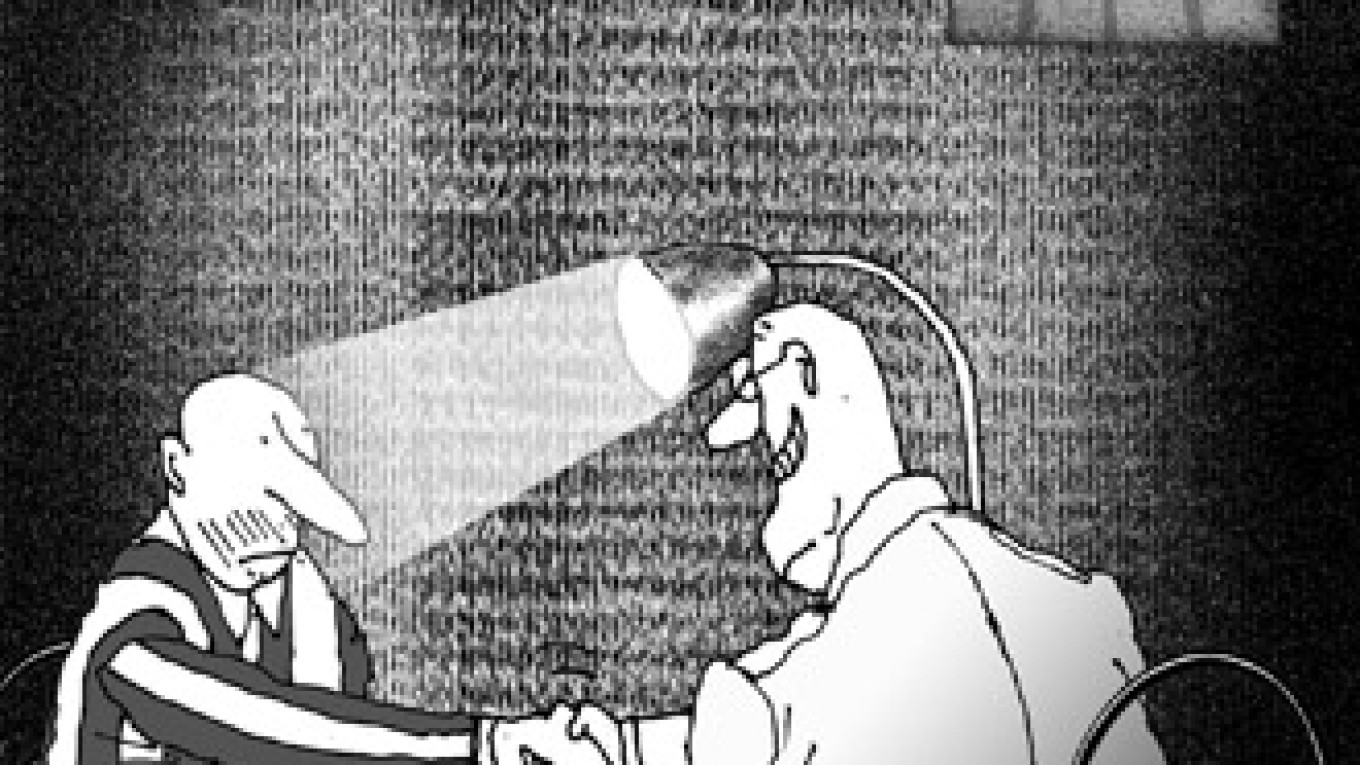
The duty of any defense lawyer is to defend the rights of people accused of committing crimes. Therefore, at first glance, I should have been happy about the new law on plea bargaining that ostensibly opens new opportunities to ease the fate of defendants. But instead of being pleased, I am alarmed.
The mechanics of plea bargaining are well known: The defendant pleads guilty to a lesser crime, and the prosecutor drops charges for the more serious crime. In any honest plea bargain, the interests of both sides should be transparent: The accused receives a lighter sentence and the prosecution is freed from the need to prove guilt, thereby saving it time and effort and thereby saving taxpayers’ money.
Unfortunately, the Russian version of plea bargaining doesn’t work this way at all. The provisions of the plea-bargaining law do not apply if the defendant’s cooperation with the authorities consists only of his admittance of guilt. He must state in writing everything he knows about his accomplices and what he will do to expose them. But this is the responsibility of the state. Why must a defendant inform on others before he can enter a plea bargain on his own charges?
This written statement could cost the defendant his life or the lives of his relatives — especially since the “state’s protection” in today’s conditions above all means the protection of the siloviki’s interests, not the defendant’s interests. Recall the story of Antonio Valdez-Garcia, a Spanish citizen who miraculously survived under the “protection” of officers from the prosecutor general and the Interior Ministry. While held in some secret place, Valdez-Garcia said he was beaten and tortured to extract incriminating evidence against his alleged accomplices.
Having already received a defendant’s written statement incriminating accomplices, investigators and prosecutors are free to refuse to fulfill their side of the plea-bargain agreement. The law provides no criteria for when the prosecution can annul a plea bargain, nor does the defendant have a right to appeal the annulment in court.
Corrupt siloviki — with no offense intended to the honest professionals in the field — will use every means at their disposal. Also, improving the statistics — that is, the percentage of solved cases — is far more important for the siloviki than protecting the rights of defendants.
Even if the defendant successfully enters a plea bargain, this doesn’t mean that he will ultimately receive a lesser sentence or even a firm commitment from the prosecution to do this in the future. The new law stipulates that “mitigating circumstances and norms of the law that may be applied” — note, “may be,” not “must be” — if the defendant meets the terms and fulfills the obligations laid out in the plea-bargain agreement, meaning the accused helped incriminate others in court and assists in prosecuting accomplices. At that point, the prosecutor and judge will decide whether the defendant “concealed information” or simply remained silent on any point.
The criteria used to determine plea-bargaining eligibility are “criminal acts that are revealed (prosecuted) as a result of cooperation” with authorities. Stated more simply, a defendant must inform on others. The other criteria are completely subjective, such as assessing the character, scope and significance of the defendant’s assistance provided to the prosecution. It is left entirely to the discretion of the prosecution and the judge. If they want to, they will recognize the defendant’s assistance as important, in which case the authorities will grant a lesser sentence. If they don’t feel like it, they won’t. This opens up new opportunities for corruption in applying this law.
But even if the defendant jumps over all of the hurdles and successfully plea-bargains a lesser sentence, if it is “discovered” later that he lied or concealed any relevant information, the reduced sentence can be revised upward. Who will “discover” this information and prove its veracity? What are the criteria for determining not only that something was “relevant,” but that the defendant was aware of its relevance to the case? There are no answers, only a vague reference to a different section of the Criminal Procedural Code that stipulates three different procedures. The right to choose which procedure to apply is left up to the prosecution, giving the siloviki yet another golden opportunity to abuse their powers. Thus, the “sword of retribution” will hang perilously above the neck of the defendant who is willing to cooperate with the prosecution.
How should we interpret this new law on plea bargaining? Is it a step toward the strengthening of the rule of law and more humane legislation? Will it help law enforcement officers prosecute dangerous criminals — in particular leaders of organized crime syndicates — even if it means manipulating plea-bargaining agreements and tricking defendants into informing on other people? I concede that the State Duma deputies who voted for the law naively had these goals in mind. However, the new plea-bargaining law will inevitably be associated with disgraceful, corrupt and politically driven crimes, the desire to “expose” high-profile crimes at any price, torture and blackmail — all of which Russia had enough of before the law.
The world will long remember the story of Vasily Aleksanyan, in which investigators used inhumane methods to extract from him “proof incriminating other accomplices and helping to reveal additional crimes.” While in custody, Aleksanyan’s accusers deprived him of urgently needed treatment for his terminal illness and offered him a depraved deal: his testimony that the investigators needed for its case in exchange for his life.
The Valdez-Garcia and Aleksanyan cases are perhaps the most infamous examples of prosecutors abusing a defendant’s rights, but there are many similar cases across Russia. Armed with the new law on plea bargaining, siloviki have been given a smoke screen that will help legalize these abuses of power, whether the lawmakers wanted this or not.
Vadim Klyuvgant is an attorney-at-law.
A Message from The Moscow Times:
Dear readers,
We are facing unprecedented challenges. Russia's Prosecutor General's Office has designated The Moscow Times as an "undesirable" organization, criminalizing our work and putting our staff at risk of prosecution. This follows our earlier unjust labeling as a "foreign agent."
These actions are direct attempts to silence independent journalism in Russia. The authorities claim our work "discredits the decisions of the Russian leadership." We see things differently: we strive to provide accurate, unbiased reporting on Russia.
We, the journalists of The Moscow Times, refuse to be silenced. But to continue our work, we need your help.
Your support, no matter how small, makes a world of difference. If you can, please support us monthly starting from just $2. It's quick to set up, and every contribution makes a significant impact.
By supporting The Moscow Times, you're defending open, independent journalism in the face of repression. Thank you for standing with us.

Remind me later.