

Until a few days ago, everyone assumed that President Vladimir Putin had ordered the humiliating searches of opposition leaders' apartments last week. The goal seemed to be clear: to intimidate the leaders and their followers. It was logical at that point to expect that pro-government provocateurs would instigate more clashes with the police during the March of Millions on June 12, thereby justifying the harsher anti-protest legislation recently adopted by the government. But the march was peaceful, and there were no arrests.
Kremlin-friendly publicists are now putting forward a completely different version of events. They claim that Investigative Committee head Alexander Bastrykin had organized the search of opposition leaders' apartments to try to distract the attention of the media and the public from a scandal of his own, which erupted after he ordered several police officers to take Novaya Gazeta investigative journalist Sergei Sokolov into the woods, where Bastrykin reportedly threatened to kill Sokolov. By all indications, Bastrykin had it out for Sokolov for writing an article implying that Bastrykin was in cahoots with organized crime.
Realizing that this would inevitably become public knowledge, Bastrykin ordered the search and seizures against opposition leaders to demonstrate his loyalty to Putin in the hopes that his patron would shield him from the scandal. After Novaya Gazeta editor-in-chief Dmitry Muratov published a scathing article criticizing Bastrykin, the Kremlin apparently nudged Bastrykin into adopting a more conciliatory stance. He ultimately apologized in person to Muratov, Sokolov and other Novaya Gazeta employees.
During the peak of the Bastrykin scandal, the U.S. National Intelligence Council sent a report to Congress claiming that Russia has been supplying Iran with technology to create long-range ballistic missiles. That accusation had been made before, but this time the National Intelligence Council included a strange disclaimer that in all likelihood the Kremlin "is not pursuing a policy in support of the Iranian missile program." The implication was that Russia's ??sharing of ballistic-?missile technology was an independent initiative by Rosoboronexport, the agency that deals with weapons exports, without the sanction of the Kremlin. Thus, the U.S. intelligence agency concluded, "The Russian government is unable to control the activities of state companies and cannot prevent them from participating in illegal transactions with the Islamic Republic of Iran."
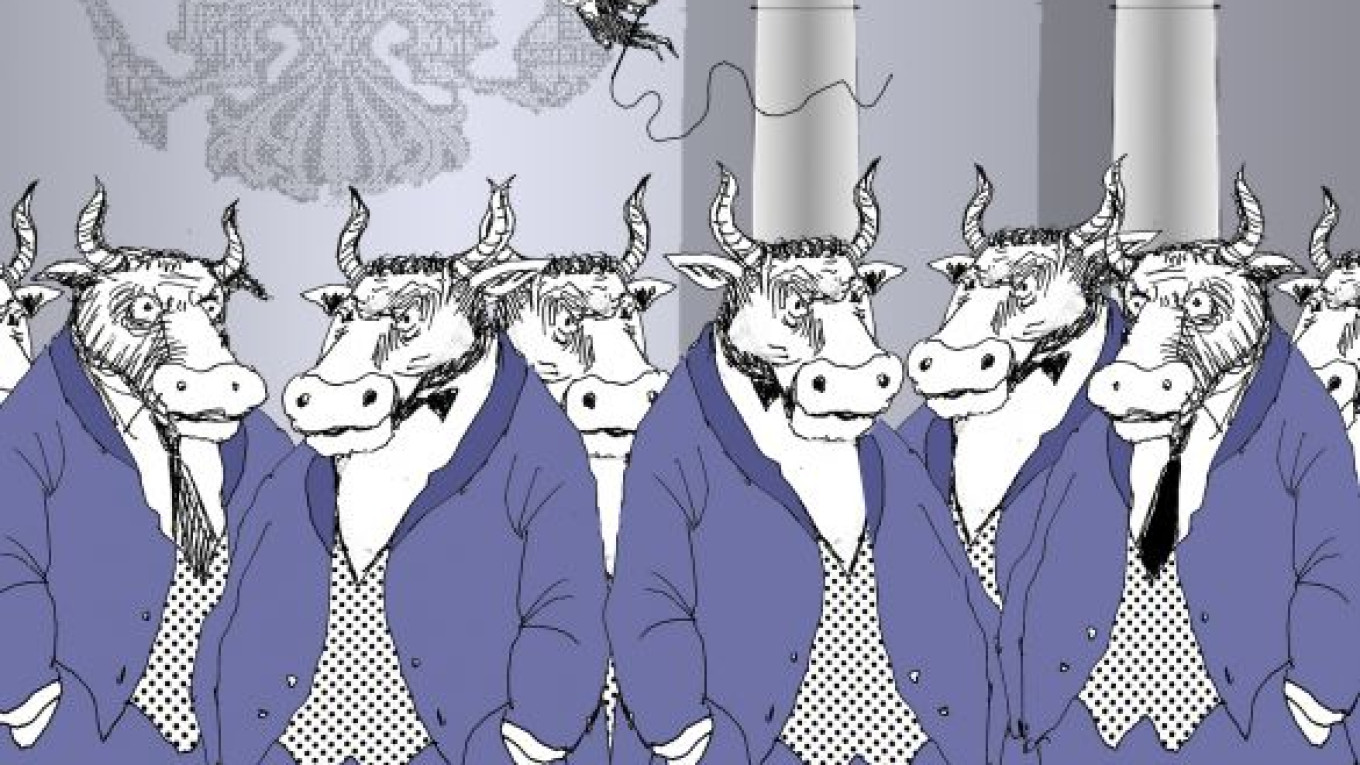
If that is the case, there is reason to believe that the power vertical Putin has tried to erect over the past 12 years is collapsing. Putin's authoritarianism no longer resembles an autocratic monarchy in which the king alone makes decisions that are faithfully carried out by his subjects. Now the regime looks more like a chaotic feudal system that has been weakened by overly independent and obstinate local chiefs.
Putin's "new nobility," as Security Council head Nikolai Patrushev in 2005 called the chekhists in Putin's ruling elite, have started to view their respective agencies as their personal property. In reality, they report to Putin on paper only. It has even reached the point where state agencies are developing their own domestic and foreign policies.
Thus, we don't know for sure whether Bastrykin and Rosoboronexport head Anatoly Isaikin are carrying out state policy as defined by Putin as an authoritarian leader or are acting out of purely selfish interests. And it also leads to the more basic question of where Putin's authority ends and where the new robber barons' authority begins.
The serious cracks in Putin's power vertical are now apparent. Historically, authoritarian leaders have always needed to rally their subjects around a national idea, such as the need to repel a formidable, insidious enemy. To be sure, Putin has tried to mobilize the masses around the fight against his fictitious enemy of choice: the United States and NATO. But there are limits to the effectiveness of these tactics.
Instead, Putin's real "national idea" is to allow his friends and former colleagues to use such institutions as law enforcement, intelligence agencies, key political and economic ministries, state corporations, the judicial system and parliament exclusively for their personal enrichment. Former Federal Drug Control Service head Viktor Cherkesov once appealed to his fellow chekhists to remain warriors who defend the motherland and not to become corrupt merchants. Needless to say, Cherkesov's appeal failed miserably.
The result is that the longer Putin's vertical power system acts like everything is business as usual, the weaker it becomes. Although Putin has only just returned to the Kremlin, it is looking more and more like his new term has already finished.
Alexander Golts is deputy editor of the online newspaper Yezhednevny Zhurnal.
A Message from The Moscow Times:
Dear readers,
We are facing unprecedented challenges. Russia's Prosecutor General's Office has designated The Moscow Times as an "undesirable" organization, criminalizing our work and putting our staff at risk of prosecution. This follows our earlier unjust labeling as a "foreign agent."
These actions are direct attempts to silence independent journalism in Russia. The authorities claim our work "discredits the decisions of the Russian leadership." We see things differently: we strive to provide accurate, unbiased reporting on Russia.
We, the journalists of The Moscow Times, refuse to be silenced. But to continue our work, we need your help.
Your support, no matter how small, makes a world of difference. If you can, please support us monthly starting from just $2. It's quick to set up, and every contribution makes a significant impact.
By supporting The Moscow Times, you're defending open, independent journalism in the face of repression. Thank you for standing with us.

Remind me later.