

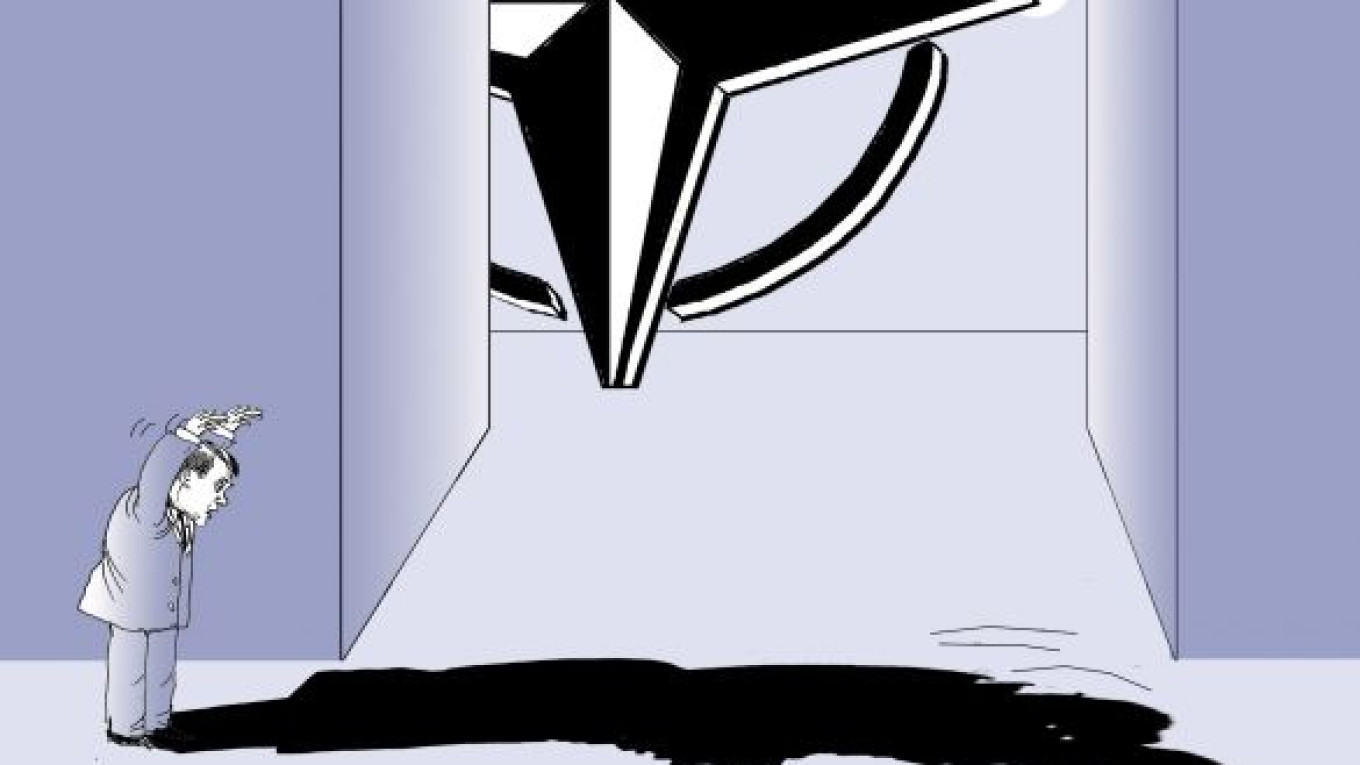
For the last several weeks, President Dmitry Medvedev and senior Russian officials have tensely been promising to reveal which measures Moscow will take if Europe deploys a missile defense system. They have been so overwrought that even I began to wonder whether Russia was going to try to scare the West with some type of new weapon. And when Medvedev finally made his announcement, everyone breathed a sigh of relief. The “threat” from the Russian president should calm whatever anxieties the West might have had.
Russia has threatened to start the operation of an early warning radar station in Kaliningrad. However, it is difficult to understand the logic of those who claim that a station designed to warn of enemy missiles flying toward Moscow can be considered a response to the deployment of a missile defense system in Europe designed to intercept enemy missiles. Both are defensive in nature and pose no threat to the other. In fact, if the early warning station in Kaliningrad poses a threat to anybody, it is to Belarussian dictator Alexander Lukashenko. When the Kaliningrad station begins operations, it will eliminate the need for the early warning radar station that Russia has been using in the Belarussian region of Baranovichi — a station that Lukashenko regularly uses to blackmail Moscow. What’s more, Oleg Ostapenko, commander of the Space Forces, promised one month ago to put the Kaliningrad station online. In effect, Medvedev’s “response” is to do something that was already planned.
The president also issued an order to “strengthen the protection of elements of the strategic nuclear forces.” However, the U.S. Standard-3M missile cannot now and never will be able to strike the starting position of Russia’s nuclear missiles. Moreover, such “protection” can only be provided by intercepting the enemy’s incoming ballistic missiles. It has been said the S-400 air defense system is capable of achieving that. However, the Almaz-Antei firm has been unable to start serial production of that weapon system. Thus, Medvedev will have to wait for the construction of two missile defense factories to be completed before he can make good on his “response.”
Medvedev also said Russian missiles would be equipped with highly effective new warheads and promised new capabilities for overcoming missile defenses. We have been hearing all of that for the last eight years. Apparently, the reference is to “planning warheads” that will be able to maneuver after their return to the Earth’s atmosphere. The problem is that the United States could only hope to stop such warheads by deploying interceptor missiles on or near U.S. territory: the planned deployment of U.S missile defense system elements in Poland, Turkey, Romania and Spain that has so badly agitated Moscow would be useless against such warheads.
Moreover, Medvedev has now threatened to develop the means to disrupt the information and control systems of Western missile defense installations if necessary. This does not refer to nuclear missile attacks on those systems, but to the need for Russia’s military to develop the capacity for a cyber attack against U.S. missile defense systems. However, considering Russia’s extremely modest achievements in the field of information technology, a U.S. counterattack along the same lines could be devastating.
In addition, Medvedev has threatened to deploy modern attack systems in Russia’s western and southern regions that could destroy the elements of the missile defense system in Europe. One step toward that goal would be the deployment of Iskander missile systems in the Kaliningrad special district. However, if Russia decides not to violate the Intermediate-Range Nuclear Forces Treaty, the Iskander will not be able to fly further than 500 kilometers. In that case, the missiles could only reach part of Poland but none of Romania. Moreover, from a military point of view, the best single way to destroy missile defense systems is with a preemptive strike. That means Medvedev is threatening the possibility of starting a war against NATO.
And finally, the most ridiculous threat: in a worst-case scenario, Russia reserves the right to reject further steps toward disarmament and, accordingly, arms control. What’s more, according to Medvedev, “there might be grounds for our country to withdraw from the New START treaty.” At a time when the United States and other NATO states have a significant numerical superiority in both conventional and nuclear weapons, this “arms control” is especially beneficial for Russia. For example, consider the New START treaty from which Russia is now threatening to withdraw. If to use the rules for calculating weapons from the previous treaty, the United States has almost two times more delivery vehicles for nuclear weapons than Russia (and one-third more according to the current rules). In either case, Russia could reach the maximum number of weapons permitted in the new treaty only by 2028 at the earliest. Under such conditions, Moscow would only be shooting itself in the foot if it withdrew from the treaty.
Thus, all of Medvedev’s statements have no relationship to any real military threat or to Russia’s current capabilities. It seems that the proposals for a “response” to the West were prepared by the top brass in the same haphazard way that a list was made of individuals responsible for a series of unfulfilled state defense contracts that Medvedev had angrily demanded from his subordinates several months ago. That list included the names of all the people who had already been fired over the previous 18 months. In a similar fashion, Medvedev has responded to the “cunning schemes” of the West by listing everything that the Defense Ministry had already been planning in the fields of nuclear weapons and missile defense.
Alexander Golts is deputy editor of the online newspaper Yezhednevny Zhurnal.
A Message from The Moscow Times:
Dear readers,
We are facing unprecedented challenges. Russia's Prosecutor General's Office has designated The Moscow Times as an "undesirable" organization, criminalizing our work and putting our staff at risk of prosecution. This follows our earlier unjust labeling as a "foreign agent."
These actions are direct attempts to silence independent journalism in Russia. The authorities claim our work "discredits the decisions of the Russian leadership." We see things differently: we strive to provide accurate, unbiased reporting on Russia.
We, the journalists of The Moscow Times, refuse to be silenced. But to continue our work, we need your help.
Your support, no matter how small, makes a world of difference. If you can, please support us monthly starting from just $2. It's quick to set up, and every contribution makes a significant impact.
By supporting The Moscow Times, you're defending open, independent journalism in the face of repression. Thank you for standing with us.

Remind me later.