

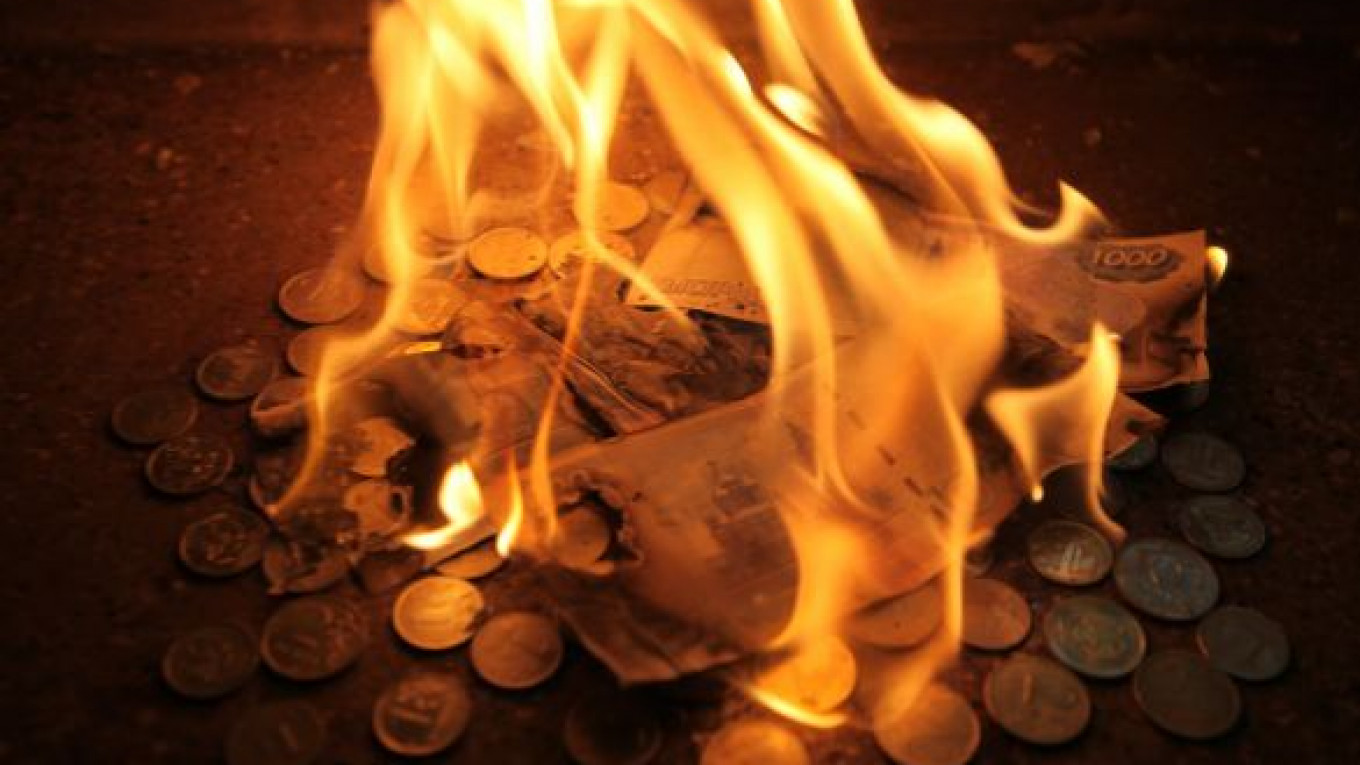
The slowly unfolding financial meltdown in Greece was not inevitable any more than the 1998 economic crisis in Russia. But a combination of an unsustainable fiscal policy, weak government and some bad luck was enough to provoke the financial markets to abandon Russia in droves some 12 years ago. A similar set of circumstances seems to be conspiring to erupt in a financial collapse in Greece in the near future.
Although Russia’s default on its domestic ruble-denominated debt in August 1998 differs in some respects fr om what is happening in Greece — every debt crisis has its own unique characteristics — they share some key features that warrant attention. The critical point is that the debt dynamics in Greece, as with Russian GKOs, or treasury bonds, in the early summer of 1998, are probably beyond the point of no return. If the Russian precedent is valid, then the latest European bailout package, announced with much pomp on Sunday, in conjunction with resources fr om the International Monetary Fund, will only postpone the inevitable.
In the Russian case, access to easy credit quickly led to an unmanageable pile of debt. As debt grew, the credibility of fiscal policy to generate tax income was increasingly put in doubt. For Russia, the use of financing from the GKO market was intended to sustain economic growth while a proper tax system was created. But that didn’t happen — at least not until after the crisis forced a strong dose of reality upon the country. As one London-based investment banker told me in July 1998, after a $22 billion IMF-coordinated bailout had been approved, “Investors no longer believe that they are bridging [their loans] to future tax receipts.” ?
For Greece, its inclusion in the euro zone in 2001 meant that the Greek government could borrow cheaply with the implicit guarantee of the other members, at least as far as many investors were concerned. Thus the Greek-German bond yield spread averaged about 0.65 percentage points in the five years through November, before worries started to mount about the gaping budget deficit.
Since then, there has been increasing skepticism over Greece’s ability to manage its estimated state debt of 300 billion euros ($400 billion), well in excess of its 240 billion euro annual economic output last year. This is strikingly similar to the skepticism regarding Russia in early and mid-1998, several months after the world had witnessed the Asian crisis in late 1997. The initially euphoric market reaction to each announcement of a solution to this Greek tragedy in recent weeks has been inevitably followed by worried investors dumping Greek stocks and bonds. Last week, Fitch downgraded Greece to one notch above junk with a negative outlook, saying a deepening recession and rising debt-service costs would make it even harder for Athens to meet its budget deficit reduction target. At the same time, yields on Greek bonds rose as confidence in the nation’s assets withered. The extra yield that investors demanded to hold the country’s 10-year bonds instead of German bonds, the euro zone’s benchmark government securities, climbed to 442 basis points on April 8, the highest since 1998. Worried depositors reportedly withdrew money from their bank accounts, and Greek banks were facing massive liquidity shortages.
All of this is reminiscent of Russia in 1998. Of course, Russia already had an IMF program that was seen by many market participants as an implicit guarantee that the major powers would not let the country fail, especially considering its large territory and nuclear arsenal. Under that program, the Russian government was supposed to reduce its budget deficit in exchange for financing to cushion the shock of economic adjustment. But political reality impeded the implementation of the agreed-upon program, and revenue targets were consistently missed. In Greece, too, even before any expected IMF involvement, the government has supposedly imposed tough austerity measures to meet a pledge to cut the public deficit by 4 percentage points of gross domestic product to 8.7 percent this year from 12.9 percent now estimated for 2009. Don’t hold your breath. Partial results leaked about actual performance in the first quarter imply overspending and, therefore, the need to catch up during the rest of the year — an exercise in daydreaming that Russian officials will recall with foreboding. And this is before a planned April 22 civil servants strike in Greece.
The large financial support package announced by euro-zone members on Sunday sounds encouraging if you ignore, for a moment, questions regarding how the funds will be disbursed and under what conditions. Even if Greece has gained some breathing room, it is far from clear how it can get out of the hole that it has dug. After all, even assuming an optimistic average interest rate of about 4 percent for official financing, Greece would have to implement budget policies to ensure a 5 percentage or 6 percentage point turnaround in the primary fiscal account. Even then, it would have to maintain this level, while at the same time produce real economic growth of 1 percent a year and generate an external current account surplus to honor interest payments to foreign creditors.
Russia wasn’t able to accomplish this until the credit tap stopped after the default. Greece is unlikely to be any different. In fact, as long as it stays with the euro, Greece could face years of deflation — a prospect that Russia avoided, owing to the devaluation of the ruble after the GKO default.
What happens next? On Tuesday, Greece issued about 1.2 billion euros of six-month and 12-month treasury bills. The Greek debt agency seemed pleased that it paid only 4.85 percent on the 12-month bills. In the January auction, 12-month bills were sold at a yield of 2.2 percent. The problem is that with the bulk of Greek debt rolling over in two to three years, the country gradually will become immersed in interest expenses, even as its overall output stagnates as a result of austerity measures needed to reduce its need for borrowing. There is no way that these rates in a no-growth environment can be consistent with a sustainable situation or a situation wh ere a liquidity crisis can be avoided.
The result of Tuesday’s auction confirms that the package announced Sunday has enabled Greece to finance itself in the short run. But the longer-term fundamental issues haven’t changed. Greece has to put its finances in order against the backdrop of an economy that currently is shrinking. Yet the Greek government is having difficulty convincing its people of the magnitude of the country’s problems and the required domestic adjustments. As a result, Greece is unable to provide sufficient assurances to its creditors, thereby further complicating an already tough situation. Unlike Russia in 1998, the Greeks have lim ited policy tools: They can either default or deflate. Many Greeks, no doubt, wish that they had taken their Russian lessons more seriously.
Martin Gilman, former senior representative of the International Monetary Fund in Russia, is a professor at the Higher School of Economics.
A Message from The Moscow Times:
Dear readers,
We are facing unprecedented challenges. Russia's Prosecutor General's Office has designated The Moscow Times as an "undesirable" organization, criminalizing our work and putting our staff at risk of prosecution. This follows our earlier unjust labeling as a "foreign agent."
These actions are direct attempts to silence independent journalism in Russia. The authorities claim our work "discredits the decisions of the Russian leadership." We see things differently: we strive to provide accurate, unbiased reporting on Russia.
We, the journalists of The Moscow Times, refuse to be silenced. But to continue our work, we need your help.
Your support, no matter how small, makes a world of difference. If you can, please support us monthly starting from just $2. It's quick to set up, and every contribution makes a significant impact.
By supporting The Moscow Times, you're defending open, independent journalism in the face of repression. Thank you for standing with us.

Remind me later.