

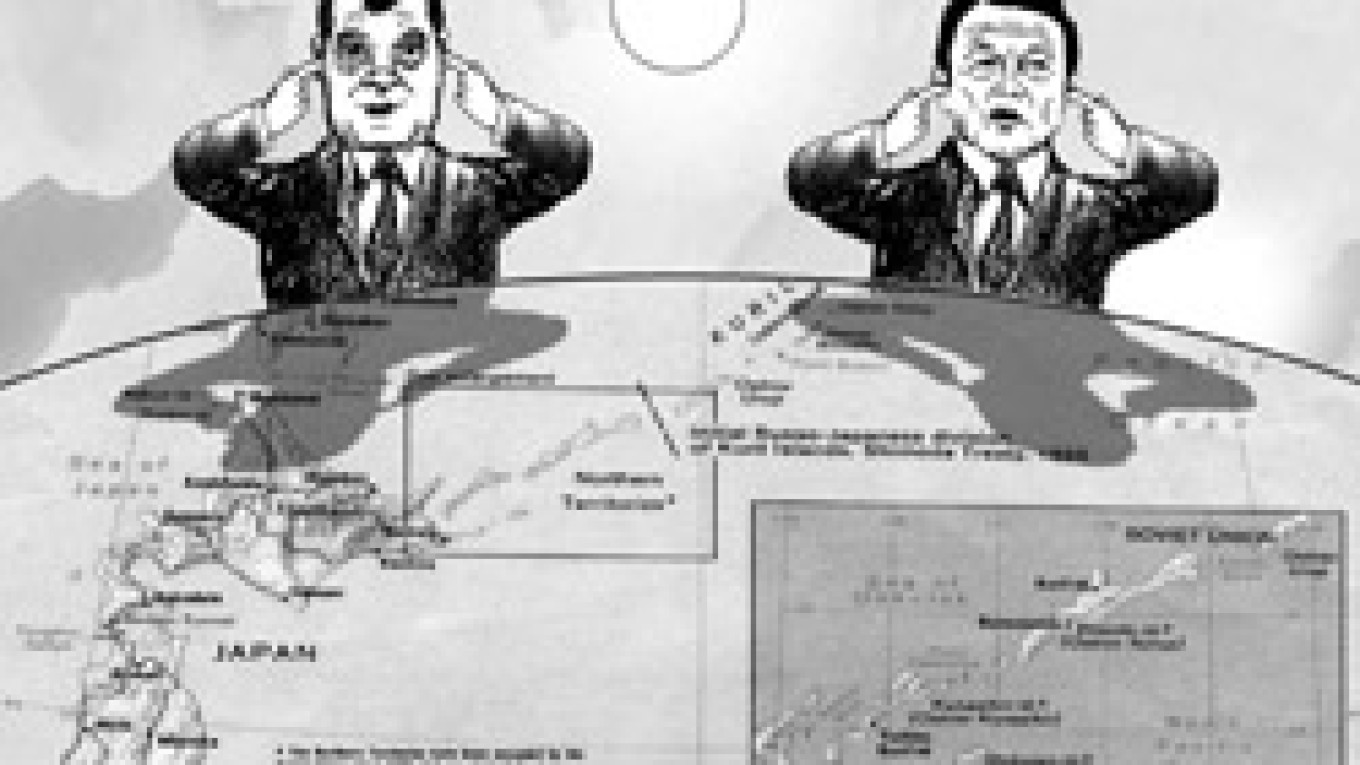
At their bilateral meeting in L’Aquila, Italy, on the sidelines of the Group of Eight summit earlier this month, President Dmitry Medvedev and Japanese Prime Minister Taro Aso exchanged views on the dispute that has darkened bilateral relations since 1945 — the Kuril Islands. Both leaders have once again “agreed to disagree” over this thorny issue that prevented Moscow and Tokyo from normalizing their political relationships in full and signing a peace treaty, which does not exist to this day.
“Japan cannot be satisfied with this situation,” Aso said. “Unless Russia takes practical steps to sign a peace treaty, we will be unable to develop partner relations with it in the Asia-Pacific region.” He insisted that Moscow should return to Japan the so-called Northern Territories, which is the Japanese political name for the South Kuril Islands that it took after defeating the Russian Empire during the 1904-1905 war in the Far East. The head of the Japanese government has also threatened to halt the implementation of multibillion-dollar contracts with Russia if the islands aren’t returned.
On June 11, the lower house of Japan’s parliament adopted amendments to the 1982 law on special measures to facilitate a solution of the “Northern Territories” issue, with the upper house approving it July 3. According to this law, the four South Kuril Islands were called “indigenous Japanese territory” and therefore should be given back to Japan.
Russia responded to the amendments with strongly worded statements by Medvedev and members of the State Duma, Federation Council and Foreign Ministry. The Federation Council, for example, labeled the Japanese parliamentary initiative as “the most unfriendly gesture, which is insulting to the Russian people.” The senators asked Medvedev to impose a moratorium on the visa-free regime existing between the two countries.
The Foreign Ministry said the Japanese move produced a sharply negative reaction in Russian society and called Japan’s territorial claims “inadmissible” and “unacceptable.”
This sharp reaction by Russia’s top political leaders is justified for many reasons. Among the most important:
First, the Japanese parliament has proclaimed the four islands as Japanese “historic land” for the first time in the long postwar history. There was not such a law in that country since 1945, though there were a number of resolutions on this case.
 | |
|
To Our Readers | |
|
The Moscow Times welcomes letters to the editor. Letters for publication should be signed and bear the signatory's address and telephone number.
| |
| | |
Second, the Russians are suspicious that if they hand over the four Kuril Islands, Japan will soon demand the rest of the Kuril chain of islands up to the Kamchatka Peninsula plus Sakhalin Island, both of which are rich in sea, agricultural and energy resources. Moreover, the straits between them are of strategic significance.
Third, in Russia’s mind, the June-July decision by the Japanese parliament has global implications. It creates a dangerous precedent in world politics and in the Asia-Pacific region. Above all, it can be interpreted as a threat to Russia’s national security.
Fourth, the move has been regarded here as an attempt to redraw postwar borders already fixed by international law. Proponents of the Russian sovereignty over the islands hold that the recent Japanese decisions run counter to Article 2 of the United Nations Charter, which urges all nations to observe sovereignty and territorial integrity of all other countries. These territories and the southern part of Sakhalin, Russians say, were discovered and inhabited by Russians at the beginning of 18th century, and they were returned to the Soviet Union under the decisions made at the Yalta and Potsdam conferences of the Allied Powers in 1945 as well as Article 2 of the San Francisco Peace Treaty between the Allied Powers and Japan, signed in 1951, that renounced Japan’s rights to the Kuril and Sakhalin islands.
Fifth, Moscow holds that the Japanese action may complicate efforts aimed at the signing of a peace treaty between them. In its statement issued June 24, the Duma said that after the Japanese action, any attempt to resolve the issue of a peace treaty “has lost its political significance and practical perspective.”
In Medvedev’s blog, a contributor suggested that Russia change its stance on a peace treaty by offering his own formula: “Russia will sign a peace treaty [with Japan], if Japan renounces its claims to the four islands for good.” Japan’s position on this issue is that it would sign a peace treaty with Moscow only after Russia returns all four disputed islands.
Some of Russia’s top leaders point out that Moscow actually does not need a peace treaty with Tokyo at all because a number of problems that appeared after World War II — establishing diplomatic relations, demarcation of their borders and many other key issues — have been happily resolved so far in the 1956 Soviet-Japanese Joint Declaration.
Where the current row between Moscow and Tokyo initiated by Japanese parliament could lead is a big question. But one observation is certain: It has caused serious damage to Russian-Japanese relations, and it will be not so easy to repair them in the immediate future.
Vladimir Kozin has been awarded the title of state adviser, second category.
A Message from The Moscow Times:
Dear readers,
We are facing unprecedented challenges. Russia's Prosecutor General's Office has designated The Moscow Times as an "undesirable" organization, criminalizing our work and putting our staff at risk of prosecution. This follows our earlier unjust labeling as a "foreign agent."
These actions are direct attempts to silence independent journalism in Russia. The authorities claim our work "discredits the decisions of the Russian leadership." We see things differently: we strive to provide accurate, unbiased reporting on Russia.
We, the journalists of The Moscow Times, refuse to be silenced. But to continue our work, we need your help.
Your support, no matter how small, makes a world of difference. If you can, please support us monthly starting from just $2. It's quick to set up, and every contribution makes a significant impact.
By supporting The Moscow Times, you're defending open, independent journalism in the face of repression. Thank you for standing with us.

Remind me later.