

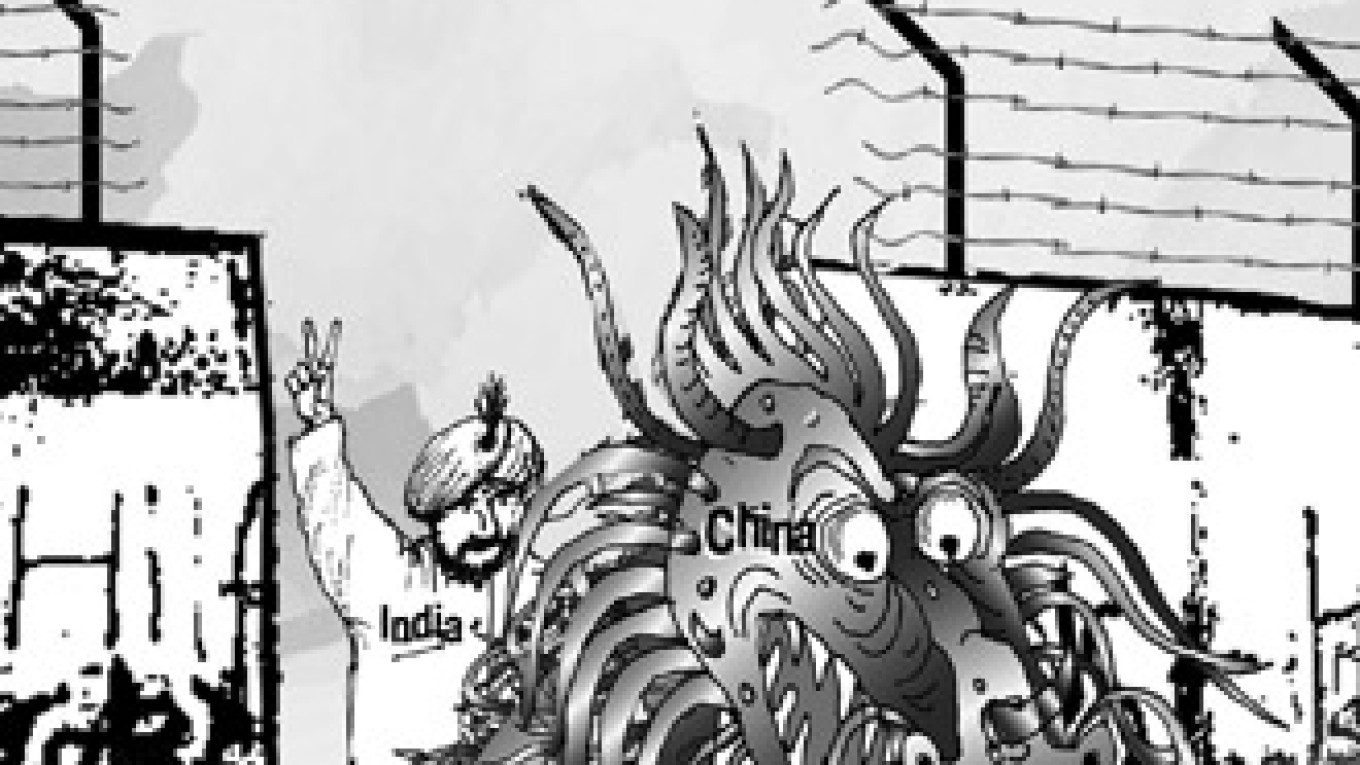
By marking the Cold War’s end and the looming collapse of the Soviet Union, the fall of the Berlin Wall 20 years ago transformed global geopolitics. But no continent benefited more than Asia, whose dramatic economic rise since 1989 has occurred at a speed and scale without parallel in world history.
For Asia, the most important consequence of the fall of the Berlin Wall was that the collapse of communism produced a shift from the primacy of military power to economic power in shaping the international order. To be sure, rapid economic growth also occurred during the Industrial Revolution and in the post-World War II period. But in the post-Cold War period, economic growth by itself has contributed to altering global power relations.
Another defining event in 1989 was the Tiananmen Square massacre of pro-democracy protestors in Beijing. If not for the Cold War’s end, the West would not have let China off the hook over those killings. Instead, the West adopted a pragmatic approach, shunning trade sanctions and helping to integrate China into the global economy and international institutions through the liberalizing influence of foreign investment and trade. Had the United States and its allies pursued an approach centered on punitive sanctions, as with Cuba and Burma, the result would have been a less prosperous, less open and potentially destabilizing China.
Indeed, China’s phenomenal economic success — illustrated by its world-beating trade surplus, world’s largest foreign-currency reserves and highest steel production — owes a lot to the West’s decision not to sustain trade sanctions after the Tiananmen Square massacre. Having vaulted past Germany to become the world’s biggest exporter, China now is set to displace Japan as the world’s second largest economy.
India’s rise as an economic giant is also linked to the post-1989 events. India was heavily involved in barter trade with the Soviet Union and its communist allies in Eastern Europe. When the East Bloc unraveled, India had to start paying for imports in hard cash. That rapidly depleted its modest foreign-exchange reserves, triggering a severe financial crisis in 1991, which in turn compelled India to embark on radical economic reforms that laid the foundations for its economic rise.
More broadly, the emblematic defeat of Marxism in 1989 allowed Asian countries, including China and India, to pursue capitalist policies overtly. Although China’s economic renaissance had already begun under Deng Xiaoping, the Chinese Communist Party, after 1989, was able publicly to subordinate ideology to wealth creation. That example, in turn, had a constructive influence on surviving Communist Parties in Asia and beyond.
Geopolitically, the post-1989 gains extended far beyond the West. The Soviet Union’s sudden collapse was a strategic boon to Asia, eliminating a menacing empire and opening the way for China rapidly to pursue its interests globally. Russia’s decline in the 1990s became China’s gain.
For India, the end of the Cold War triggered a foreign-policy crisis by eliminating the country’s most reliable partner, the Soviet Union. But, as with its 1991 financial crisis, India was able to emerge with a revamped foreign policy — one that abandoned the country’s quixotic traditions and embraced greater realism and pragmatism. Post-Cold War India began pursuing mutually beneficial strategic partnerships with other key players in Asia and the wider world. The new “global strategic partnership” with the United States — a defining feature of this decade — was made possible by the post-1989 shifts in Indian policy thinking.
Of course, not all post-1989 developments were positive. For example, the phenomenon of failing states, which has affected Asian security the most, is a direct consequence of the Cold War’s end. When the Cold War raged, one bloc or the other propped up weak states. But with the Soviet Union’s disappearance, the United States abandoned that game.
As a result, dysfunctional or failing states suddenly emerged in the 1990s, constituting a threat to regional and international security by becoming home to transnational pirates (Somalia) or transnational terrorists (Pakistan and Afghanistan), or by their defiance of global norms (North Korea and Iran). Asia has suffered more casualties from the rise of international terrorism than any other region.
Moreover, two decades after the Berlin Wall fell, the spread of democracy has stalled. Between 1988 and 1990, as the Cold War was winding down, pro-democracy protests erupted far from Eastern Europe, overturning dictatorships in countries as different as Indonesia, South Korea, Taiwan, and Chile. After the Soviet disintegration, even Russia emerged as a credible candidate for democratic reform.
But while the overthrow of totalitarian or autocratic regimes shifted the global balance of power in favor of the forces of democracy, not all the pro-democracy movements succeeded. And the subsequent “color revolutions” in places like Ukraine only instilled greater caution among the surviving authoritarian regimes, prompting them to implement measures to counter foreign-inspired democratization initiatives.
Aside from the retreat of democracy in Russia, China — now the world’s oldest autocracy — is demonstrating that when authoritarianism is entrenched, a marketplace of goods and services can stymie the marketplace of political ideas. Twenty years after communism’s fall, authoritarian state capitalism has emerged as the leading challenger to the spread of democratic values.
Brahma Chellaney is professor of strategic studies at the Center for Policy Research in New Delhi and the author of “Asian Juggernaut: The Rise of China, India and Japan.” © Project Syndicate
A Message from The Moscow Times:
Dear readers,
We are facing unprecedented challenges. Russia's Prosecutor General's Office has designated The Moscow Times as an "undesirable" organization, criminalizing our work and putting our staff at risk of prosecution. This follows our earlier unjust labeling as a "foreign agent."
These actions are direct attempts to silence independent journalism in Russia. The authorities claim our work "discredits the decisions of the Russian leadership." We see things differently: we strive to provide accurate, unbiased reporting on Russia.
We, the journalists of The Moscow Times, refuse to be silenced. But to continue our work, we need your help.
Your support, no matter how small, makes a world of difference. If you can, please support us monthly starting from just $2. It's quick to set up, and every contribution makes a significant impact.
By supporting The Moscow Times, you're defending open, independent journalism in the face of repression. Thank you for standing with us.

Remind me later.