

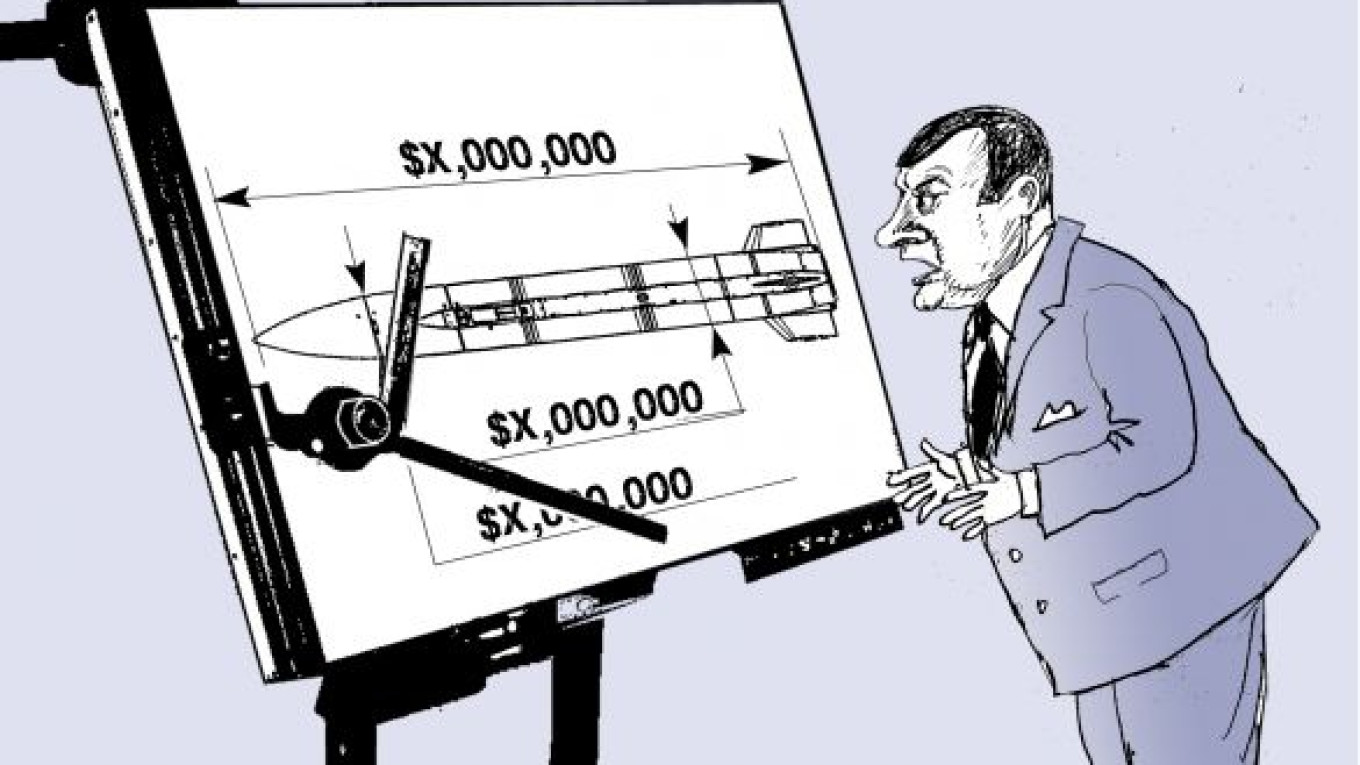
In light of a recent quarrel between President Dmitry Medvedev, Defense Minister Anatoly Serdyukov and Yury Solomonov, chief designer at the Moscow Institute of Thermal Technology, it seems that Russia urgently needs another Lavrenty Beria. We are not talking about Beria the henchman, of course, but Beria the “effective manager” who headed the Soviet atomic project and was able to reach all of the military procurement goals that the Kremlin handed to him.
Serdyukov recently promised to increase the production of new intercontinental ballistic missiles by 3 1/2 times by 2015. But Solomonov, whose institute designs the Topol-M and Yars ICBMs, said in a July 6 Kommersant interview that the plan for 2011 defense orders will not be filled because the military has not signed a single contract with the institute.
Medvedev has demanded that Serdyukov find a solution to the problem. “If the situation is like? what is described by some people, then we need to make some personnel changes, and everybody needs to be held responsible regardless of rank and position,” Medvedev told Serdyukov on the same day the Kommersant interview was published.
“But if the situation is different, then we need to find those responsible for the panic. Do you know how those who spread panic were punished during the war period? They were shot!” Medvedev joked, referring to the Stalin period.
Serdyukov later told journalists that the Defense Ministry has failed to sign contracts for only 18.5 percent of the government’s defense orders. The reason for the unfulfilled orders, Serdyukov explained, is that the Defense Ministry has flatly refused to place orders from defense contractors that have sharply increased the price of their products without explanation. For example, the Moscow Institute of Thermal Technology, which is the country’s only manufacturer of solid fuel rockets, increased the sales price of its Topol-M missile by 3.9 billion rubles ($139 million) and its Yars missile by 5.6 billion rubles ($200 million) since last year.
Serdyukov wants to find out how the sales prices are set. He suspects that design bureaus and manufacturing plants throw into the end prices all of their nonrelated expenses. If it takes Sevmash nine years to produce one ship, he says, then all of its expenses — including its pig farms, children’s summer camps, recreation facilities and hospitals — must be paid for by selling one very expensive ship. Before, a ship cost 47 billion rubles ($1.7 billion), and this year the manufacturer is asking 112 billion rubles ($4 billion), Serdyukov said.
If the defense contractors are willing to open up their books to the Defense Ministry and justify all their expenses, Serdyukov said he would not oppose including a 20 percent or 25 percent profit margin into the final purchase price. But Solomonov has failed to explain in detail the huge rise in prices. Instead, he has tried to shift the blame by telling Kommersant, “The Defense Ministry has been turned into the Federal Tax Service.”
This is both a scornful reference to Serdyukov’s previous job as head of the tax service and an attempt to slight Serdyukov for what Solomonov views as excessive nitpicking in questioning his institute’s rise in prices for ICBMs. Solomonov calls anybody who questions his costs a “tax inspector.”
It is clear that Solomonov dreams of the day when the Kremlin appoints a new Beria to head the Defense Ministry — an “effective manager” who will hand over as much money as Solomonov asks for the institute’s ICBMs. After all, Beria never bothered manufacturers with silly demands to justify their costs.
The beginning of this conflict goes back several years when then-President Vladimir Putin and then-First Deputy Prime Minister Sergei Ivanov did not want to reform the country’s military-
industrial complex. They formed giant “unified state corporations” that were reincarnations of dozens of Soviet ministries and agencies from the defense industry. The problem is that these Soviet enterprises were able to survive as long as they did only because of the Soviet Gosplan, which allocated funds and dictated prices for all products in the manufacturing chain: raw materials, elements and smaller components.
But, of course, Gosplan cannot exist in a market economy, and even Putin cannot bring it back, regardless of how hard he tries. Therefore we need to look for new ways to improve the efficiency and productivity of the military-industrial complex. But few want to do so because they will inevitably butt heads with Putin. This may explain why Medvedev has no other choice but to dream of Beria and how he solved problems in the good old days.
But Medvedev and Solomonov apparently don’t understand that the adoption of Beria’s “effective management” style could very well lead to other attributes of the Soviet military-
industrial complex, including the kind of prison labor camps that Sergei Korolyov, father of the Soviet ICBM program, served in during the Stalin years; the return of closed military towns; and financial rewards for outstanding military achievement in the form of 20 grams of butter.
Alexander Golts is deputy editor of the online newspaper Yezhednevny Zhurnal.
A Message from The Moscow Times:
Dear readers,
We are facing unprecedented challenges. Russia's Prosecutor General's Office has designated The Moscow Times as an "undesirable" organization, criminalizing our work and putting our staff at risk of prosecution. This follows our earlier unjust labeling as a "foreign agent."
These actions are direct attempts to silence independent journalism in Russia. The authorities claim our work "discredits the decisions of the Russian leadership." We see things differently: we strive to provide accurate, unbiased reporting on Russia.
We, the journalists of The Moscow Times, refuse to be silenced. But to continue our work, we need your help.
Your support, no matter how small, makes a world of difference. If you can, please support us monthly starting from just $2. It's quick to set up, and every contribution makes a significant impact.
By supporting The Moscow Times, you're defending open, independent journalism in the face of repression. Thank you for standing with us.

Remind me later.