

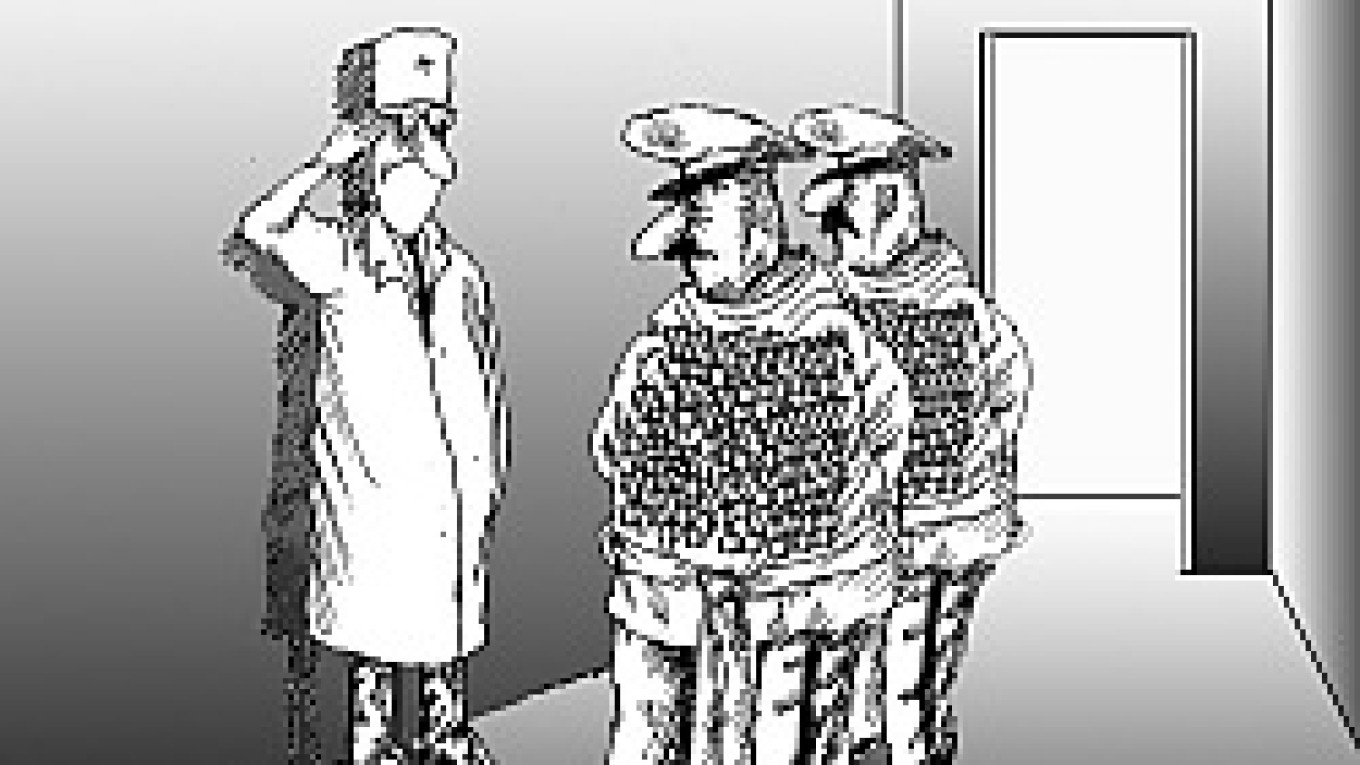
Izvestia published an article titled, "Have White Swans Settled on the Island of Freedom?" It quotes an unidentified, highly placed source as saying Russia's Tu-160 strategic bombers (known as "White Swans") have started flights to Cuban military bases. The same day, an Interfax interview quoted another unidentified but supposedly well-informed source from "military and diplomatic circles" as saying, "Should the appropriate political decision be made, the Tu-160 nuclear bomber and the Tu-95 strategic bomber could refuel at one of Cuba's airfields." The Interfax report added that Russian specialists had already carried out the necessary reconnaissance for such a move.
 | To Our Readers |
The Moscow Times welcomes letters to the editor. Letters for publication should be signed and bear the signatory's address and telephone number. |
On the very same day, however, the Russian media nonchalantly wrote and spoke about a new idea for a "military response" to the U.S. expansion. A former chief of the Russian Strategic Missile Forces in the General Staff, General Viktor Yesin, recalled how the Soviet Union developed its breakthrough "orbital missile" in the 1970s. The missile was designed to carry a nuclear warhead into space and fire its payload from any point along its flight path. This would enable the missile to strike any location on the planet, and it would make it impossible for the enemy to determine the intended target in advance.
The orbital missile was decommissioned as part of the SALT II Treaty in 1979. But Yesin suggested that if Russia were to produce this missile again and if Moscow fired it at the United States over the South Pole, the U.S. missile-defense system would not be able to intercept it. Moreover, Russia needs to withdraw from the Intermediate-Range Nuclear Forces Treaty and deploy Iskander missiles in the Kaliningrad region.
Unfortunately, every military response that was mentioned is either pointless or impossible to develop. For example, there is absolutely no military necessity to refuel strategic bombers on Cuban military bases. For 30 years, Russia has placed a prime value on the ability of its long-range aircraft to reach any point on the globe without having to land to refuel, and it built a fleet of aerial-refueling planes to make this possible.
Even from the standpoint of mutual deterrence, our military leaders long ago found a much shorter patrol route that would theoretically allow them to strike U.S. territory by launching cruise missiles from the border of the Faroe Islands. As for the orbital missiles, they were manufactured in Ukraine during the 1970s, not in Russia. Thus, it would require the construction of a gigantic new manufacturing facility in Russia to produce them again, and that would require many years, if not decades.
So why all of these information leaks? It would seem to be an illustration of the domino theory, in which one ridiculous remark inspires a second, and so on, ad infinitum. The first foolish move was to threaten a military response to the planned deployment of a U.S. missile-defense system in Europe -- if for no other reason than this system does not threaten Russia's nuclear potential in any way. The first serious attempt to carry out a military response would inevitably lead to reciprocal measures from the United States and NATO. For example, deploying Iskander missiles in the Kaliningrad region would practically put us back to the beginning of the 1980s, when U.S. medium-range missiles stationed in Western Europe were targeted at Moscow.
The only way Russia's nuclear weapons can carry any weight in international disputes is if its adversaries detect Moscow's brinkmanship -- specifically, its willingness to start a nuclear war if its point of view is not accepted. Washington had a good share of that brinkmanship -- or, more accurately put, insanity -- when it dealt with certain Soviet leaders, and that is why the nuclear standoff during the Cold War was so serious and frightening.
The United States suspects Iran's current leaders of the same sort of madness, and that is why Tehran's hypothetical plan for building a nuclear bomb is also taken very seriously. But for some reason, the United States is finding it hard to believe that the leaders in the Kremlin today suffer from the same illness as their Soviet predecessors.
The only possible explanation for this whole concoction in the media about flights of Russian White Swans to Cuba is that Moscow is trying to convince Washington that its lunacy is serious and chronic.
Alexander Golts is deputy editor of the online newspaper Yezhednevny Zhurnal.
A Message from The Moscow Times:
Dear readers,
We are facing unprecedented challenges. Russia's Prosecutor General's Office has designated The Moscow Times as an "undesirable" organization, criminalizing our work and putting our staff at risk of prosecution. This follows our earlier unjust labeling as a "foreign agent."
These actions are direct attempts to silence independent journalism in Russia. The authorities claim our work "discredits the decisions of the Russian leadership." We see things differently: we strive to provide accurate, unbiased reporting on Russia.
We, the journalists of The Moscow Times, refuse to be silenced. But to continue our work, we need your help.
Your support, no matter how small, makes a world of difference. If you can, please support us monthly starting from just $2. It's quick to set up, and every contribution makes a significant impact.
By supporting The Moscow Times, you're defending open, independent journalism in the face of repression. Thank you for standing with us.

Remind me later.