

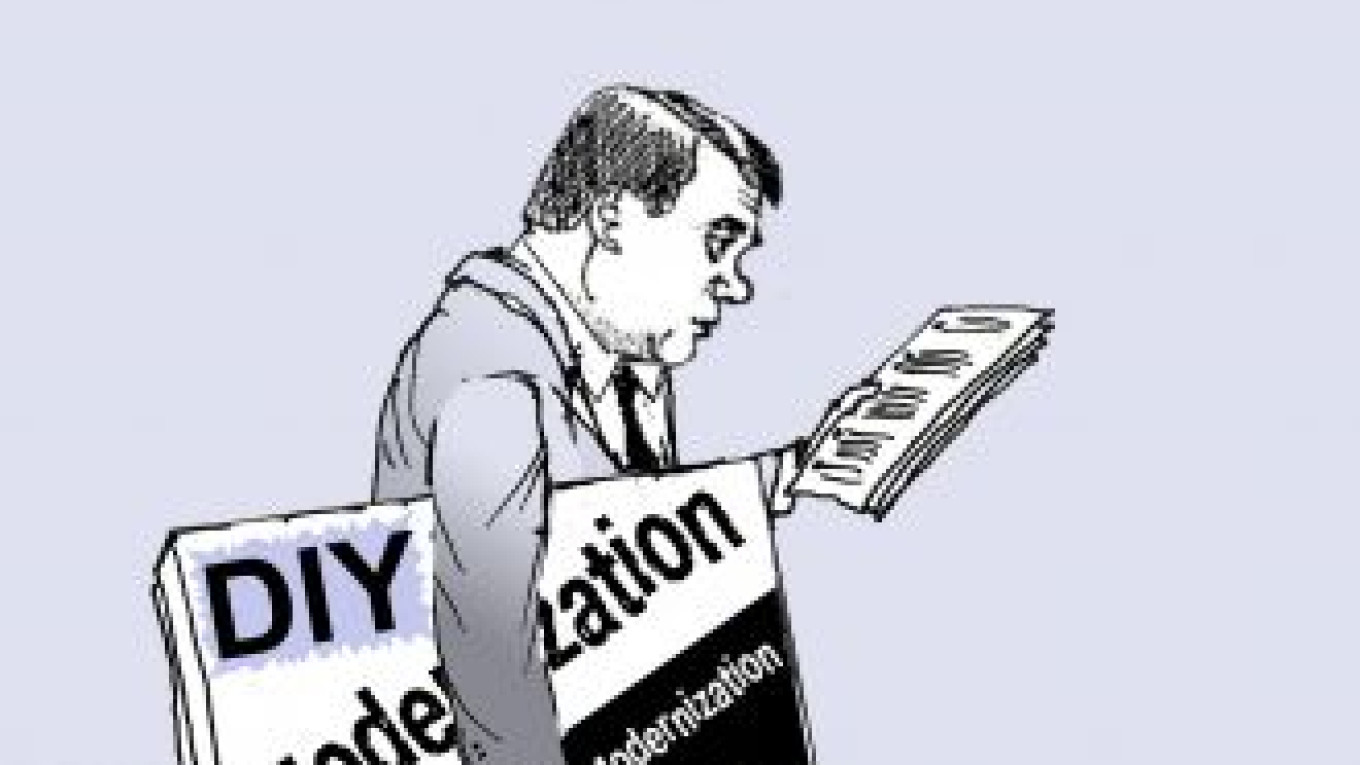
Economic modernization is high on Russia’s agenda. It is not difficult to agree that modernization is needed for the country to realize its economic potential and that a more modern economy would be less exposed to the vagaries of international commodity and financial markets. After agreeing on this, discussions often turn to the need for basic research — one of Russia’s clear strengths — and how to turn this research into innovative business activities. But along the way, the discussions too often lose sight of the simple fact that for modernization to actually occur on the ground, what Russia needs is new investment.
The investors that Russia wants to attract — be they domestic or foreign — are those who look for the stability and predictability that allow them to make long-term commitments. That is why strong economic policy institutions and frameworks are so important. Among economists, these terms refer to the broader set of bodies and laws that include corporate governance, low corruption, social safety nets and prudent monetary and fiscal policy management. Equally important is the practical behavior of those in charge — in other words, implementation. This is all especially relevant because Russia’s policy frameworks remain largely in a formative state, even though it has been 20 years since the country started its transition to a market-based economy. The response to the global crisis offers an opportunity to assess Russia’s frameworks and chart the way forward.
First, consider Russia’s reaction to the global crisis. The dual shock of collapsing oil prices and reversals in international capital markets in late 2008 hit the country particularly hard. After some hesitation, the macroeconomic and financial policy response was both forceful and broad-based. A major budget expansion was carried out in the second half of 2009, monetary and exchange rate policies were generally accommodative, and a large injection of liquidity and relaxation of prudential regulations helped ease the situation in the banking system. All told, Russia’s response to the global crisis was quite effective and showed that certain aspects of the country’s frameworks do work well. This was especially true of the government’s reserve funds from oil windfalls and the Central Bank’s anti-crisis measures.
Nevertheless, the severity of the spillovers from global events points to shortcomings in how economic policy has been formulated and implemented in practice. The policy frameworks did not prevent expansionary fiscal and monetary policies in the run-up to the crisis, even as the economy had strong momentum of its own and vulnerabilities in the banking system were allowed to build up. The result was an economy that was becoming more dependent on oil. It was also overheated when the global crisis struck.
What lessons does this experience hold for the future? The highest priority will be to put in place a more firmly anchored framework for government budget policy. To reduce its oil dependence, Russia faces the task of scaling back public spending over the medium term, especially after the expansionary budget policies during the years of high oil prices, culminating in the anti-crisis fiscal stimulus. This is a difficult task that will require a convincing plan for fiscal policy for the years ahead to help organize budget priorities and improve investor confidence. Experience from other countries has demonstrated the usefulness of adopting a medium-term budget “anchor” and then formulating annual budgets with this in mind. For Russia, a target on the government deficit excluding revenue from the petroleum sector — the so-called “non-oil deficit” — would help move spending in line with available budget income over time and limit the crowding out of private investment. To support the achievement of this target, restarting reforms of the public sector and refraining from excessive use of supplementary budgets are both needed.
A second priority is to focus monetary policy even more directly on inflation, through the Central Bank’s move to a full-fledged formal inflation-targeting framework. This is because low and stable inflation is essential for sound development of the financial sector and for the saving and investment needed to underpin longer-term growth. Russia would be well advised to use the opportunity provided by the current relatively low inflation to anchor its price level. Inflation could be targeted at between 5 percent and 6 percent over the near term, with a further reduction in coming years. Experience from other emerging market countries suggests that focusing monetary policy effectively on inflation will mean adopting a flexible exchange rate. The Central Bank’s moves in this direction over the past year are therefore welcome.
In the financial sector, banks need to resume credit extension. More fundamentally, the banking system should be further developed to help channel domestic saving to productive uses. Both point to the need for a strong supervisory policy framework. For the near term, priorities include improved provisioning and capitalization standards. Looking further ahead, the Central Bank could usefully be afforded greater authority in consolidated supervision. In addition to a sound macroeconomic environment, a more stable and developed financial system will require the implementation of a broader agenda, including increased competition in the financial sector and a tightening of accounting and reporting standards.
Finally, the policy frameworks defining Russia’s investment climate need enhancement. The importance of predictability and more rules-based processes in policies affecting the business environment is generally understood and agreed. Key steps include scaling back the role of the state, reforming the civil service, curtailing government influence on economic decision making, protecting property rights, fighting corruption and joining the World Trade Organization. Policy plans exist across the full range of these issues, but implementation has been lagging.
Russia’s leaders understand this reform agenda well, and the expected payoffs of stronger economic policy frameworks for the country are very substantial. A strengthening of these frameworks holds the key to the sound policy implementation that will unlock the country’s economic potential through modernization.
Odd Per Brekk is the senior resident representative of the International Monetary Fund in Russia.
A Message from The Moscow Times:
Dear readers,
We are facing unprecedented challenges. Russia's Prosecutor General's Office has designated The Moscow Times as an "undesirable" organization, criminalizing our work and putting our staff at risk of prosecution. This follows our earlier unjust labeling as a "foreign agent."
These actions are direct attempts to silence independent journalism in Russia. The authorities claim our work "discredits the decisions of the Russian leadership." We see things differently: we strive to provide accurate, unbiased reporting on Russia.
We, the journalists of The Moscow Times, refuse to be silenced. But to continue our work, we need your help.
Your support, no matter how small, makes a world of difference. If you can, please support us monthly starting from just $2. It's quick to set up, and every contribution makes a significant impact.
By supporting The Moscow Times, you're defending open, independent journalism in the face of repression. Thank you for standing with us.

Remind me later.