

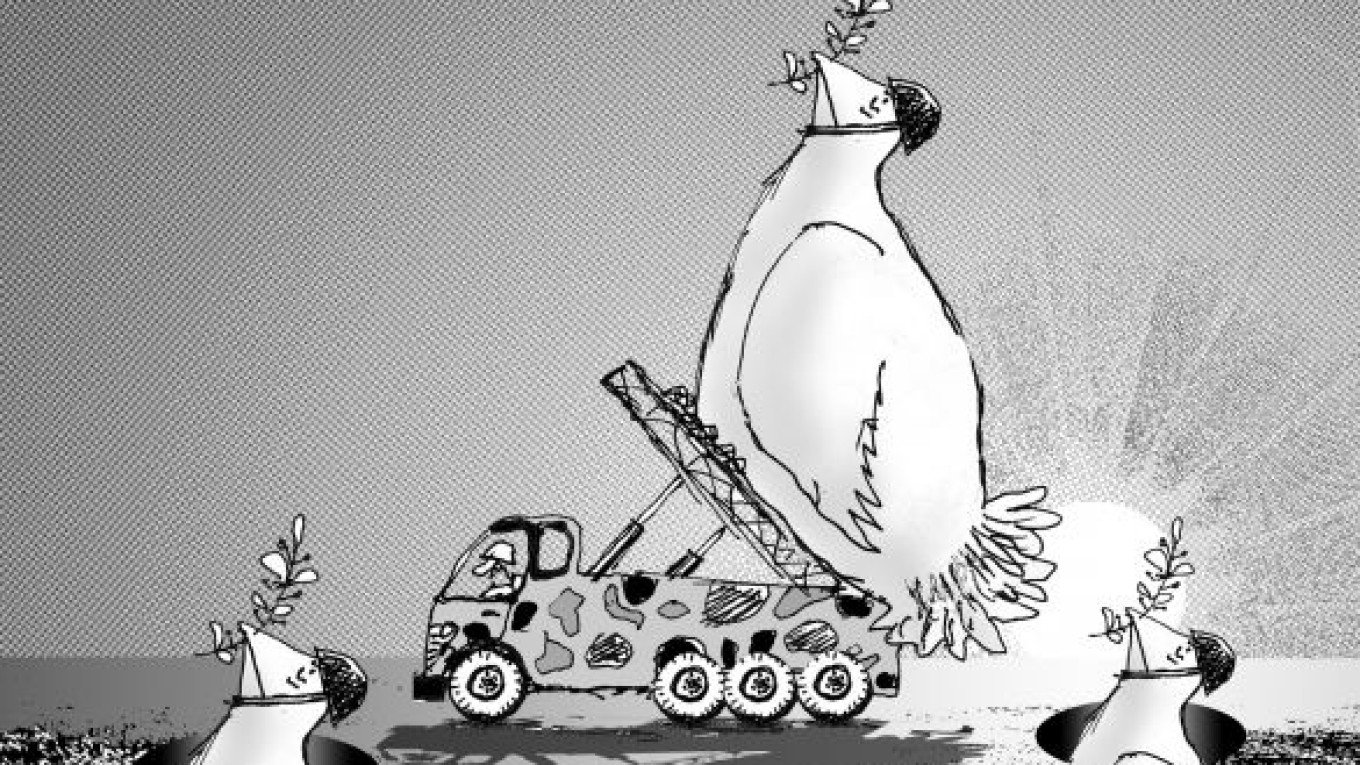
The new Russian military doctrine approved by President Dmitry Medvedev on Feb. 5 elicited an unwarranted negative reaction from the West.
Many analysts claim that the doctrine is divorced from reality and deliberately vague. Some incorrectly cited passages from Russia’s two previous military doctrines adopted in 1993 by President Boris Yeltsin and in 2000 by President Vladimir Putin. A few critics did not even bother to compare the major differences between Russia’s new doctrine and the military doctrine of the United States.
The main criticisms of the new Russian doctrine are that it supposedly allows for the possibility of a nuclear first strike and places unjustified emphasis on the military danger posed by NATO. Unfortunately, those conclusions are based on very loose and subjective interpretations of the wording.
The military doctrine refers to the possibility of “defensive nuclear deterrence.” It does not include provisions for a preventative or pre-emptive nuclear strike, which would be permissible only as a counterstrike to a nuclear attack against Russia. Moreover, there is nothing in the doctrine that provides Moscow the right to use nuclear weapons in regional or local conflicts. In contrast to Russia’s nuclear doctrine, the U.S. nuclear strategy is based on “offensive nuclear deterrence.”
Both the Soviet Union and the Russian Federation several times proposed to other nuclear powers that an agreement be signed to reject the possibility of delivering a nuclear first strike. Unfortunately, these initiatives were not supported in the West. As a result, only two out of the eight declared and undeclared nuclear powers — Russia and China — have pledged a no-first-strike policy.
What’s more, Moscow is opposed to the U.S. policy of “extended nuclear deterrence” — in specific, its policy of deploying tactical nuclear weapons in non-nuclear European countries and in Turkey. This is in violation of Articles 1 and 2 of the Nuclear Non-Proliferation Treaty that prohibit the transfer of nuclear weapons and technology to non-nuclear states.
In contrast to U.S. strategic plans, Russia’s military doctrine does not provide for the development of a global missile defense system. In addition, the document does not contain any plans to deploy offensive weapons in space, but the United States is developing this system that will give it the ability to deliver a nuclear first strike.
Russia’s 2000 military doctrine was in large part a response to the first wave of NATO expansion and the alliance’s massive bombing of Yugoslavia in 1999. The expansion and buildup of foreign military bases and troops close to Russia’s borders was alluded to in the 2000 doctrine, although the word “NATO” was not specifically used.
It is true that the 2010 doctrine specifically mentions certain NATO activities as the country’s leading external military danger, but Russia’s concerns are in response to a number of objective factors involving the advancement of NATO’s infrastructure toward Russia’s borders. One fresh example is that Bulgaria, Poland and Romania plans to host a U.S. missile defense system that will be even more powerful than the previous one planned for Poland and the Czech Republic. In addition, the United States is modernizing its strategic nuclear potential and is deploying U.S. tactical nuclear weapons in several Europe countries and Turkey. Furthermore, Moscow has not forgotten the financial and military support that NATO member states gave to Georgia, which played a critical role in Tbilisi’s decision to invade South Ossetia in August 2008. Russia is justifiably concerned about the U.S. commitment to rebuild and strengthen Georgia’s armed forces Tbilisi was routed in the Russia-Georgia war.
What is so “unrealistic” about those assessments? No commander-in-chief of any country would ignore such clear strategic dangers and threats to its national security.
Many Western analysts incorrectly evaluated the basic tenets of Russia’s military doctrine. In the best case, they were simply careless in reading and analyzing the document. In the worst case, this was a deliberate attempt to misrepresent Russia’s military policy — a calculated move to divert attention away from the deficiencies in the West’s own military strategy, which has shown its inability to adapt to new circumstances in international affairs.
In either case, this can lead to a distorted interpretation of Russia’s foreign and defense policies. The allegation that Russia has a nuclear first-strike policy may be exploited by the United States to justify its ambitious global missile defense program and to maintain its current nuclear doctrine as is.
The most dangerous assumption in the West’s analysis of Russia’s military doctrine is that Moscow allegedly does not want good relations with the West and NATO. On the contrary, Russia is very interested in constructive, friendly relations with the West under two conditions: that the United States and NATO accept Russia as a fully legitimate and equal partner in European and global affairs and that they do not undermine its security.
The rest of the world would be happy if Washington changed its current military doctrine to more closely match the spirit of Russia’s doctrine.
Vladimir Kozin is head of the analytical section of the Asia-Pacific department at the Foreign Ministry. The views expressed in this comment are his own.
A Message from The Moscow Times:
Dear readers,
We are facing unprecedented challenges. Russia's Prosecutor General's Office has designated The Moscow Times as an "undesirable" organization, criminalizing our work and putting our staff at risk of prosecution. This follows our earlier unjust labeling as a "foreign agent."
These actions are direct attempts to silence independent journalism in Russia. The authorities claim our work "discredits the decisions of the Russian leadership." We see things differently: we strive to provide accurate, unbiased reporting on Russia.
We, the journalists of The Moscow Times, refuse to be silenced. But to continue our work, we need your help.
Your support, no matter how small, makes a world of difference. If you can, please support us monthly starting from just $2. It's quick to set up, and every contribution makes a significant impact.
By supporting The Moscow Times, you're defending open, independent journalism in the face of repression. Thank you for standing with us.

Remind me later.