

Saakashvili won a second term in an election Saturday with 52 percent of the vote, according to near-complete returns from the Central Elections Commission. His main opponent, Levan Gachechiladze, won 25 percent.
International observers gave a mixed assessment of the vote, saying it was a significant achievement for democracy but noting an array of violations.
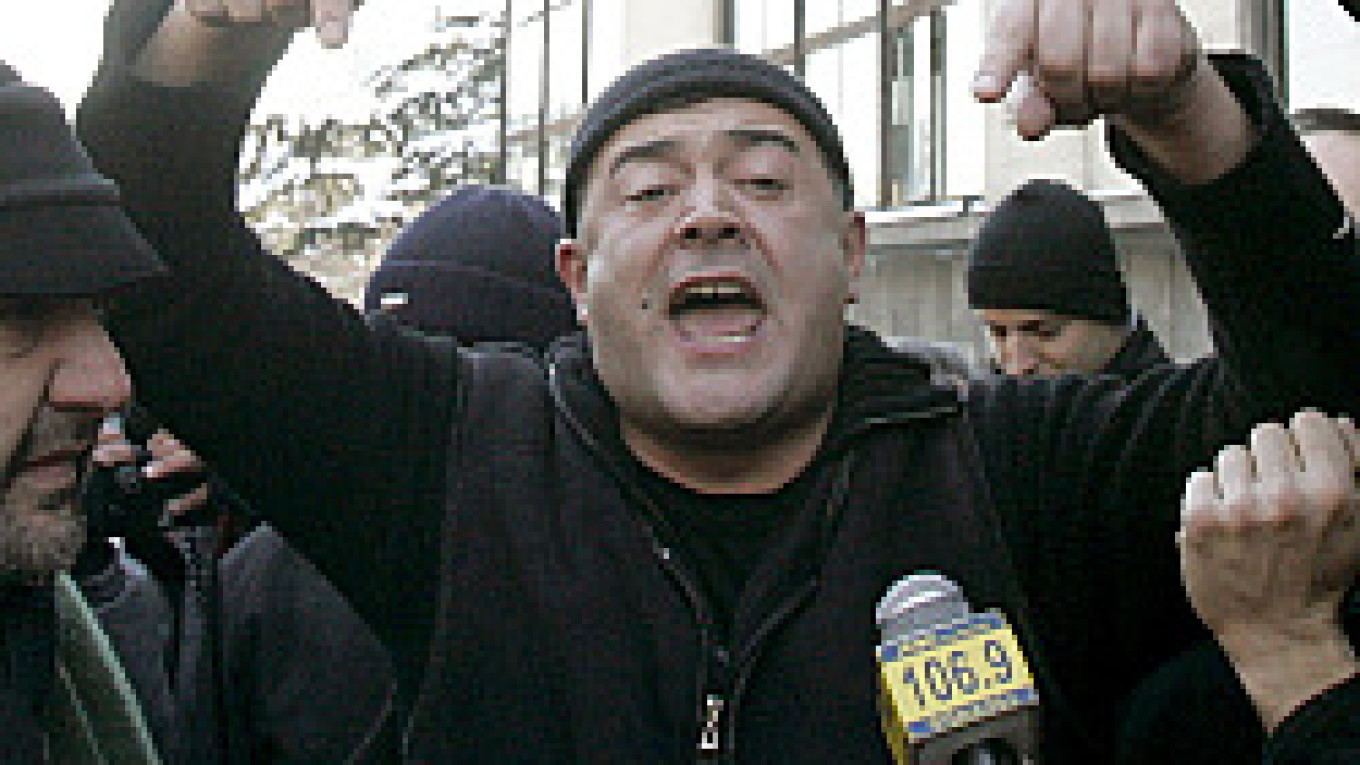
Speaking to about 100 opposition activists, Gachechiladze accused the government of denying the opposition air time to publicize its complaints. He said they would start a hunger strike Wednesday.
"We are beginning a hunger strike in connection with the falsification of the election and the fact that we are not being given direct air time," Gachechiladze said.
Another opposition leader, Giorgy Khaindrava, claimed that Saakashvili received fewer votes than Gachechiladze and demanded a runoff, which under election law must be held if no candidate receives more than 50 percent of the vote. He threatened mass opposition protests.
"We will all take to the streets and let Saakashvili arrest us all, but he won't have enough prisons; he will have to build new prisons," Khaindrava said. "We will be in prison, but this country will be free."
Opposition leaders cite official election protocols obtained by supporters who sat on electoral commissions across the country as evidence the vote was rigged. They claim Gachechiladze was deprived of more than 100,000 votes cast in his favor -- enough to invalidate Saakashvili's victory in the first round.
Gachechiladze tried to meet Tuesday with Levan Tarkhnishvili, head of the Central Elections Commission. After Tarkhnishvili refused to receive him, Gachechiladze stormed into the official's office and the two were heard exchanging heated words.
Later Tuesday, Gachechiladze and other opposition leaders met with Western ambassadors and representatives from the Organization of Security and Cooperation in Europe, a leading international body that monitored the vote, to discuss their complaints.
Saakashvili, a U.S.-educated lawyer, first was elected by a landslide in January 2004 after leading the Rose Revolution protests that prompted the resignation of longtime President Eduard Shevardnadze.
Saakashvili has helped transform Georgia into a country with a growing economy and aspirations of joining the European Union and NATO, cultivating close ties with the United States and seeking to decrease Russia's influence.
But he had been under pressure lately to prove he remains committed to democracy. Late last year, he ordered the violent dispersal of anti-government protests, imposed a state of emergency and shut down an independent television station.
In an interview Monday, Saakashvili said the vote had an "amazingly low number" of violations and demonstrated that his country was on the road to becoming a European democracy.
"This is still a country in transition, this is still not a full-fledged, very well-formed, crystalized society. We still have lots of things to do," Saakashvili said.
"But I think we are on the right track and this election has just proven that," he said.
The United States gave the vote its overall seal of approval Monday, calling it Georgia's first genuinely competitive presidential election.
U.S. State Department spokesman Sean McCormack said, however, that monitors had "identified significant problems that must be corrected" and that Georgians should investigate all allegations of irregularities.
Russia called the election campaign "hardly free or fair."
An opposition rally protesting the election results Sunday drew some 5,000 people, but tensions quieted as Georgians celebrated Orthodox Christmas on Monday.
In the center of Tbilisi, glistening with a fresh dusting of snow, Christmas music rang out from churches and children rode a toy train and ice skated at an amusement park set up in front of parliament.
Svetlana Malofeyeva, 32, who was watching the ice skaters with her two small children, said she had badly wanted to see Saakashvili win and her friends all knew this. "Everyone called me to congratulate me and we had a celebration at home," she said.
She is unemployed but just completed a three-month jobs program introduced by Saakashvili and has hopes of starting work soon.
n? Exiled Georgian opposition leader Irakly Okruashvili will file a complaint in Germany's top court to protest his detention in a Berlin jail pending a decision on his extradition, Reuters reported Tuesday.
Okruashvili, a former defense minister whose allegations of corruption against Saakashvili sparked anti-government protests last year, was arrested in Germany in November. His lawyer said he had applied for asylum just days before his detention.
A German court announced Tuesday that it would continue to hold him while the authorities sought more information on Georgian government accusations that Okruashvili ordered the purchase of aircraft fuel at excessive prices from a company controlled by a friend while he was defense minister.
A Message from The Moscow Times:
Dear readers,
We are facing unprecedented challenges. Russia's Prosecutor General's Office has designated The Moscow Times as an "undesirable" organization, criminalizing our work and putting our staff at risk of prosecution. This follows our earlier unjust labeling as a "foreign agent."
These actions are direct attempts to silence independent journalism in Russia. The authorities claim our work "discredits the decisions of the Russian leadership." We see things differently: we strive to provide accurate, unbiased reporting on Russia.
We, the journalists of The Moscow Times, refuse to be silenced. But to continue our work, we need your help.
Your support, no matter how small, makes a world of difference. If you can, please support us monthly starting from just $2. It's quick to set up, and every contribution makes a significant impact.
By supporting The Moscow Times, you're defending open, independent journalism in the face of repression. Thank you for standing with us.

Remind me later.