

STAR CITY — There is no space for tourists wishing to fly to the International Space Station, a top space official said Thursday.
Since the space station's crew doubled to six people earlier this year, there is no longer room for tourists who pay tens of millions of dollars for a trip on a spacecraft from Earth, said Sergei Krikalyov, the chief of the Cosmonaut Training Center.
The Soyuz spacecraft will provide the only link to the station after the planned retirement of the U.S. shuttle fleet next year.
Each Soyuz craft can accommodate three people. With the doubling of the station's permanent crew, the station will now make four, rather than two, launches each year to allow for crew rotation.
A permanent crew of six means that the space program has to have two Soyuz ships permanently docked at the station to be used in case of emergency.
Canadian Cirque du Soleil founder Guy Laliberte returned to Earth last month after a stint as the seventh paying space tourist aboard the station.
Laliberte, the first professional artist to fly to space, paid $35 million for a 10-day trip to the station. "When there was a spare place, the space tourist could fly together with the main crew and return back with them," Krikalyov told reporters at the training center in Star City outside Moscow.
"Now that we have switched to a six-person crew, there is no spare room."
Krikalyov added without elaboration that "the situation will remain the same for the nearest flights."
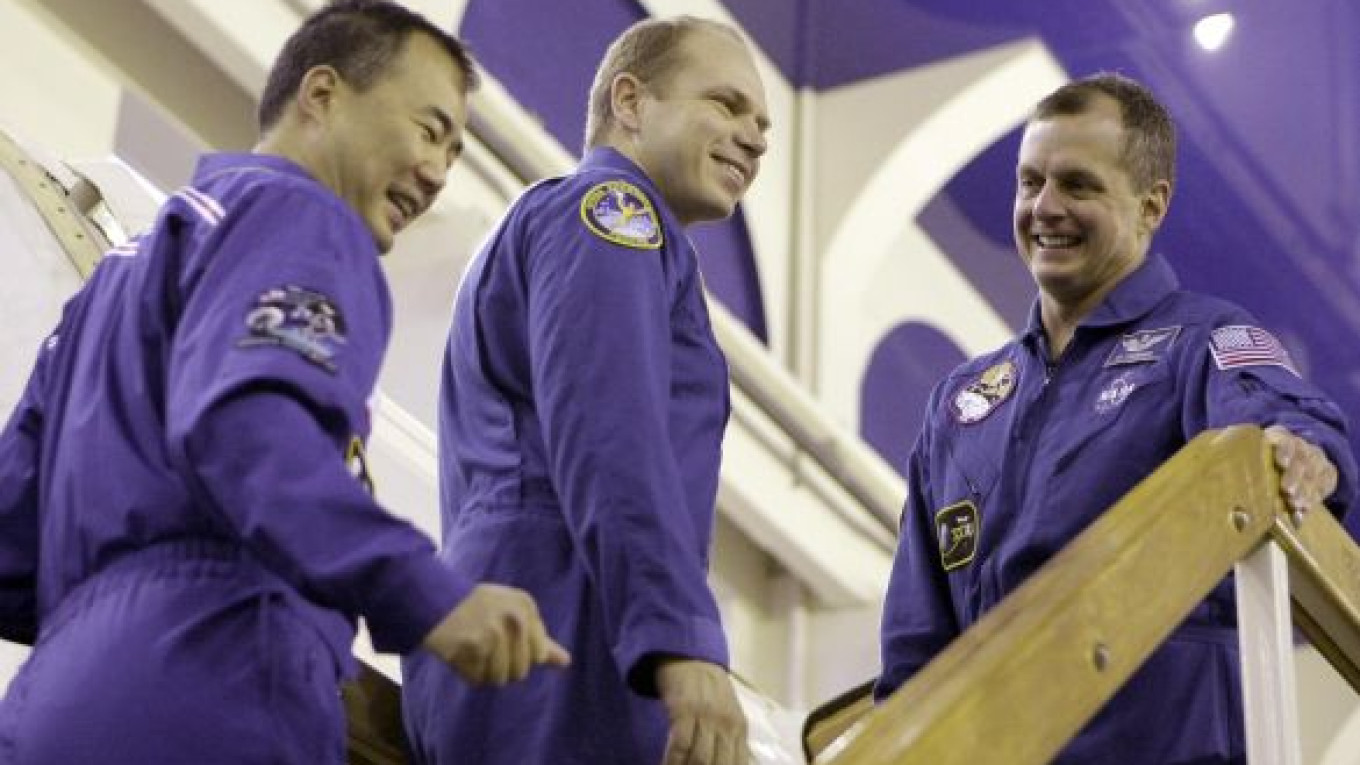
Krikalyov spoke during exams for a crew set to blast off for the station in late December. The crew includes Oleg Kotov, Soichi Noguchi of Japan and NASA astronaut Timothy J. Creamer.
The mammoth station consists of 10 modules built by the United States, Russia, Canada, Japan and the 18-nation European Space Agency. Doubling of its permanent crew will allow other nations to send their astronauts to the station, which had mostly been manned in the past by Russian and U.S. crew members.
A Message from The Moscow Times:
Dear readers,
We are facing unprecedented challenges. Russia's Prosecutor General's Office has designated The Moscow Times as an "undesirable" organization, criminalizing our work and putting our staff at risk of prosecution. This follows our earlier unjust labeling as a "foreign agent."
These actions are direct attempts to silence independent journalism in Russia. The authorities claim our work "discredits the decisions of the Russian leadership." We see things differently: we strive to provide accurate, unbiased reporting on Russia.
We, the journalists of The Moscow Times, refuse to be silenced. But to continue our work, we need your help.
Your support, no matter how small, makes a world of difference. If you can, please support us monthly starting from just $2. It's quick to set up, and every contribution makes a significant impact.
By supporting The Moscow Times, you're defending open, independent journalism in the face of repression. Thank you for standing with us.

Remind me later.