

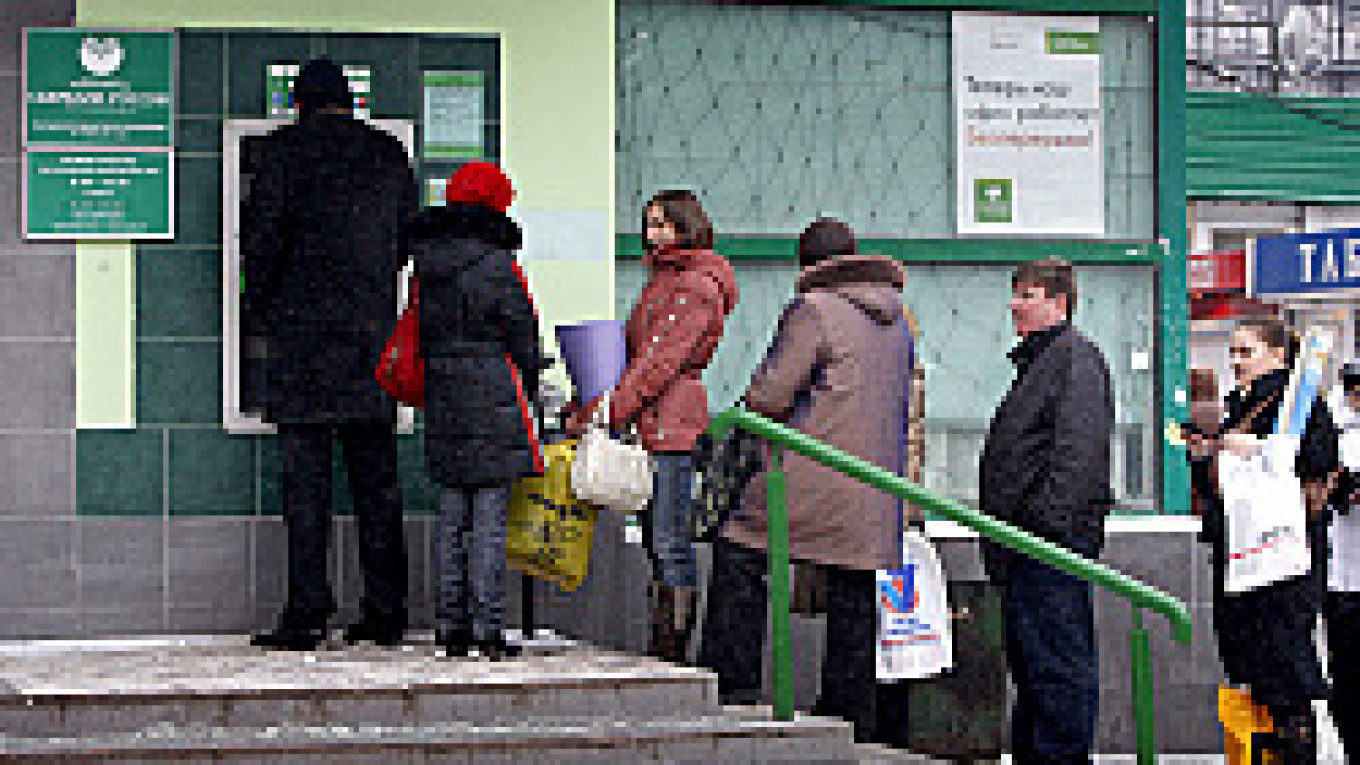
The earnings cuts, alongside inflation and the weakening ruble, have dealt Russian wage earners a triple whammy, and the Central Bank's devaluation of the currency Thursday brought it past the 32 mark against the dollar for the first time since the 1998 redenomination (Story, Page 7.)
Over the past few years, real wages have increased at roughly twice the rate of worker productivity. Now that the value of the ruble is falling — and the job market is shrinking ?€” employers say they'll be able to start paying employees to match their output.
In just the past four months, investment bankers accustomed to annual salary jumps of 30 percent are now being offered new jobs at 40 percent of what they had been making. In advertising, sales and marketing, job candidates are facing salary decreases of more than 10 percent, according to recruitment agency Antal Russia.
Yevgeny Nadorshin, chief economist at Trust National Bank, said the devaluation would correct what were previously "overvalued" wages and give employers a leg up in contract negotiations.
"Eventually it will attract more companies to Russia and help us weather the crisis better," said Elina Ribakova, chief economist at Citibank.
Wages grew 12.4 percent year on year in the third quarter of 2008, according to the most recent figures from the State Statistics Service, while productivity ?€” real output per employed person ?€” during the same period increased 8.24 percent, based on figures from Haver Analytics.
The data already reflect a slowdown since the second quarter, when wages rose 12.6 percent year on year and productivity increased 5.93 percent. In the second quarter of 2007, wages increased 16.7 percent year on year while productivity rose 6.43 percent.
For workers, though, "devaluation means high inflation" in the short term because of Russia's strong dependence on imported goods, Nadorshin said. Though inflation growth fell to a four month-low in December of 0.7 percent, the rate will rise once discounts from cash-strapped foreign producers disappear, he said.
After the 1998 crisis, many Russia-based multinational companies paid their employees in foreign currencies or in rubles at the going Central Bank rate, but with increased stability over the past three to four years, many have switched to a fixed ruble salary.
Tremayne Elson, managing director at Antal, said salaries were typically calculated at an exchange rate of about 28 rubles to the dollar and were not renegotiated to reflect inflation.
Steve Castelete, president of Avalon Logistics Russia, said that most of his employees' salaries had been set to an exchange rate of about 27.5 rubles per dollar after the company switched to paying in rubles five or six years ago.
Employees benefited during the years the ruble appreciated, Castelete added.
According to Antal's figures, a "large number" of companies have already cut salaries, particularly in the banking and construction sectors. Castelete said Avalon had not yet been forced to reduce its workforce.
"We're not seeing a correction of salaries at the moment, but we would expect that they would become more realistic as more workers come into the marketplace," he said, referring to contracts for new hires.
The shift will be what Danilo Lange, general manager of communications agency Louder Russia, calls a "market cleansing."
"It was very difficult to find people for good value the last four years. The employee market was basically empty and everyone wanted super-high salaries," Lange said, clarifying that he believed his employees "deserved" their respective salaries.
Louder re-evaluates its ruble-denominated salaries every six months to account for inflation, he said. While the company has not made wage cuts, they did eliminate 2008 bonuses.
"There's going to be more balance this year," said Castelete, of Avalon. "And I think that's a good thing."
A Message from The Moscow Times:
Dear readers,
We are facing unprecedented challenges. Russia's Prosecutor General's Office has designated The Moscow Times as an "undesirable" organization, criminalizing our work and putting our staff at risk of prosecution. This follows our earlier unjust labeling as a "foreign agent."
These actions are direct attempts to silence independent journalism in Russia. The authorities claim our work "discredits the decisions of the Russian leadership." We see things differently: we strive to provide accurate, unbiased reporting on Russia.
We, the journalists of The Moscow Times, refuse to be silenced. But to continue our work, we need your help.
Your support, no matter how small, makes a world of difference. If you can, please support us monthly starting from just $2. It's quick to set up, and every contribution makes a significant impact.
By supporting The Moscow Times, you're defending open, independent journalism in the face of repression. Thank you for standing with us.

Remind me later.