

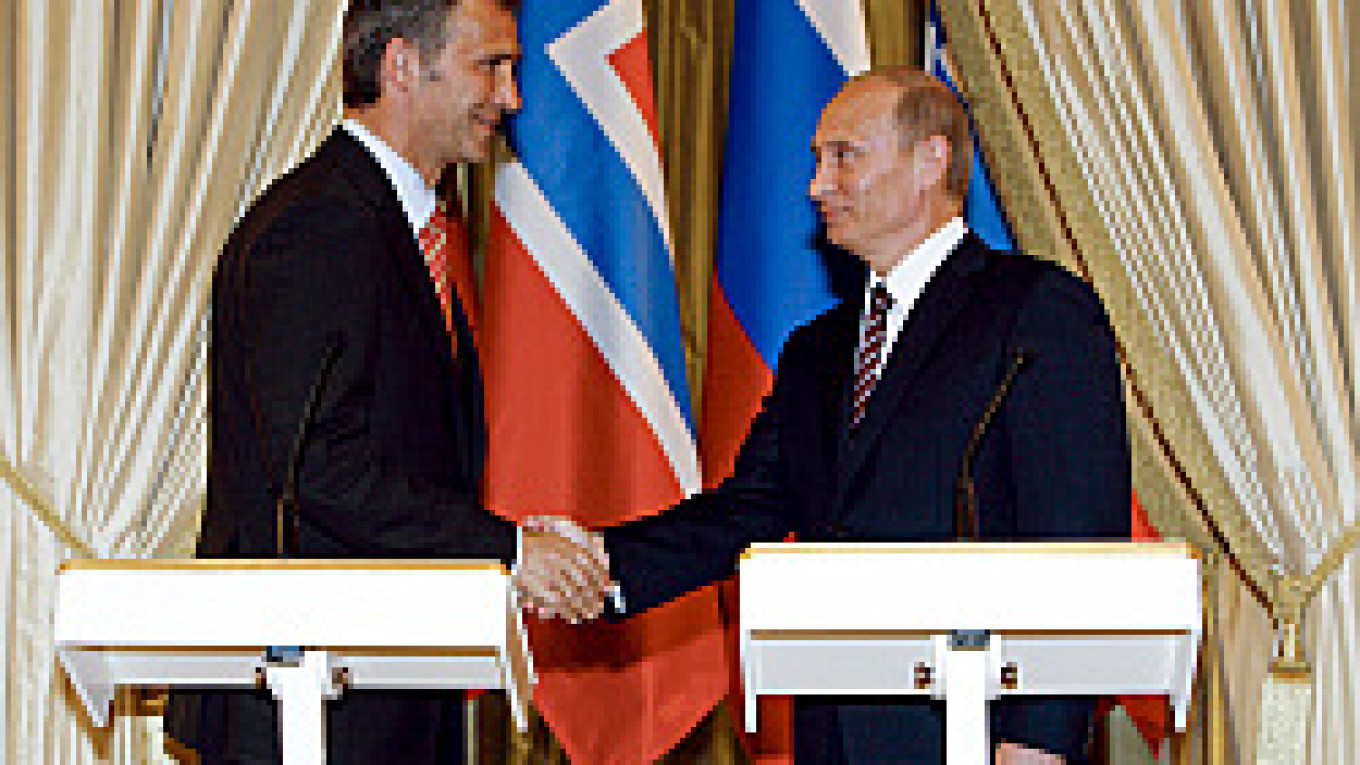
Putin spoke after talks with Norwegian Prime Minister Jens Stoltenberg, who declared that Putin is "very much aware of what is now the Norwegian position."
Telenor's legal problems arose from a spat with a Russian partner in VimpelCom, Russia's second-biggest mobile-phone operator. The partnership soured after Telenor resisted a proposal from the partner, the privately owned Alfa Group, for VimpelCom to buy a Ukrainian telecom operator in 2005.
"We spoke about opportunities of joint work in third countries," Putin told reporters after the talks with Stoltenberg. "I would very much like partners in telecommunications companies to come to terms about effective joint work in third countries' markets rather than put spokes in one another's wheels."
Telenor has said the price for the Ukrainian company, WellCom, was too high and the investment would be difficult to recoup. Telenor also balked at the deal because it was unable to gain any knowledge about the owners of the Ukrainian company.
Alfa and VimpelCom later managed to force through the acquisition by circumventing VimpelCom's board of directors, where Telenor holds a blocking position. A court ruled earlier this year that Telenor must pay $1.7 billion in damages to VimpelCom -- by selling its 29.9 percent stake in the Russian company -- as compensation for the delay in the Ukrainian deal. Telenor is appealing the ruling, which was made in a case filed by a tiny VimpelCom shareholder, Farimex.
Telenor says Alfa is behind the lawsuit, a charge that Alfa denies.
Stoltenberg said Russia and Norway agreed that Telenor and Alfa must try to resolve the issue out of court. Even if they failed to do so, Telenor's holding in VimpelCom must stay intact until the Norwegian company exhausts all opportunities for appeal, he said.
"Both the Norwegian and the Russian government hope and believe that the best solution would be ... on the corporate level between the two companies," he told The Moscow Times in an interview at the Norwegian Embassy. "At the same time ... I believe that it is important that there is no forced sale of the assets of Telenor before there is a final decision by the judicial system."
Putin said the government was interested in making foreign investors feel "comfortable." If Russian private companies enter into disputes with their foreign partners, the government's task is to ensure the rule of law, he said.
"Everyone will have to obey the law," Putin said.
Stoltenberg, turning to another area of cooperation -- the development of the huge Shtokman gas field in the Arctic -- told The Moscow Times that the economic crisis could bring down costs. Norway's StatoilHydro and France's Total are participating as junior partners in the Gazprom-led project.
The prime ministers also discussed the countries' fishing policies and cooperation on northern Spitsbergen Island.
A Message from The Moscow Times:
Dear readers,
We are facing unprecedented challenges. Russia's Prosecutor General's Office has designated The Moscow Times as an "undesirable" organization, criminalizing our work and putting our staff at risk of prosecution. This follows our earlier unjust labeling as a "foreign agent."
These actions are direct attempts to silence independent journalism in Russia. The authorities claim our work "discredits the decisions of the Russian leadership." We see things differently: we strive to provide accurate, unbiased reporting on Russia.
We, the journalists of The Moscow Times, refuse to be silenced. But to continue our work, we need your help.
Your support, no matter how small, makes a world of difference. If you can, please support us monthly starting from just $2. It's quick to set up, and every contribution makes a significant impact.
By supporting The Moscow Times, you're defending open, independent journalism in the face of repression. Thank you for standing with us.

Remind me later.