

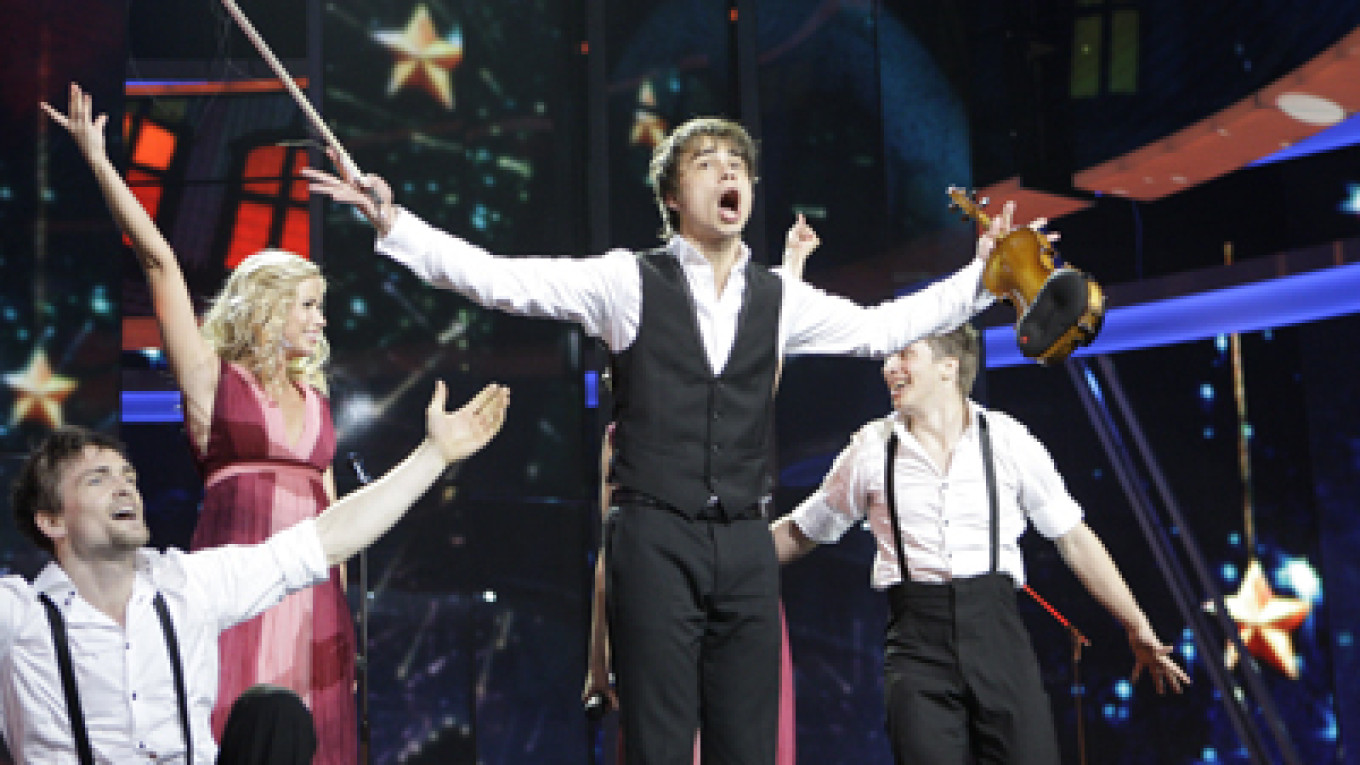
Russia won high praise from organizers and participants alike for its hosting of the 2009 Eurovision Song Contest final on Saturday, complete with hovering swimming pools, Dima Bilan "flying" over the audience and a video message from an astronaut in the international space station.
But international reaction was clouded by the violent suppression of a gay rights protest earlier in the day that threatened to tarnish a national image that Russia had spend millions of dollars trying to buff.
The winner, Norway's "Fairy Tale," performed by Belarussian-born Alexander Rybak, 23, won a record 387 votes, against 218 for second-place Iceland.
The event was reported around the world alongside stories about the gay rights protest in Moscow. The New York Times gave scant coverage to the contest in a story about riot police breaking up the gay rally. Britain's Sunday Herald newspaper headlined its story, "Inside: Eurovision, The Campest Show on Earth. Outside: Riot Police Round Up Moscow's Gays."
Sergei Karpukhin / Reuters
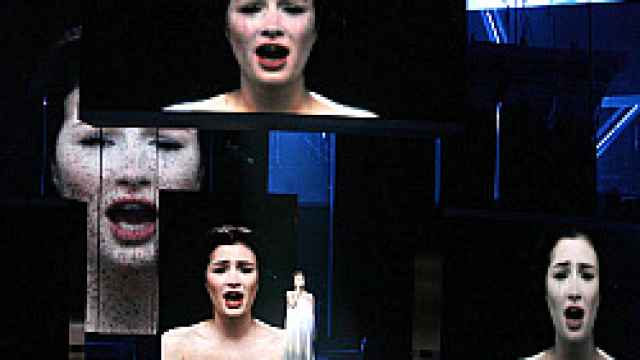
Russia's entry, Anastasia Prikhodko, singing during the Eurovision final.
|  |
| |
President Dmitry Medvedev and Prime Minister Vladimir Putin have described Russia's victory last year that gave it the right to host the event as important for the country. Putin even sent Dima Bilan, last year's winner, a telegram saying his achievement was "another triumph for all of Russia," coming after Zenit St. Petersburg winning the UEFA Cup football final and Russia winning the World Ice Hockey Championship.
With such high expectations, Eurovision 2009 was under unprecedented media scrutiny, with a record 2,238 accredited journalists.
Gay rights activists said Russia ruined its reputation internationally with the police clampdown on the rally.
"In the minds of most European people, this year's Eurovision Song Contest will be linked to the violent suppression of a wholly peaceful protest," British activist Peter Tatchell said Sunday. He was detained at the march but released without charges.
"The universal reaction from journalists, politicians and members of the public [in Britain] is utter revulsion at the scenes of police brutality and suppression that they saw on the television news," Tatchell said.
He said he was "disappointed" that no contestants spoke out against police brutality. "They were under huge pressure from their own managers and from the Russian organizers not to bring any politics to the event," he said.
Sergey Ponomarev / AP
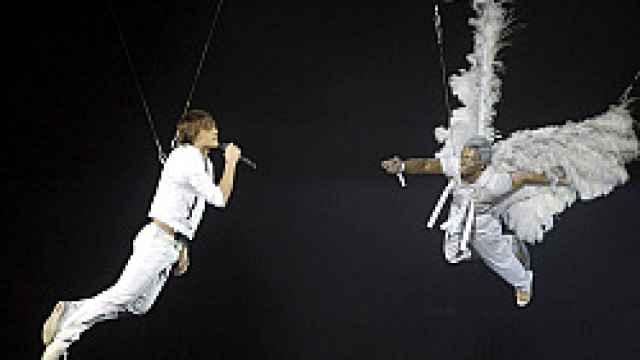
Eurovision 2008 winner Dima Bilan, of Russia, performing before the start of the 2009 Eurovision final Saturday.
| |
| |
The organizer of the protest, Nikolai Alexeyev, said he believed that he was detained overnight to keep him from disrupting the final. "I think the main idea was to keep me and other people in the police station to prevent us doing anything during Eurovision," he said.
The strategy misfired, Alexeyev said: "I can tell you the image of Russia after all that is totally spoiled. Obviously, this is not a democratic country that respects human rights."
European Broadcasting Union, which owns Eurovision, has declined to enter the controversy. "As guests in Moscow, we feel obliged to organize the event within the limits of local law. If organizers of other events decide differently, that is up to their judgment," the association's spokesman Sietse Bakker said last week.
At a news conference after the final, Bakker called the event "the best Eurovision Song Contest we have ever had."
However, one of the first questions from reporters was about the police action against the gay rally.
"I think it's a little bit sad that they chose to have the protest today. They spent all their energy on that parade, while the biggest gay parade in the world was tonight," Rybak, this year's winner, said in an answer that skirted around the police violence.
Sergey Ponomarev / AP
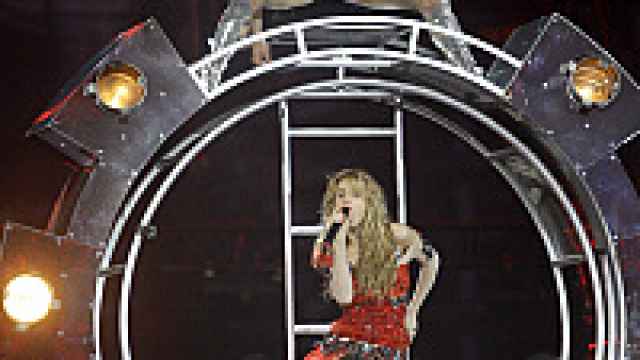
Ukraine's Svetlana Loboda singing at a final rehearsal Saturday afternoon.
| |
| |
The Eurovision final ran smoothly -- most of the time, anyway -- and was warmly received by the audience.
Hours before the 11 p.m. start, the Olimpiisky Sports Complex was surrounded by flag-waving fans. Sporting Union Jack flag face paint and a beaded Russian headdress, Helena Davidson from London praised Russia for its handling of the semifinals. "It's putting on an amazing show. I can't wait for tonight," she said.
Moscow police said there were no incidents at the event. Officers were courteous as crowds maneuvered through multiple barriers and metal detectors.
The show began with last year's winner, Bilan, suspended from a wire in the roof and swooping onto the stage, where he launched into his Eurovision song, "Believe."
The hosts were popular comedian Ivan Urgant and pop singer Alsou. Making his English-language debut, Urgant seemed relaxed in his interaction with the audience. "Are you enjoying my flawless British accent?" he asked the crowd to screams of approval.
There were a few hitches: Bilan couldn't free himself from his flying harness and had to be helped by a backing dancer. The screen flickered as Azerbaijan announced its votes and a bizarre interval act involving performers splashing in suspended swimming pools drew a muted reaction. The linkup with the international space station had unclear sound at times.
Because of the time difference with Western Europe, about a third of the audience drifted away before all the votes were announced, leaving conspicuously empty spaces. Nevertheless, Norway's victory with "Fairy Tale" was greeted with deafening cheers.
In his acceptance speech, Rybak switched between English and unaccented Russian, repeating, "Thank you so much, spasibo bolshoye, Rossiya."
CORRECTION: In the original version of this story published in the May 18, 2009 edition of The Moscow Times, it was stated that the message from the International Space Station featured on the Eurovision program was live from outer space, when in fact it was a recorded message.
A Message from The Moscow Times:
Dear readers,
We are facing unprecedented challenges. Russia's Prosecutor General's Office has designated The Moscow Times as an "undesirable" organization, criminalizing our work and putting our staff at risk of prosecution. This follows our earlier unjust labeling as a "foreign agent."
These actions are direct attempts to silence independent journalism in Russia. The authorities claim our work "discredits the decisions of the Russian leadership." We see things differently: we strive to provide accurate, unbiased reporting on Russia.
We, the journalists of The Moscow Times, refuse to be silenced. But to continue our work, we need your help.
Your support, no matter how small, makes a world of difference. If you can, please support us monthly starting from just $2. It's quick to set up, and every contribution makes a significant impact.
By supporting The Moscow Times, you're defending open, independent journalism in the face of repression. Thank you for standing with us.

Remind me later.