

The announcement to put together a replacement for the Strategic Arms Reduction Treaty did not come as a surprise after both sides earlier stressed the necessity of a new agreement before the Cold War-era one expires in December after 15 years.
But the pledge is seen as a vital stepping stone in both leaders' promises to mend relations, which spiraled downward under their predecessors, Vladimir Putin and George W. Bush.
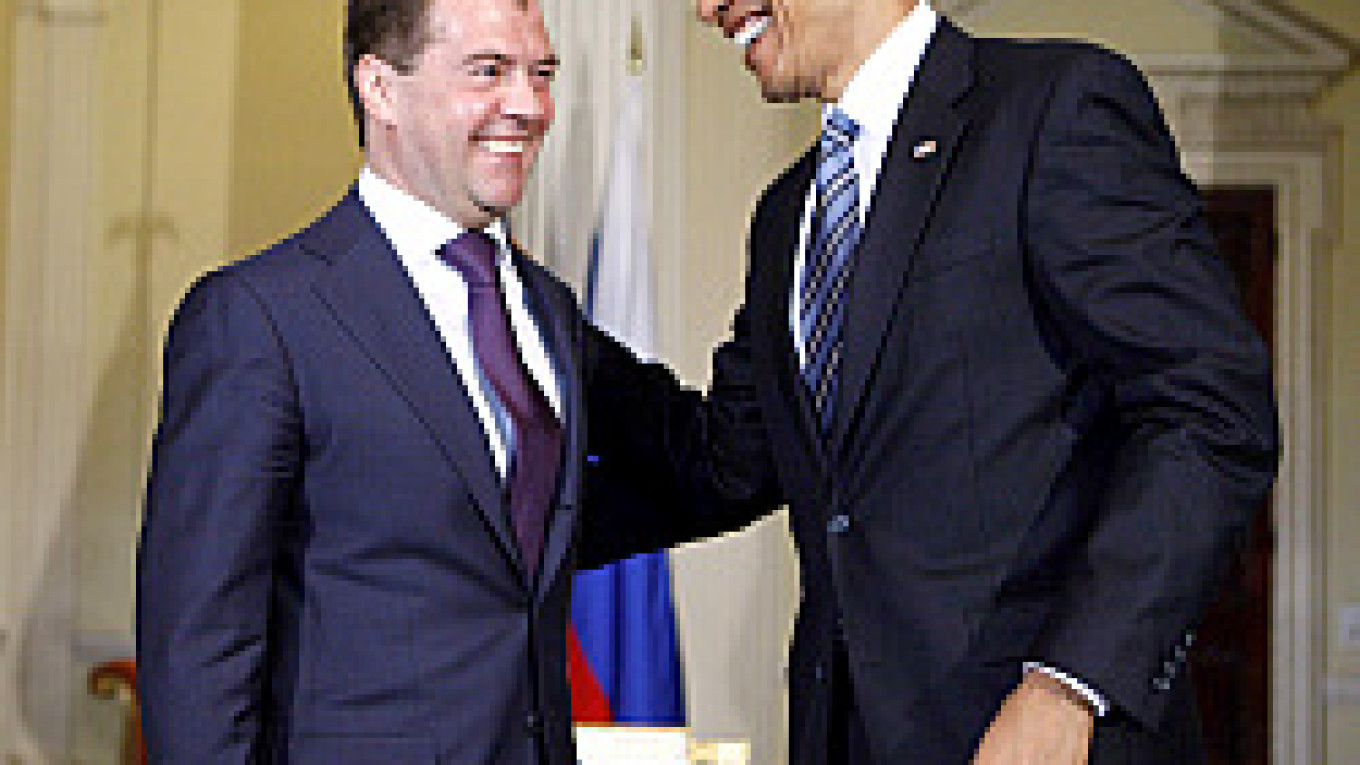
"We ... are ready to move beyond Cold War mentalities and chart a fresh start in relations between our two countries," Obama and Medvedev said in a joint statement released just before their sit-down in Winfield House, the U.S. ambassador's residence, in London.
Obama lamented tensions and the "drift" between Moscow and Washington in recent years. "I have no interest in papering those over," he said at a news conference with British Prime Minister Gordon Brown earlier in the day.
He said both countries share many interests, including reducing the threat of terrorism and stabilizing the world economy.
"Both sides of the Atlantic understand that, as much as the constant cloud of nuclear warfare has receded, that the presence of these deadly weapons continues to be the gravest threat to humanity," Obama said.
He said the United States wanted to "press the reset button," a phrase coined by Vice President Joe Biden in addressing U.S.-Russian relations at a Munich conference in February.
Analysts said mutual mistrust has grown so much in recent years that tackling an obvious issue like START was good news indeed.
"There is nothing automatic in this relationship anymore," said Sam Greene, deputy head of the Carnegie Moscow Center.
While "ground-level processes" formerly worked quietly in the background, Washington and Moscow came to the conclusion in recent years "that we did not need to have a structured relationship anymore," he said.
Greene said the negotiations about a new arms treaty were "an excellent first step" because everybody agrees on the importance that both countries regulate their nuclear arsenals.
Obama and Medvedev met on the eve of the G20 summit in London, where world leaders will discuss how to tackle the worst global recession since the 1930s. Expectations were low for much immediate progress on other contentious issues between Washington and Moscow, including missile defense, NATO expansion and last summer's Russia-Georgia conflict.
"The challenges that lie beyond START are tremendous," Greene said.
Observers also noted that Medvedev did not take a direct road to London but chose to make a stop Tuesday in Berlin, where he and German Chancellor Angela Merkel agreed on the necessity of a new global financial architecture.
Alexander Rahr, an analyst with the German Council on Foreign Relations, said the two showed remarkable trust. "Rarely have Berlin and Moscow shown so well-coordinated positions before a G20 summit," Rahr said.
Rahr said the European position was at odds with the Obama administration, which has advocated big fiscal spending to fight the economic downturn.
Obama downplayed the rift Wednesday, saying there was "enormous consensus" between leaders.
Analysts said Medvedev's decision to stick with the Europeans was understandable because Russia would not be the engine to end the crisis.
Medvedev also met Chinese President Hu Jintao and paid a visit to Brown at his residence at 10 Downing Street on Wednesday. In addition, the pre-G20 summit schedule included a get-together with Queen Elizabeth II. But while Obama and his wife, Michelle, were to be treated to a personal audience on Wednesday evening, Medvedev, who was accompanied by his wife, Svetlana, was only to meet the queen at a later reception with about 150 participants from all visiting delegations, said a spokesman for Buckingham Palace.
"There will be handshakes with the royal family," the spokesman said on customary condition of anonymity. Asked why the Medvedevs did not get a private audience, the spokesman said, "Everyone will get his turn eventually."
Russian-British ties have been deeply troubled after the murder of Kremlin critic Alexander Litvinenko in London in 2006 and Moscow's refusal to extradite the prime suspect, State Duma Deputy Andrei Lugovoi.
nWashington and Moscow are quietly resolving a simmering spy spat, with the U.S. defense attache in Moscow, Brigadier General Henry Nowak, leaving the country in January at the request of the Russian government, The New York Times reported Wednesday.
Canada had asked the Russian military attache in Ottawa to leave because of suspected spying activities, the report said. When Moscow then tried to accredit the attache in Washington, the United States denied him a visa, prompting retaliation against Nowak.
The U.S. Embassy in Moscow confirmed on Wednesday Nowak's departure.
A Message from The Moscow Times:
Dear readers,
We are facing unprecedented challenges. Russia's Prosecutor General's Office has designated The Moscow Times as an "undesirable" organization, criminalizing our work and putting our staff at risk of prosecution. This follows our earlier unjust labeling as a "foreign agent."
These actions are direct attempts to silence independent journalism in Russia. The authorities claim our work "discredits the decisions of the Russian leadership." We see things differently: we strive to provide accurate, unbiased reporting on Russia.
We, the journalists of The Moscow Times, refuse to be silenced. But to continue our work, we need your help.
Your support, no matter how small, makes a world of difference. If you can, please support us monthly starting from just $2. It's quick to set up, and every contribution makes a significant impact.
By supporting The Moscow Times, you're defending open, independent journalism in the face of repression. Thank you for standing with us.

Remind me later.