

Aslamazyan, who was hit with the charge last year after she failed to declare 9,550 euros at Sheremetyevo Airport, expressed joy at the ruling.
"I'm overjoyed, I'm happy. I don't even know what to say," she said by telephone from Paris, where she has lived since fleeing Russia last year.
It was only a partial victory, however, since Aslamazyan still faces tax-evasion charges after a crackdown that was widely seen as an attack on Western-funded NGOs and independent media outlets.
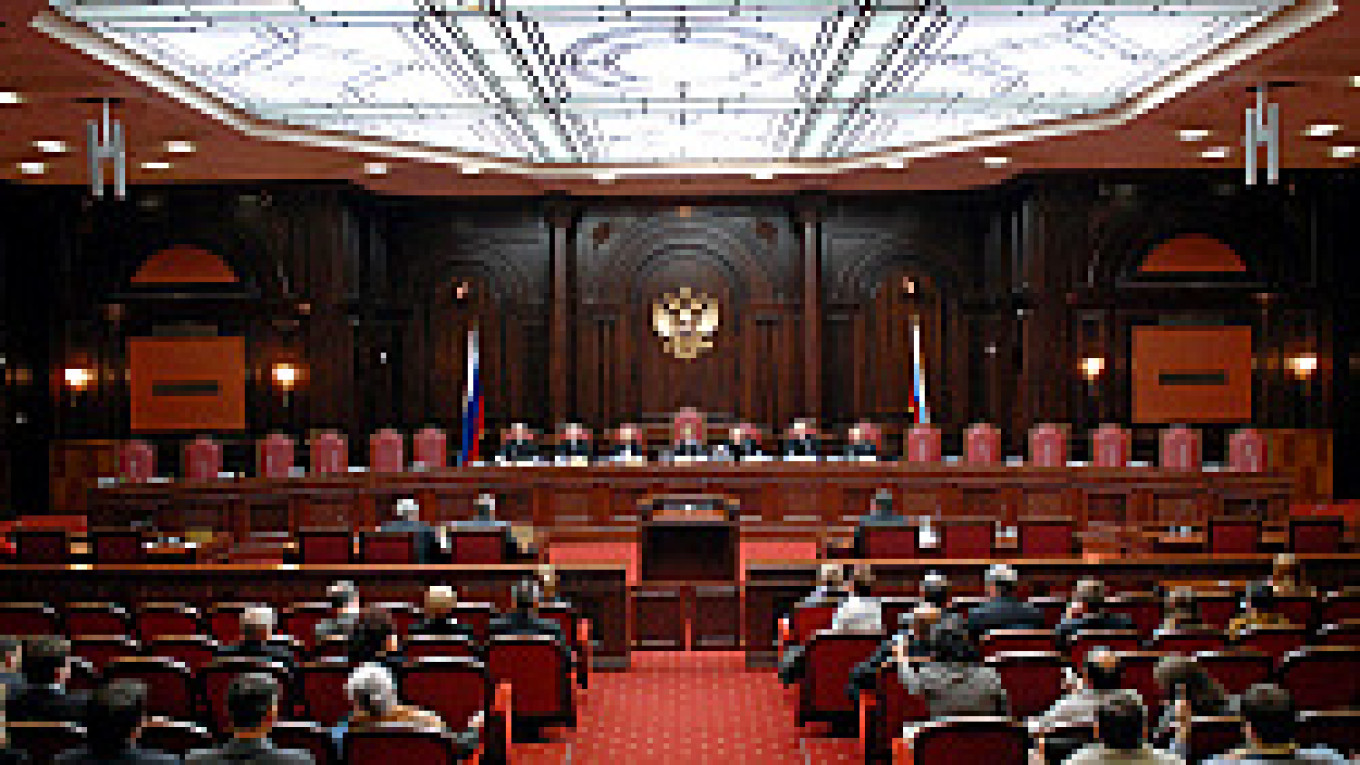
Tuesday's decision was the first ruling from the Constitutional Court since the 19-judge legal body completed its move to St. Petersburg earlier this month.
The court ruled that the smuggling law -- intended to stop people from bringing large sums of cash through airports -- violated citizens' constitutional rights by failing to define what constituted a "large sum" of money.
Under the law, travelers were permitted to bring any amount of cash into Russia, but amounts worth more than $10,000 had to be declared.
If customs officials decided that a traveler had brought a "large amount" of undeclared cash into the country, he or she could be charged with smuggling -- a criminal offense that carried a maximum penalty of five years in prison.
Alternatively, the offense could be counted as a misdemeanor, resulting in a maximum fine of just 2,500 rubles, or $105.
In its ruling, the court sided with Aslamazyan's lawyers, who had argued that the law allowed authorities to decide arbitrarily whether to press criminal charges.
In a sharply worded decision posted on its web site, the court said "the challenged norms do not correspond to the Constitution of the Russian Federation and infringe on the foundations of equability and justice."
Aslamazyan's troubles began Jan. 21, 2007, when she got off a flight at Sheremetyevo Airport and failed to declare 9,550 euros, worth $12,400 at the time.
She acknowledged her guilt from day one, calling it a "stupid oversight," and has always maintained that the ensuing cases against her were politically motivated.
An Armenian-born Russian, Aslamazyan was then head of the Educated Media Foundation, formerly Internews Russia, an NGO that helped train journalists. Largely funded by U.S. sources, the foundation had worked in Russia since 1992.
It soon came under intense pressure from the authorities. In June 2007, police raided its Moscow headquarters and froze its bank accounts, after which Aslamazyan was placed under a second investigation for tax evasion.
Just weeks later, the foundation shut its doors. Aslamazyan herself fled to Paris after the smuggling charges were filed.
Many linked the investigations of Aslamazyan to a broader Kremlin campaign to rein in the influence of foreign-funded NGOs following the so-called "color revolutions" in the former Soviet republics of Georgia and Ukraine.
Viktor Parshutkin, Aslamazyan's lawyer, called Tuesday's decision a "good omen" for the Russian legal system.
"This decision has made me very happy," he said by telephone from St. Petersburg. "[The Constitutional Court] has demonstrated its independence from the political machinations of the authorities."
He was unsure whether the second investigation against her, on tax charges, would be dropped following Tuesday's decision.
President Dmitry Medvedev, a lawyer by training, has made judicial reform a centerpiece of his presidency since being inaugurated earlier this month.
"Our main goal is to achieve independence for the courts as a reality," he said last week in comments on the Kremlin web site. "The principal that courts should be guided only by the law is well-known, and this, as a matter of fact, forms the basis for respect for the courts and trust in a fair justice system."
The newly relocated Constitutional Court experienced several technical glitches during the proceedings, including running out of paper, Interfax reported.
The court only completed its move to the reconstructed 19th-century buildings of the Senate and the Synod on May 12.
The move was proposed by St. Petersburg Governor Valentina Matviyenko in 2006 and approved by then-President Vladimir Putin in December 2007.
Putin said the decision to move the court to his hometown would help bring prestige to the northern capital and would also help cut down on judicial corruption.
Aslamazyan described the court's decision as a victory not only for her but also for the thousands of others who have been charged under the smuggling statute.
She was somewhat gloomy, however, when asked if she might return to Russia, pointing out that she still faces the tax investigation and that the foundation she ran is gone.
"Right now, we're just waiting to see what happens with our complaint regarding the ongoing investigation against us," she said with a sigh. "But of course, I want to go home."
A Message from The Moscow Times:
Dear readers,
We are facing unprecedented challenges. Russia's Prosecutor General's Office has designated The Moscow Times as an "undesirable" organization, criminalizing our work and putting our staff at risk of prosecution. This follows our earlier unjust labeling as a "foreign agent."
These actions are direct attempts to silence independent journalism in Russia. The authorities claim our work "discredits the decisions of the Russian leadership." We see things differently: we strive to provide accurate, unbiased reporting on Russia.
We, the journalists of The Moscow Times, refuse to be silenced. But to continue our work, we need your help.
Your support, no matter how small, makes a world of difference. If you can, please support us monthly starting from just $2. It's quick to set up, and every contribution makes a significant impact.
By supporting The Moscow Times, you're defending open, independent journalism in the face of repression. Thank you for standing with us.

Remind me later.